A chocolate bar starts with a living tree, a harvest and a series of decisions about wet beans. Many cacao growers operate small farms, but farm size, labor arrangements and processing systems differ across regions. A single global farmer age, holding size or income figure cannot describe all those situations without a dated survey and a clear definition of the population measured.
Quality also resists a simple percentage formula. Genetics, growing conditions, fermentation, drying and roasting interact. Calling each one exactly a quarter of flavor turns a useful reminder into an unsupported measurement. ICCO’s definition of fine-flavor cocoa instead describes the combination of planting material, environment, management and post-harvest processing.
The Cacao Tree
Theobroma cacao belongs to the family Malvaceae. Kew’s Plants of the World Online lists it as an accepted species, first published by Linnaeus in 1753, with a native range extending from Costa Rica into tropical South America.
Cacao is associated with humid tropical forests, but that does not make one shade level right for every farm. Young trees benefit from protection while they establish. For older trees, the useful balance depends on local heat, rainfall, soil moisture, tree spacing and competition from surrounding vegetation. Shade can moderate heat and support habitat; excessive shade or competition can also limit production.
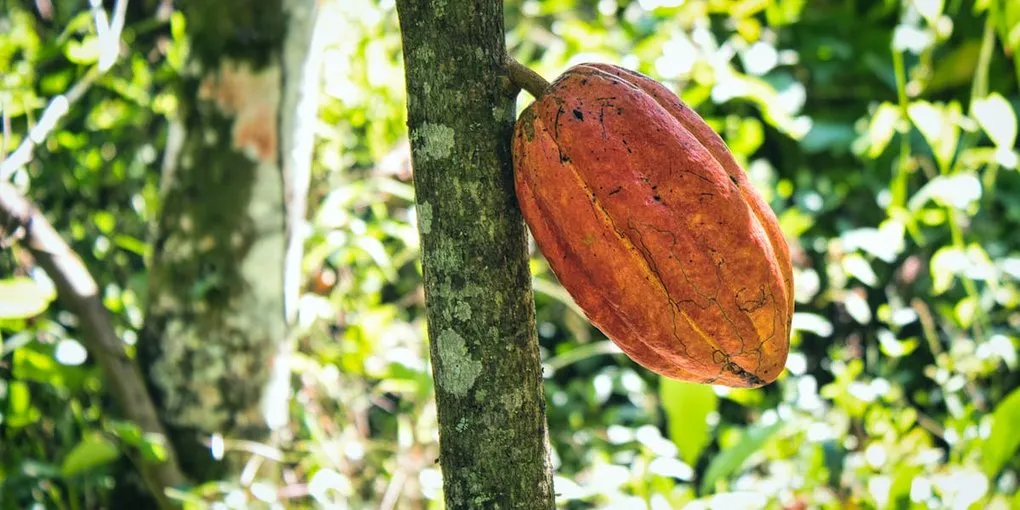
Cacao displays cauliflory: flowers emerge from cushions on the trunk and older branches, and pods develop there. Preserving those cushions matters because they can carry future flowers. A pod contains dozens of seeds surrounded by sweet, mucilaginous pulp. The seed is the main chocolate ingredient; the fresh pulp tastes quite different from finished chocolate. UF/IFAS describes the tree, flowers, fruit and propagation methods.
Seeds produced by sexual reproduction need not grow into trees identical to their mother tree. That is different from saying that every bean in every pod must be genetically distinct or have a different pollen parent. Vegetative propagation, such as grafting a selected scion onto a rootstock, allows growers to reproduce the selected scion’s genotype.
Pollination and Pod Survival
Tiny insects, including ceratopogonid midges, are important cacao pollinators. Successful reproduction also depends on compatibility: some trees need compatible pollen from another tree. Flower abundance alone therefore does not tell a grower how much fruit will be harvested.
There are several distinct measurements: a flower receiving pollen, successful fertilization, initial fruit set and a pod surviving to maturity. A study that counts young fruit shortly after pollination has not measured the final harvest. The familiar claim that “1 to 5% of flowers are pollinated and become pods” compresses these stages into a single supposedly universal rate.
Field research supports taking pollination seriously while considering the rest of the growing environment. A 2025 study across Brazil, Ghana and Indonesia examined pollination alongside climate and management. Its findings do not establish a universal shade percentage or a guaranteed yield gain from adding leaf litter. Shade, pollinator habitat, resource availability and local conditions need to be considered together.
For more on why counting pollinated flowers is different from counting a crop, see our cacao pollination guide.
Planting and Maturation
Cacao is a long-term investment. The University of Hawaiʻi’s account of its cacao research describes first fruit at about three to five years. Actual timing varies with planting material, site and management; it is not a deadline every seedling meets. Productive life is likewise variable, so a fixed 25-to-40-year return should not be assumed in a farm budget.
Seedlings and grafted plants serve different purposes. Seeds are a way to raise new trees, while selected clonal material can help retain desired characteristics. The choice should account for local performance, compatibility, quality, planting-stock availability and the resources required to manage the crop. Replanting one field also does not, by itself, prove that a genotype has disappeared from a whole region.
The 2008 Motamayor study proposed 10 major genetic groups, offering a more informative framework than treating all cacao as Criollo, Forastero or Trinitario. That framework is not a finished catalogue of every local population. A 2026 study of Peruvian cacao identified additional local lineages associated with previously described groups. Genetic grouping also does not substitute for tasting and evaluating a processed lot.
The Growing Environment
Warm conditions, available water and well-drained soil are central to cacao cultivation. As a broad description of established growing regions, ICCO gives average daily maximum temperatures around 30–32°C, average minima around 18–21°C, and preferred annual rainfall of about 1,500–2,000 millimeters. These are descriptive ranges, not hard boundaries at which a tree switches from viable to impossible. Rainfall distribution, dry periods, drainage and irrigation matter as well as the annual total.
Cold can damage cacao, and frost is a serious constraint. But latitude is a shorthand for climate, not an absolute planting rule. Cacao research and commercial growing in Hawaiʻi demonstrate why “exclusively within 20 degrees of the equator” is too rigid. The conditions on an actual site matter more than drawing a single line on a map.
Countries also contain many growing environments. Peru and Bolivia are useful examples of why an origin label cannot summarize an entire country’s planting material, altitude, climate or farming system.
Cocoa butter content should be treated as a property of a measured lot, not a fixed country constant. A USDA study of 323 accessions grown in the International Cocoa Genebank in Trinidad found substantial genetic variation in butterfat content and bean characteristics. That is one reason to avoid assuming that Tanzanian beans always contain 57–58% fat or that Ecuadorian beans always contain 52%. Formulators need information about the beans they actually buy.
Harvest: Careful Work Around the Tree
Harvesting commonly involves selecting ripe pods and cutting them carefully by hand. The pods’ positions on the trunk and branches, uneven ripening and reusable flower cushions make careful handling important. That explains the work involved without claiming that every pod in the world is harvested with a machete or that no mechanical aid can exist.
Crop timing varies with regional weather and local growing conditions. A main crop and a smaller secondary crop are common patterns, but calendars should be checked for the specific origin and season. The expansion of production in West Africa is part of chocolate’s history; it does not give every farm the same harvest schedule.
Growers need to recognize ripeness in their planting material. Pod color can help, but varieties differ. A universal squeeze test or “hollow sound means ripe” rule is not a reliable substitute for local experience and appropriate maturity assessment.
The CAOBISCO/ECA cocoa quality guide’s harvesting section emphasizes mature pods, clean equipment and avoiding damage to both trees and beans. When opening pods, methods such as a wooden mallet or suitable mechanical device can reduce the risk of cutting the beans. Wet beans and pulp are collected for processing, with damaged or unsuitable material kept out of the lot. Husk handling should follow the farm’s local crop-health and residue-management plan; simply leaving every discarded pod on the ground is not a universal recommendation.
Crop Health and Farm Planning
Crop health is a material production issue. For example, ICCO’s February 2024 market assessment identified disease, adverse weather and aging trees among pressures on supply. That is evidence of problems affecting the crop in a particular assessment, not proof that every country loses exactly 30% of production every year.
For growers, planting-stock selection and crop-health management require locally relevant advice. An origin name cannot certify a farm as free of disease, and a high-yielding variety should not automatically be described as flavorless. Resistance, yield, compatibility, growing conditions and bean quality are separate considerations. Detailed disease identification and control are outside this overview; growers should use their local extension or plant-health service for that work.
Post-Harvest: Where Farming Meets Processing
Fermentation can take place on a farm, through a cooperative or at a dedicated facility. Selling wet beans and selling dried, fermented beans involve different work, weights and contractual obligations. The useful question is who controls each step and how quality and payment are specified. No single account of “middlemen” describes all production in Peru or the wider cacao world.
Fermentation develops the precursors and other characteristics that later processing turns into chocolate flavor. Microbial activity, heat, pulp drainage and aeration interact. The process should fit the planting material, batch and equipment; assigning every yeast or bacterium an exclusive day on a universal timetable is misleading.
The industry guide to fermentation describes conventional heaps and boxes and recognizes that smaller experimental systems need different methods. Its conventional minimum of about 100 kilograms is not a law of fermentation, and it does not support a universal “more than 300 kilograms” critical mass. Neither figure is a complete operating protocol. Similarly, broad Criollo/Forastero labels are insufficient to prescribe an exact number of fermentation days.
Drying Controls Moisture and Affects Flavor
Drying follows fermentation and needs to remove moisture evenly while protecting the beans from contamination and rewetting. The CAOBISCO/ECA drying guidance calls for moisture below 8% in preparation for storage. Buyers may have more specific requirements. A moisture reading alone does not establish that beans are fit for shipment: odor, physical condition, handling history and other quality requirements still matter.
Drying too quickly, especially with excessive heat, can retain acidity and impair flavor development. That does not make it a reliable way to create desirable fruity chocolate. Very slow drying or rewetting also creates problems. The aim is an appropriate, controlled process for the weather, equipment and lot, rather than “as slow as possible.”
Clean raised drying surfaces, protection from rain and separation from fumes are important. Roadside tarps, bare ground, tarmac and concrete are not interchangeable with suitable drying platforms. Artificial drying can be needed when sunshine is inadequate; equipment should keep combustion smoke away from the beans. “Sun-dried” alone is not a complete quality specification.
Dried beans are evaluated using more than a color count. The industry quality-control guidance includes moisture, odor, defects and contractual physical requirements. A cut test is useful, but a rule such as “more than 75% brown means good” cannot guarantee flavor or acceptability across lots and varieties.
From Planting to Dried Beans
A typical sequence; timing and methods depend on the farm and lot
- 01
Planting
Choose the site and stockSelect suitable seedlings or grafted plants and plan drainage, water, spacing and shade for local conditions.
A country name or genetic group alone does not predict farm performance. - 02
Establishment
Manage developing treesSupport root and canopy growth. Adjust management as trees and surrounding vegetation develop.
Shade requirements depend on tree age, climate and competition. - 03
Flowering and Fruiting
First fruit often takes yearsA three-to-five-year first-fruiting range is a useful example, not a promise. Flowers form on trunks and older branches.
Pollination, initial fruit set and survival to harvest are distinct stages. - 04
Harvest
Select ripe podsCut suitable mature pods carefully, using appropriate tools and avoiding damage to reusable flower cushions.
Ripeness indicators and harvest calendars vary with planting material and region. - 05
Wet Bean Collection
Prepare the lotOpen pods without damaging the seeds. Collect suitable wet beans and pulp using clean equipment.
Processing may be managed on the farm, by a cooperative or at a separate facility. - 06
Fermentation
Use a suitable processManage the batch, drainage and aeration to develop the material's flavor potential.
There is no universal 300-kilogram minimum or genetic-label-based day count. - 07
Drying
Control moisture removalDry evenly on suitable clean surfaces or with appropriate equipment. Protect beans from fumes, rain and rewetting.
Industry guidance calls for moisture below 8%; moisture alone does not establish acceptability. - 08
Lot Assessment
Check before storage and saleAssess moisture, odor, defects and buyer specifications, then maintain suitable storage and handling.
Cut-test color alone cannot guarantee flavor or shipment quality.
Farm Planning
- Match planting material and management to the site
- Consider shade, water and pollination together
- Use locally relevant crop-health advice
- Budget for establishment and variable harvests
Lot and Payment Records
- Identify the farm, harvest and processor
- Distinguish wet-bean and dried-bean weights
- Record quality requirements and the price basis
- Separate gross sales from net farm income
Overview based on UF/IFAS, University of Hawaiʻi and CAOBISCO/ECA guidance. This sequence is not a farm-specific operating protocol or a disease-management guide.
jayarrchocolate.comThe Economics
Farm revenue depends on the quantity sold and the price actually received. Net income additionally depends on establishment, labor, inputs, processing, transport, finance and other costs. Household income can include other crops or activities. These quantities should not be collapsed into one universal “cacao farmers make this much” figure.
For a meaningful comparison, record the country, season, currency, sale stage and whether a number describes gross receipts or net income. A price for wet beans is not directly comparable to a price per kilogram of export-ready dried beans. A premium paid to an exporter is not automatically a premium of the same amount received by the grower.
ICCO currently describes fine-flavor cocoa as about 12% of world cocoa bean exports. That is an export-share estimate, not the share of all cocoa production or the share purchased by US craft makers. Definitions, reporting and market conditions matter when comparing it with older figures.
Quality premiums can matter to growers, but neither an origin such as Venezuela nor a named genetic group guarantees a fixed premium, a buyer or a viable net income. Consistent quality, credible lot information, reliable purchasing and the distribution of costs and payments all affect the result.
What Consumers Can Look For
A maker who identifies a farm or cooperative and explains its sourcing provides information that can help you read a craft-chocolate label. Price disclosures are more useful when they identify the year, currency and transaction stage. Long-term relationships and transparency are relevant questions to ask; neither phrase alone proves an income outcome for farmers.
The farm and post-harvest process create the material that roasting and refining will transform. Makers can develop its potential, but processing cannot be assumed to repair every underlying defect. A useful account of cacao quality follows the particular lot from planting material through harvest, fermentation, drying and manufacture.
Frequently Asked Questions
- How long does it take a cacao tree to produce pods?
- About three to five years is a commonly cited first-fruiting range, including in the University of Hawaiʻi's cacao research account. Actual timing depends on planting material, site and management. Productive life also varies, so neither first harvest nor decades of returns should be treated as guaranteed.
- Can cacao grow outside a strict equatorial band?
- Yes. Latitude is a shorthand for suitable climate, not an absolute limit. Cacao needs warm conditions, adequate water and suitable soil; cold and frost can seriously damage it. Hawaiʻi has cacao growing and research beyond the often-quoted 20-degree boundary. Site conditions matter more than a single map line.
- Why is cacao commonly harvested by hand?
- Pods grow on trunks and older branches, ripen at different times, and need to be removed without damaging reusable flower cushions. Careful manual cutting is common. That does not establish that every pod worldwide is hand-harvested or that mechanical aids cannot be used in harvesting and pod opening.
- What percentage of cacao flowers become pods?
- There is no single rate that applies to every farm and study. Pollen receipt, fertilization, initial fruit set and survival to a mature pod are distinct stages. Pollination and compatibility matter, but a count of young fruit shortly after pollination is not a measurement of harvested yield.
- Is cacao farming profitable?
- It depends on actual yield, prices, costs and the farm's circumstances. Gross bean sales are not net income, and wet-bean prices are not directly comparable to prices for dried beans. Quality premiums may help, but their value depends on the contract, processing costs and how payments reach growers.
- How does crop health affect cacao farming?
- Crop-health problems can reduce production and are part of farm planning. Their importance varies by location and season; a fixed annual loss percentage or a disease-free country claim is not a reliable planning rule. Detailed disease identification and control require locally relevant extension or plant-health advice and are outside this overview.
- How does drying affect cacao flavor?
- Excessively rapid or hot drying can retain acidity and impair flavor development, while prolonged drying and rewetting also create problems. Controlled moisture removal and clean handling matter. Industry guidance calls for moisture below 8% before storage, with buyer requirements checked separately; that reading alone cannot guarantee flavor or shipment acceptability.