A cacao pod begins with a tiny flower and successful pollen transfer. Midges are a major part of that story, but the familiar claim that every chocolate bar depends on one kind of fly is too simple. Researchers are still establishing which insects contribute most in different growing regions, and how their visits translate into harvested beans.
That distinction matters for growers. A flower can receive a visitor without receiving pollen; receive pollen that is incompatible; or begin forming a fruit that later stops developing. Improving one stage does not guarantee a proportional increase in harvest. Nor does pollination biology, by itself, explain why so much cacao is grown by smallholder farmers.
How Cacao Flowers Make Pollination Difficult
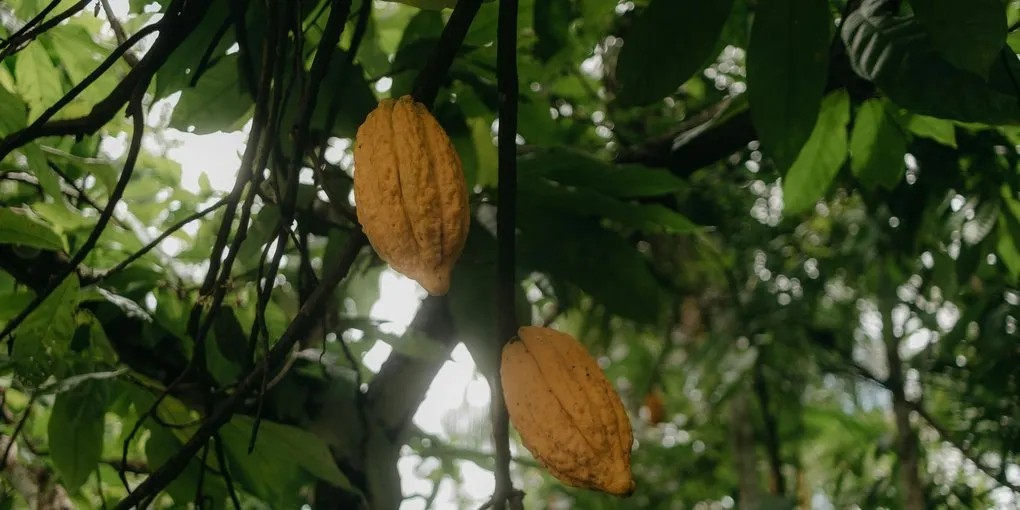
Cacao flowers emerge from cushions on older branches and trunks, a pattern called cauliflory. They are small, roughly a centimeter across. Petal hoods shelter the anthers, while five staminodes surround the central female reproductive structures. An effective visitor must contact the right parts and transfer pollen, not merely land on a petal. The CACPOL research group’s illustrated explanation shows why access and behavior matter.
How Small Insects Pollinate Cacao
Flower access matters, but size alone does not identify an effective pollinator
Schematic illustration. Numbered callouts correspond to the notes below.
Petal hood
The hood shelters the pollen-bearing anthers.
A visitor must reach pollen and later contact receptive tissue to contribute to transfer.Anthers
These are the flower’s pollen-bearing structures.
Pollen carried on an insect is evidence of transport potential, not proof of a successful pod.Stigma and style
Pollen must reach receptive surfaces and be viable and compatible.
Self-compatibility varies among cacao genotypes.Midge
Small Forcipomyia flies are important pollinator candidates.
The drawing’s 3 mm body is an illustrative example, not a universal species size or access threshold.Honeybee comparison
A larger bee illustrates the difference in body size.
The illustrated honeybee does not represent all bees. Small stingless bees have been observed visiting cacao flowers.Cauliflorous attachment
Flowers and pods develop on older woody parts of the tree.
The enlarged flower and insect comparison are separate schematics, not one shared physical scale.Schematic anatomy and body-size examples, not a test of pollinator effectiveness. See CACPOL, UF/IFAS and the field studies linked below.
jayarrchocolate.comMidges Are Important; Visitors Are Not Automatically Pollinators
Forcipomyia belongs to Ceratopogonidae, the family commonly called biting midges. That family name does not establish the feeding behavior of every cacao-associated species. Identifying a fly to family, or observing it on a flower, is also insufficient to establish its contribution to yield.
An August 2026 study in Basic and Applied Ecology, using observations from Malaysia and French Guiana, found Forcipomyia midges to be the strongest pollinator candidates among the visitors examined. They were active on reproductive structures and more often carried pollen. The authors explicitly did not directly measure successful pollen deposition and subsequent fertilization. Their results support the importance of midges without proving that only midges can pollinate cacao everywhere.
Other work asks different questions. A 2025 Ecuador study combined visitor observations, video and pollen measurements. Ant-associated flowers had more pollen on their styles, and the authors identified several potentially useful visitor groups. But prior visits could contribute to the pollen counted, so this was not a clean measurement of each insect’s individual contribution to mature pods.
The useful distinction is between visiting, carrying pollen, depositing compatible pollen, and producing fruit. Different methods measure different links in that chain. One study need not invalidate another merely because its most abundant visitors differ.
Do Bees Visit Cacao?
Yes. The statement that bees cannot fit, cannot visit, or never touch cacao’s reproductive parts is too broad. A 2024 field study in Colombia observed the stingless bee Tetragonisca angustula carrying substantial cacao pollen loads and interacting with both male and female flower parts. Those observations make a blanket exclusion untenable, but do not establish that honeybee hives can replace natural cacao pollination.
Bee size, species, behavior and contact with receptive surfaces matter. Collecting pollen can remove it without delivering useful pollen elsewhere. Managed-bee pollination is therefore a question for evidence on the particular species and farming system, not a recommendation that follows from seeing bees on flowers.
There Is No Single Flower-to-Pod Percentage
A percentage needs a numerator, denominator and observation period. “Flowers visited,” “flowers with pollen,” “flowers forming young fruits” and “flowers producing harvested pods” are not interchangeable.
In Vansynghel and colleagues’ 2022 Peru experiment, natural pollination produced young fruits from 39 of 1,952 flowers, about 2.0%. Hand pollination produced 70 from 968, about 7.2%. These were young fruits counted six days after pollination, pooled across seven weekly rounds—not ripe pods at harvest. The low hand-pollinated result also contradicts a universal 50–70% success promise.
A 2025 analysis across Brazil, Ghana and Indonesia estimated effective natural pollination at 11–27%, depending on country, using a model calibrated against hand-pollination treatments. Those estimates are a different measure from the Peruvian early-fruit counts. The experiment treated flowers below two meters; its percentages should not be relabeled as an annual census of all flowers on entire trees.
From Cacao Flower to Harvested Pod
Separate stages require separate measurements
- 01
Flower opens
Short receptive periodA flower exposes reproductive structures on a trunk or branch cushion.
Flowering and receptivity vary with genotype and conditions. - 02
Visitor arrives
A visit is not a resultAn insect may collect pollen, deposit it, feed or simply rest.
Counting visitors alone cannot identify the most effective pollinator. - 03
Pollen transfer
Amount and compatibilityViable, compatible pollen must reach receptive surfaces.
A different tree is not automatically a compatible pollen donor. - 04
Fertilization
Inside the flowerSuccessful reproduction depends on more than pollen presence.
There is no universal pollen-grain threshold for every genotype and outcome. - 05
Young fruit set
Early retentionSmall developing fruits are called cherelles.
An early fruit-set count is not a count of mature pods. - 06
Pod development
Several monthsSome developing fruits are lost before harvest.
Tree resources and growing conditions influence how many are retained. - 07
Harvest
Count mature pods and beansRecord actual harvested pods and dried-bean yield over a defined period.
Do not estimate annual output by multiplying unrelated flower counts and success rates.
Evidence of pollination limitation
- Compare natural and supplemented pollination
- Use compatible pollen donors
- Follow young fruit through harvest
- Measure results at the same scale and over the same period
Evidence of an economic benefit
- Measure additional saleable beans
- Include labor and other added costs
- Use local prices and wages
- Check whether gains persist across seasons
Conceptual sequence. Study-specific results do not define universal conversion rates or a farm income forecast.
jayarrchocolate.comHand Pollination Can Help—and Has Been Used Commercially
Hand pollination transfers pollen directly to receptive flower parts using suitable donor flowers and tools. It is labor-intensive, but a farmer does not need to pollinate every flower a tree produces to investigate a useful gain.
In a 2020 Indonesian field experiment, hand-pollinating easily reached flowers—about 13% of all flowers per tree—increased yield per tree by about 51%. A separate, more extensive treatment increased yield by about 161%. The study’s economic calculation estimated a 69% increase in annual net income after including operational, pollination-labor and opportunity costs. These were results under the study’s conditions and prices, not a current profit forecast for every origin.
Use also extends beyond research stations. Ghana Cocoa Board’s project record describes a nationwide hand-pollination initiative launched in 2017. COCOBOD subsequently reported farmers and cooperatives employing trained pollinators in its 2024 account of productivity programs. These first-party reports document implementation; they do not independently establish every claimed yield or income benefit.
Labor availability, training, donor compatibility, weather and the extra crop’s value still determine whether it pays. A sensible comparison is the cost and return of a specific treatment against an untreated baseline—not the cost of pollinating an imagined 100,000 flowers on every tree.
Compatibility Matters as Much as Moving Pollen
Some cacao genotypes are self-incompatible; others can set fruit using their own pollen. Different trees can also be cross-incompatible. Planting several unspecified genetic lines does not automatically solve the problem.
A 2017 genetic study identified different mechanisms involved in cacao self-incompatibility, including gametic non-fusion and fruit drop. It identified self-compatibility-associated alleles in Amelonado and Criollo material and used CCN-51 as a self-compatible control. It therefore does not support calling most Criollo inherently self-incompatible or CCN-51 merely partially self-compatible.
Use tested compatibility information for the actual planting material. A 2023 Peruvian pollen-supplementation experiment found that donor genotype mattered, while genetic distance alone did not predict fruit-set success. The broad Criollo, Forastero and Trinitario categories are not a substitute for that information. High-yield material such as CCN-51 should also be assessed for its complete agronomic characteristics, rather than attributing its production to one compatibility trait.
Habitat Management Needs Local Evidence
Moist decomposing plant material, including leaf litter and banana pseudostems, can provide larval habitat for cacao-associated midges. The CACPOL group describes adding suitable breeding habitat as one possible intervention. It is not a prescription to scatter all pod waste indiscriminately or create standing water everywhere; local crop-management advice and substrate condition matter.
Shade has several effects at once. It changes the flower visitors’ environment, tree temperature, available light and competition among plants. The 2022 Peru study found different relationships between canopy closure and visitation in its dry northern and wetter southern sites. That result does not support a universal rule that more shade always brings more pollination, or that full-sun plots necessarily lose it altogether.
The 2025 multi-country study linked yield to pollination, temperature and tree/soil-resource factors. Its leaf-litter association was not evidence that midges caused the yield benefit; the authors considered soil-resource effects an explanation. Habitat protection and tree nutrition can both matter without being the same mechanism.
What This Means for Yields and Chocolate
Cacao’s flowers are numerous, but harvested output must be measured directly. Multiplying 50,000 annual flowers by an unrelated 2% figure gives 1,000 mathematically; it does not establish that an average cacao tree produces 1,000 mature pods. UF/IFAS’s home-growing guide, for example, describes up to about 50 pods per plant per year under its stated conditions, with strong dependence on vigor, climate, management and variety. That is a contextual horticultural estimate, not a global limit.
Large farms also exist: a Brazilian hand-pollination experiment worked within a 150-hectare cacao agroforest. Pollinator dependence does not biologically mandate tiny farms or explain farmers’ average age. Likewise, cocoa-price volatility cannot be reduced to one insect’s life cycle.
For buyers, useful questions concern documented farm practices and outcomes: what habitat is maintained, how planting material is selected, and whether productivity claims come from measured harvests. Forest-grown cacao, including Bolivian wild-harvest cacao, should not be presumed free of pollination constraints merely because it grows in forest.
Frequently Asked Questions
- How is cacao pollinated?
- Small insects transfer pollen between receptive flower parts. Forcipomyia midges are important, but an insect’s presence on a flower does not prove effective pollination. Regional species and their contributions remain active research questions.
- Why don't bees pollinate cacao?
- That premise is too absolute. Small stingless bees have been observed carrying cacao pollen and contacting reproductive structures. Their contribution to fruit production needs species- and site-specific evidence; this does not justify treating honeybee hives as a replacement for natural cacao pollination.
- What percentage of cacao flowers become pods?
- There is no single rate for all plantations. State whether a study measures pollen arrival, early fruit set or mature harvest. The Peru experiment discussed here found about 2% natural early fruit set, counted six days after pollination; that is not a universal ripe-pod conversion rate.
- Can you hand-pollinate cacao?
- Yes. Field trials have demonstrated gains, and Ghana has implemented a wider program. Labor costs, compatible donors and local conditions determine the economic outcome. Neither guaranteed 50–70% success nor universal commercial impossibility is supported.
- Why do cacao plantations need shade trees and biodiversity?
- Vegetation and organic matter can support pollinator habitat and moderate the growing environment. The useful level of shade depends on local climate, light and tree needs. More shade does not automatically mean more pollination or higher yield.
- What is cauliflory?
- It is flowering on older woody stems and branches, as cacao does. The location is easy to observe; it does not by itself prove one evolutionary explanation or determine which insect species can pollinate the flowers.
- Which species of midge pollinates cacao?
- Forcipomyia species in Ceratopogonidae are important documented candidates. A single species cannot represent every cacao region, and effective pollination requires more evidence than a family-level identification or flower-visitor count.