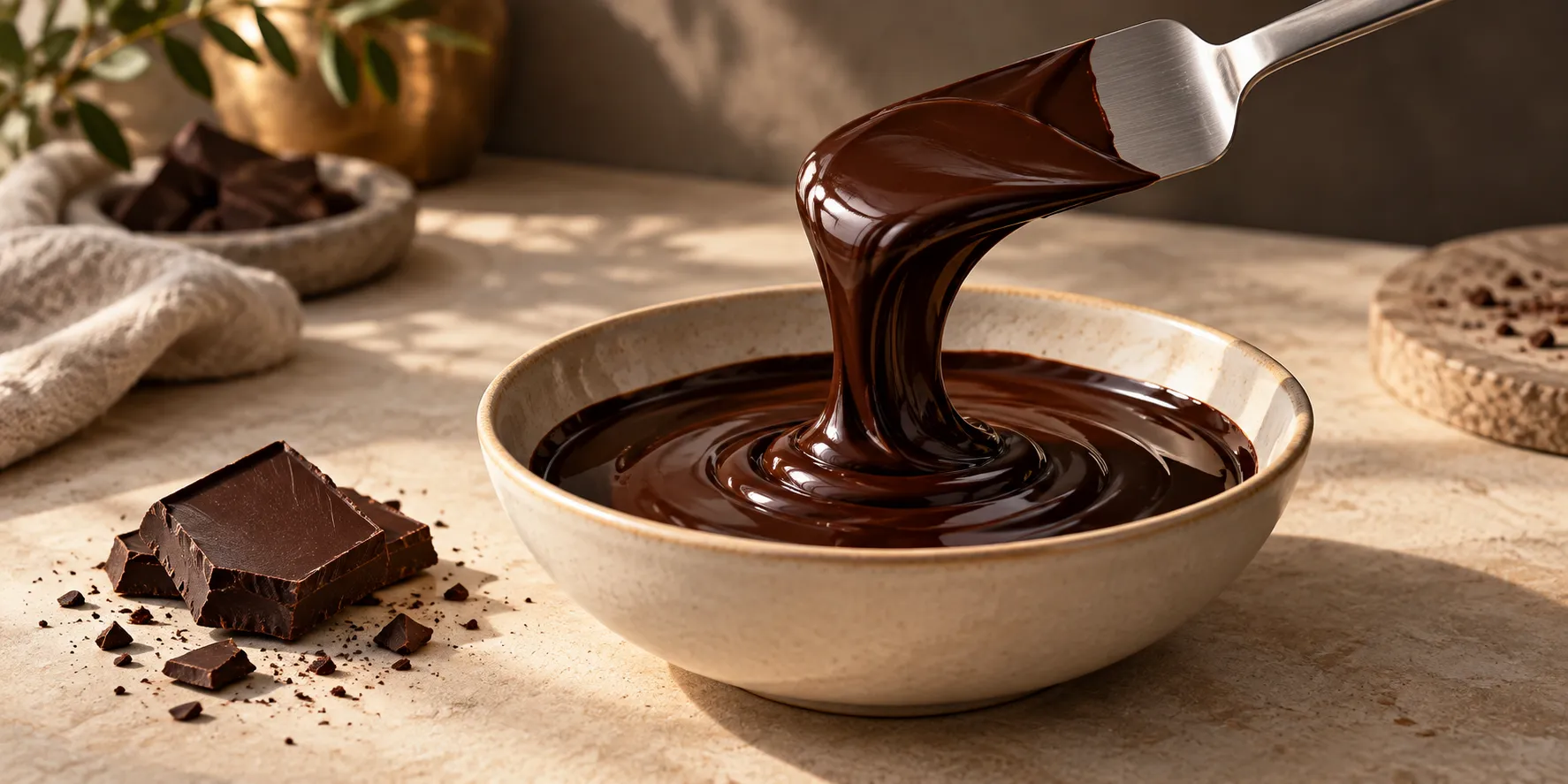
The image is memorable: a chocolate maker leaves his factory on Friday, a machine keeps working, and Monday brings a discovery. It is also a legend. Lindt & Sprüngli’s company history dates Rodolphe Lindt’s conching breakthrough to 1879, while describing the accidental weekend as an allegation rather than a documented sequence of events.
The achievement matters without a certain account of that weekend. Lindt’s chocolat fondant — melting chocolate — helped establish a style prized for its texture and aroma. Understanding its history means separating the successful process from the story told about its discovery.
For practical processing, see our conching chocolate guide. For the wider chronology, see the history of chocolate from Maya to bean to bar.
Chocolate Before Lindt
Chocolate existed as both a drink and a solid long before 1879. Fry’s 1847 molded eating bar is an important commercial milestone, but it was not the first occasion on which anyone could eat solid chocolate. A historical study hosted by the Smithsonian reproduces an eighteenth-century account of doing exactly that. Smithsonian’s Fry collection record; Snyder, Olsen, and Brindle, From Stone Metates to Steel Mills, p. 612.
Many nineteenth-century accounts describe coarse eating chocolates. That does not give us a measured particle-size distribution, acid content, or sensory score for every manufacturer’s product. Nor did earlier cocoa butter lack the ability to melt. Lindt improved the experience of eating chocolate; he did not invent melting fat.
Conching belongs in a history of several developments, including the Van Houten cocoa press and Daniel Peter’s milk chocolate. Those innovations addressed different ingredients and manufacturing problems. They were not interchangeable solutions to a single defect.
The Bern Workshop and the Weekend Story
The Swiss National Museum places Lindt’s workshop in Bern’s Matte district and describes his purchase of old machinery and fire-damaged premises. Its account retells the weekend story but questions the supposed circumstances of his departure. It also presents a more complicated business personality and later relationship with Sprüngli than the familiar portrait of a modest inventor happily retiring after a sale. Swiss National Museum.
Lindt’s own account of the invention says he worked with secondhand equipment and experimented with his formula. It explicitly leaves accident versus intention unresolved. The company connects the name conche with Spanish concha, meaning shell, because of the vessel’s shape.
The Smithsonian-hosted historical chapter describes Lindt modifying a water-powered grinding machine attributed to an earlier maker, Bozelli, and adding cocoa butter to improve flow. This is a historical reconstruction, not a surviving log of that weekend. It is safer to credit Lindt with developing the successful conching process than to claim that he designed every part of the machinery from scratch. Historical chapter, p. 616.
The often-repeated three days belongs to the discovery narrative. It should not be turned into a verified production record showing that every Lindt batch ran for exactly 72 hours, or that nobody else had ever mixed chocolate for a comparable time.
What Conching Changes
Fine grinding and conching perform different jobs, even when a small machine contributes to both.
Refining reduces individual particles. In its description of current production, Lindt places fine grinding before the conche. Conching should not be described as automatically grinding every particle below one universal 30-micron sensory threshold. Lindt’s processing description.
Conching improves the flow of a concentrated suspension. A 2019 experimental study examined a simplified chocolate formulation and showed how mechanical work and staged addition of dispersants changed its ability to flow. Breaking up aggregates was part of the proposed explanation. Separating clusters is different from necessarily grinding down every primary particle. The experiment helps explain modern processing; it does not establish the exact physics of Lindt’s original recipe. Blanco and colleagues, PNAS.
Conching changes aroma. Some volatile compounds leave the chocolate, while others redistribute between particles and fat or show different concentration changes. A 2024 study followed six aroma-active compounds during conching of dark-chocolate plastic masses and found important effects of temperature and partitioning. Evaporation does not require the chocolate to reach the normal boiling point of pure acetic acid. Guckenbiehl and colleagues.
This is also different from alkalization. Dutch processing treats cocoa with alkali; it is not simply conching by another route. The very dark color of black cocoa is associated with that separate treatment, not a longer run in the conche.
There is no universal modern processing time that guarantees the same outcome as Lindt’s chocolate. Equipment, formulation, starting material, and the desired result differ. John Nanci’s practical guidance likewise rejects a single ideal time or temperature for every chocolate. Ask the Alchemist #105.
Secrecy and the 1899 Deal
The process became a valuable business asset. Lindt’s Swedish company history describes the 1899 acquisition of Lindt’s business, secret process, and brand, and gives a figure of 1.5 million gold francs. That is the company’s historical account; an exact conversion to today’s money would require a stated valuation method and comparison year. Lindt’s company history.
The buyer was Johann Rudolf Sprüngli, whose chocolate-manufacturing business was separate from the confectionery shops inherited by his brother David Robert in the 1892 family division. The Kilchberg factory was completed in 1899. The combination of the Sprüngli operation with Lindt’s business established the company whose modern name is Lindt & Sprüngli. Company history.
It is tempting to explain secrecy as a simple choice Lindt made between a Swiss patent and keeping his method hidden in 1879. The chronology does not support that framing: the Swiss Federal Institute of Intellectual Property dates the first Swiss patent to 1888. This does not establish every option Lindt might have had abroad or later, and it does not document his personal reasoning. IPI’s account of the first Swiss patent.
The basic patent principle also matters. Disclosure is exchanged for rights that can exclude unauthorized commercial use; publication is not a general permission for competitors to copy a protected invention. IPI: What is a patent?.
Lindt's Conche: Documented Milestones and a Legend
The invention story belongs within a longer history of chocolate
- 1847
Fry's molded eating bar
A milestone in commercial eating chocolate. Solid chocolate had also been eaten earlier.
- 1879
Lindt develops conching in Bern
The accepted milestone in Lindt's history. The famous weekend discovery remains an account whose accidental or deliberate nature is uncertain.
- 1888
The first Swiss patent
The Swiss patent office dates the first national patent to this year, after Lindt's conching breakthrough.
- 1892
The Sprüngli businesses separate
Johann Rudolf takes the chocolate-manufacturing business; David Robert takes the confectionery shops.
- 1899
The Lindt–Sprüngli acquisition
Lindt's business, brand, and process join the Sprüngli operation. The company's history reports 1.5 million gold francs.
- 1949
Lindor begins as a bar
The Lindor name first appears on a filled chocolate bar. The round truffle comes later.
Historical sources and modern processing studies answer different questions. None supplies a complete experimental record of the legendary weekend.
jayarrchocolate.comThe Legacy Beyond the Legend
Lindt’s conching process remains central to the company’s identity, and the technique became widely used in chocolate manufacturing. That does not mean every later brand followed an identical recipe, machine design, or timetable.
Even the product history needs care: Lindor began in 1949 as a filled bar, not as the familiar round truffle. The later format belongs to a subsequent chapter of the business. Lindt’s brand history.
Modern craft makers can combine grinding and aspects of conching in a melanger, or use separate machines. The shared goal of developing texture and flavor does not make every modern stone grinder a direct mechanical copy of Lindt’s longitudinal trough.
The appeal of the story is discovery through experimentation and observation. That is also part of the story told about caramelized blonde chocolate, though the products and processes are different. In Lindt’s case, the lasting contribution is the successful process and its commercial adoption. Whether one forgotten switch provided the decisive moment remains uncertain.
Frequently Asked Questions
- Who invented conching?
- Rodolphe Lindt is credited with developing conching in Bern in 1879. The famous weekend discovery is a legend whose accidental or deliberate nature is not established.
- Why is it called a conche?
- Lindt explains the name through Spanish concha, meaning shell, referring to the shape of the vessel. Modern conches can have different designs.
- How long did Lindt run the original conche?
- The discovery story describes roughly three days of continuous operation. That is not a verified schedule for every commercial batch, and it does not establish the correct duration for modern equipment.
- Why did Lindt keep the process secret instead of patenting it?
- The process was a valuable secret, but the sources here do not establish his exact patent strategy. Switzerland's first patent dates to 1888, after the 1879 invention. Patent disclosure also does not mean that competitors receive unrestricted permission to use a protected invention.
- Who bought the Lindt business in 1899?
- Johann Rudolf Sprüngli acquired the Lindt operation, brand, and secret process. The company's history reports 1.5 million gold francs. This chocolate-manufacturing business was separate from the confectionery shops run by his brother David Robert.
- What is chocolat fondant?
- It means melting chocolate and was the name associated with Lindt's smooth-melting style. It describes a product and its eating qualities, not evidence that earlier cocoa butter could not melt.
- Was every chocolate before conching gritty?
- Historical accounts describe many coarse products, but they do not establish one particle size or texture for every earlier chocolate. Refining reduces individual particles; conching also changes dispersion, flow, and aroma.
- Is today's Lindt brand connected to the 1879 invention?
- Yes. Lindt & Sprüngli traces its history through the 1899 acquisition and Rodolphe Lindt's conching process. Later products developed over time: Lindor started as a bar in 1949, with the round truffle following later.