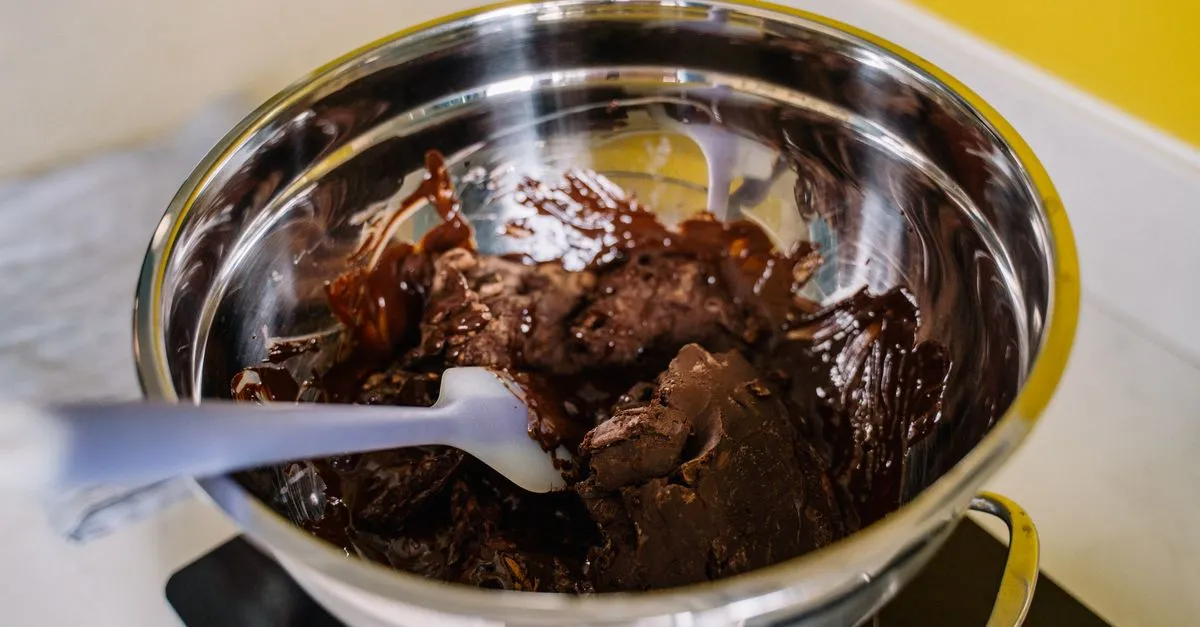
The word conching comes from industrial chocolate making, where a conche’s mixing, shear, warmth, and aeration changed the mass. A small stone melanger can combine some of those functions with particle reduction, but the equipment is not identical and the word is not a promise that every batch follows the same curve.
In its historical equipment experiment, Dandelion described using melangers both to reduce particle size and to allow volatile aromas to evaporate, then explored separating those jobs. That is a maker’s firsthand account, not a controlled comparison of home machines.
What the warm mixing can change
The 2024 industrial-chocolate study describes conching as mixing, kneading, and ventilation under controlled temperature and discusses the influence of particle surfaces, fat, and moisture. Its industrial setting helps explain the mechanisms, but does not supply a home-melanger schedule.
Particle and surface behavior
Mechanical contact can reduce or reshape particles and distribute fat across their surfaces. That can change flow and mouthfeel. A sample that feels smooth is useful craft evidence, but it is not a measured particle-size distribution. The exact effect depends on the recipe, solids, fat, load, tension, temperature, and machine.
Volatile and sharp notes
Warm exposure and aeration can change the balance of volatile compounds and sensory sharpness. The direction is not identical for every origin or formula. A brighter origin may reward a different stopping decision than a darker, rounder one. Write what the sample tastes like rather than promising that all sharp notes will become caramel or tobacco.
Fat distribution and flow
Flow can improve as fat coats particles and the mass becomes more uniform. Flow also depends on fat percentage, particle surface area, temperature, sugar, milk solids, and the way the rollers are loaded. “It flows” is not the same as “it has reached a specified micron value.”
The observable decision sequence
Conching is a decision sequence, not a universal clock
Keep the physical condition, texture, and flavor observations separate.
- 01
Normal motion
Mechanical checkConfirm normal circulation, sound, and roller movement for the exact model. Pause for a blockage, unusual scraping, overheating smell, or stalled material.
A motor rating does not authorize unattended use. - 02
Stopped sample
Measurement checkStop the machine before sampling or probing. Note the actual material condition and temperature context, then keep the sample outside the batch.
Do not sample a moving drum. - 03
Texture check
Coarse particlesAssess grittiness separately from flow. A qualitative tongue check is useful, but it cannot establish D90 or another lab PSD value.
Gauge readings need a named method. - 04
Flavor check
Preference checkDescribe acidity, bitterness, aroma, and balance without assuming that a named origin must follow a universal flavor path.
Record sugar timing without assuming that it stops flavor development. - 05
Continue or collect
DecisionContinue only when the exact machine route and the current condition support it. Collect when texture and flavor meet the stated goal.
No universal 18–24, 24–48, or 30-hour stop is asserted.
Model-specific instructions support recorded observations and recipe-specific planning examples, not a single cross-model schedule.
jayarrchocolate.comHow long should conching take?
The Premier stainless-holder manual and Elgi Ultra’s Chocogrind FAQ describe different recipes and conditions. They are manufacturer examples, not independent head-to-head tests.
Timing examples need their recipe and machine
| Source | 01Reported example | 02Important limit |
|---|---|---|
| Premier manual, page 19 | About 8 hours after all nibs are loaded; sugar in 100 g increments; then at least 10–15 hours, described as approximate | The example's 1 kg recipe conflicts with minimum-capacity guidance elsewhere; confirm the permitted load before using it |
| Elgi Ultra Chocogrind FAQ | A 1 kg, 70:30 roasted-nib:sugar test took 9 hours to reach the manufacturer's stated <20 micron result | The same FAQ says there is no standard grinding time; this is a reported test, not a promise |
Elapsed time describes a batch. It does not replace normal operation, texture assessment, or tasting.
jayarrchocolate.comPremier’s manual also gives broader 24–48-hour language on page 13 and 12/24-hour language on page 14. Those statements should not be combined into a guaranteed schedule. Use the instructions confirmed for your machine and load, and keep texture and flavor as separate decisions.
Sugar timing and flavor
Follow the recipe confirmed for your machine, adding sugar gradually enough to maintain normal circulation. Premier’s manual, page 19, describes about eight hours of nib refining before 100 g sugar additions in its example; its capacity discrepancies must be resolved before using that recipe as an operating plan.
In its historical equipment experiment, Dandelion described standardizing sugar-addition timing and changing melanger speed by origin. That is a maker’s process account, not proof that sugar freezes flavor or guarantees a particular result. Record when sugar was added and compare samples at similar temperatures rather than assuming that later flavor development has stopped.
Lid and ventilation
A lid changes the environment, but it is not a sealed preservation guarantee. Dandelion’s historical experiment describes open- and closed-lid stages in a separate longitudinal conche. That is not a direct instruction for a countertop melanger. Use your machine’s ventilation and safety requirements first.
Do not turn “lid off” into a universal acid-removal accelerator or “lid on” into a universal bright-note keeper. Those are source- and condition-dependent observations. Record the lid state alongside the temperature and flavor note.
Warming: use the exact recipe and equipment limits
Do not copy 71°C / 160°F as a general melanger setting. Premier’s manual separates several contexts: page 14 describes off-machine ingredient warming at 50–60°C and says the machine/product temperature should stay below 65°C; the dark recipe on page 19 says never to exceed 60°C. These are different instructions, not interchangeable targets.
Use the limits and procedure confirmed for your exact machine. Never aim heat at electrical or plastic parts or a concentrated spot of chocolate. Stop the machine before inserting a probe or utensil, and measure the material rather than inferring its temperature from the bowl. A stalled, wet, hardened, or contaminated batch needs diagnosis, not automatic extra heat.
Particle size and “smooth enough”
Conching and refining overlap, but their evidence should not be blended:
- Taste: qualitative coarse-particle check.
- Flow: evidence about the current mass condition at a stated temperature and stage.
- Micron gauge/grindometer: a method-dependent proxy; record the gauge and method.
- PSD/D90: a measurement claim requiring a named instrument/method and volume, mass, or number basis.
- Manufacturer micron phrase: a product claim unless the source supplies method and basis.
A narrow particle-size distribution is not automatically the best flow in every recipe. Larger and smaller particles, surface demand, packing, fat, and lecithin can interact. There is no single 10–20 µm optimum for every recipe, and a tongue test is not a D90 result.
When further conching is not the answer
If the batch is thick, first record the stage and temperature. Ask whether it was difficult to move while warm, thickened only after a sample cooled, suffered a wet addition, or lost normal circulation. Those are different conditions.
Do not add heat, water, or lecithin by reflex. No generic warming/moisture rescue or repeated redosing protocol is established by this guide. If there is unusual wear debris, suspected contamination, or uncertain ingredients, isolate the batch instead of treating a longer run as a safety fix.
If an interruption occurs before the chocolate is ready, follow the machine’s shutdown/unloading instructions and identify the material as incomplete. Premier’s manual, page 7, requires supervision throughout operation. Its continuous motor rating is not an unattended-use permission or a validated storage-and-restart procedure.
A conching log that produces useful evidence
| Field | Record |
|---|---|
| Exact machine/version | Product page, holder, voltage, controller, drum, and manual identity |
| Ingredient condition | Nibs, sugar, fat/milk solids, dry state, lot notes |
| Stage | What has been added and how well it circulates |
| Temperature | Stopped material reading, probe context, and time |
| Flow | How the material moves over/under the rollers at that condition |
| Texture | Qualitative coarse-particle observation; separate from flow |
| Flavor | Acidity, bitterness, aroma, balance, and preference |
| Lid/ventilation | Actual setting and model instruction |
| Decision | Continue, stop, unload incomplete, or collect; explain why |
Related reading
- Grinding chocolate in a melanger
- Best melanger for chocolate
- Premier vs. Spectra vs. CocoaTown
- What to do when chocolate is too thick
- The grindometer and particle-size limits
Frequently asked questions
Frequently Asked Questions
- Is conching the same as refining?
- Not exactly. In a small melanger, particle reduction and warm mixing can happen together, so makers often use “conching” for the flavor-development part of the run. Keep texture and flavor as separate observations.
- Should I conch for 30 hours?
- Thirty hours is not a universal endpoint. Use the instructions confirmed for the machine and load, then decide from normal operation, texture, and flavor. A clock reading cannot establish readiness.
- Does conching remove all acidity?
- No universal removal result is established. Warm mixing and aeration can change volatile and sharp notes, but the direction and preferred endpoint depend on the origin, formula, machine, and reader preference.
- Should the lid be on or off?
- Follow the exact model’s ventilation and safety instructions. Lid observations are condition-specific; neither “on” nor “off” is a universal flavor rule or preservation guarantee.
- Can I use 71°C / 160°F to speed conching?
- Do not copy that as a universal rule. The current Premier dark route uses a stricter 60°C ceiling, and other machines have their own boundaries. Use a stopped, representative material reading and the exact current instructions.