The book from JayArr Chocolate

The Chocolate Melanger Field Guide

Making Chocolate and Making It Your Own · by Jay Arr

Paperback · 144 pages · 7 × 10 in

The cover of The Chocolate Melanger Field Guide by Jay Arr: a yellow cover with the title in brown and blue above an illustrated tray of dark, milk and white chocolate squares, some topped with nibs.

A bar you can understand.

Make chocolate from roasted nibs in a tabletop melanger, finish it into tempered bars, then choose what to change next and know what else moves.

Free sample: PDF · 12 real pages · no email needed

144-page illustrated guide

8 chapters, each with a route

Learning checks with explanations

Machine and finishing records

Who it’s for

You own a small melanger, or you’re about to.

You want to make chocolate you understand: why it came out smooth or gritty, why the bowl thickened, why a bar tastes sweeter than you hoped, and what to change next time.

The book starts where your work starts, with purchased, ready-to-eat roasted nibs, and follows one complete route:

  1. Plan the batch, the day and the finishing station before you switch on.
  2. Refine in the melanger, reading texture, flow and flavor as you go.
  3. Temper one portion into bars, with a film test before molding.
  4. Improve the next batch with one deliberate change.

Not covered: roasting, winnowing, raw-cacao treatment, or a plan for selling chocolate. The worked machine route names one current tabletop melanger; owners of others use the same principles with their own manual’s settings.

How it teaches

Three questions explain the process

Before choosing a remedy, the book asks which kind of change you’re looking at. The same three labels run from the first chapter to the last.

  1. 01

    Composition What is in it?

    The ingredients you weighed: cocoa material, sugar, fat and anything you add. Changing them can change flavor and handling before you touch a machine setting.

  2. 02

    Particles How fine are they?

    What refining does. Warm mixing in the melanger can also change the flavor you perceive, but more time under the stones won’t temper the chocolate.

  3. 03

    Crystals How will it set?

    What tempering manages. A refined chocolate can still set poorly; tempering doesn’t make particles smaller or change the sugar-to-nib ratio.

An enlarged detail from the black-and-white interior.

Try one decision from the book

One record, two questions

Chapter 8 ends with a worked case. Here is its imagined batch record. Read it, then choose what you’d change.

Imagined record
Batch70/30 dark, 2,200 g, one nib lot, classic bowl cycle
The barSmooth, pleasantly fruity, a little sweeter than I like
FinishingFilm passed; then the bowl thickened while I filled the molds

The finishing bowl · check crystal state

A passing film shows the state was right when you tested; it doesn’t hold it still. More crystals are one possible reason the bowl thickened, so check the state within your method and test a fresh film before touching the recipe.

The finished bar · composition

The sugar share was weighed before the run began. Sweetness is a question for the next batch’s formula.

Your goal Less sweet, and keep the fruity character you liked. Which change would you try?

Choose a change to see what the book says about it.

It leaves the weighed sugar at 30%.

Extra processing can change how the bar tastes, and Dandelion’s makers report brighter notes often diminishing in long runs, so the fruit you liked might fade. It won’t show you a lower-sugar bar.

Two changes at once.

It adds fat while diluting the sugar share, weighted by the amount added. More available fat can help flow, but cocoa butter doesn’t refine particles, and adding it would blur the sweetness question.

It changes a factor you’d like to hold steady.

You liked this lot’s fruity character. Keeping the lot doesn’t prove the lot made the fruit, but it keeps the comparison readable.

It moves the sugar share directly, with lot and method held steady.

This is the book’s choice. Now read what else moves with it.

Same 2,200 g · replace 110 g sugar with 110 g of the same nibs

70/30 is 1,540 g nibs and 660 g sugar: 35% fat, 35% nonfat cocoa, 30% sugar. 75/25 is 1,650 g nibs and 550 g sugar: 37.5% fat, 37.5% nonfat cocoa, 25% sugar.

1,540 g nibs + 660 g sugar becomes 1,650 g + 550 g. With the book’s 50%-fat nib assumption, the 110 g brings 55 g cocoa butter and 55 g nonfat cocoa: one choice, three linked changes. Less sugar usually lets more cacao come forward, and bitterness or acidity may show more.

It still has to fit. 1,650 g of nibs in the named machine’s nib-only stage clears the book’s conservative 1,451.5 g planning minimum; coverage and circulation are still checked at the machine.

“I like this lot’s fruity character, but I want the bar less sweet. I’ll make 75/25 at 2,200 g with the same nibs and method, and compare it with my 70/30.”

The comparison shows whether you prefer the choice, not which linked change did the work.

Adapted from the worked case on pages 117–122; the bars illustrate the book’s arithmetic.

See inside

Real pages, as printed

Enlarged details from the black-and-white interior. Select one to read the full pages.

01 · Chapter 3 · page 49

Continue, end, or stop

During the run, every decision starts at a gate: is the machine operating normally, and is the material suitable? Then you continue for a stated goal, end a completed run, or stop an abnormal machine. Elapsed time goes in the record; texture, flow and flavor decide.

02 · Chapter 4 · page 61

Recover from the state you see

Finishing follows one complete classic method: melt the whole portion, cool it until it begins to thicken, rewarm gently and test a thin film before molding. When the bowl thickens, overshoots or fails its film, you start from the state in front of you and end with a fresh film. Tempering sets the crystals; it doesn’t refine particles or remove a flavor you dislike.

03 · Chapter 2 · page 29

Take the plan to your machine

The worked route names one machine. Formula arithmetic and principles travel; settings and load requirements don’t. Using a fictional machine’s supplied numbers, this page checks a plan against its first-stage minimum and final maximum, then lists what that machine’s own manual still has to supply.

Free sample

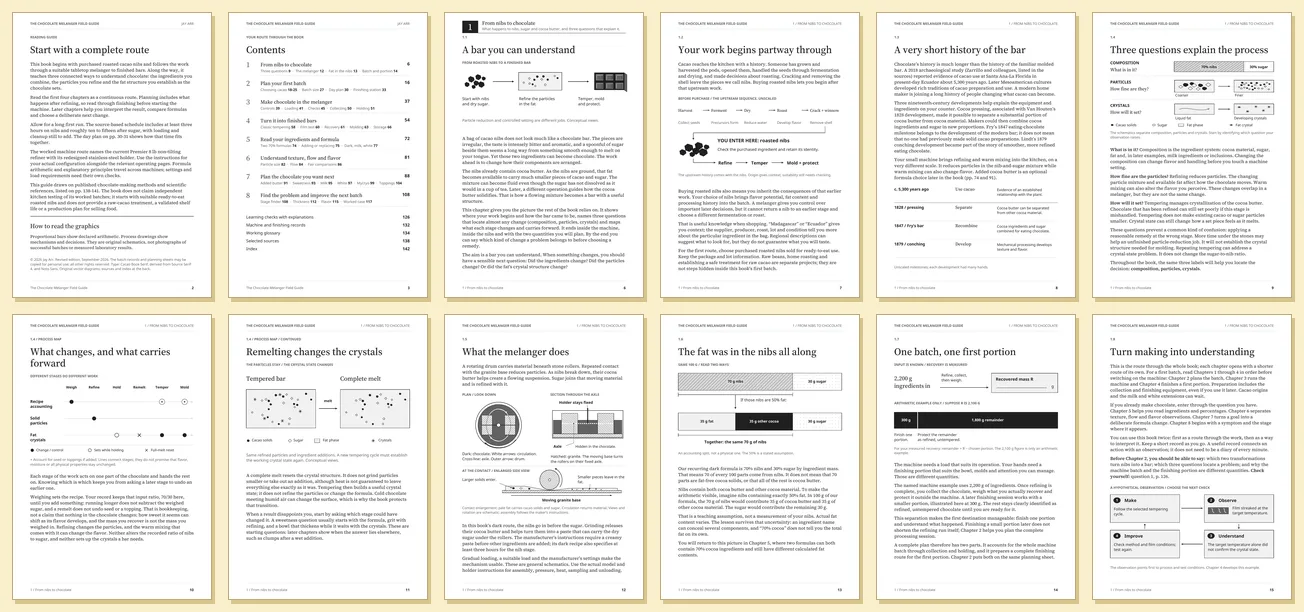
Read all of Chapter 1

Twelve pages in the book’s own order: the reading guide and contents, then the whole first chapter, with the three questions, what each stage changes and carries forward, what the melanger does, the fat inside the nibs, and one batch with one first portion. Page numbers match the printed book.

Download the free sample

PDF · 12 pages · 110 KB · no email needed

Eight chapters

A question for every stage

Read the first four chapters as one route before your first run. The later four interpret the result and plan a deliberate next change. Each chapter opens with its route.

Also inside: nine learning checks with explanations, a machine-session record and a finishing-session record to copy, a working glossary, selected sources, and an index.

  1. 1

    From nibs to chocolate

    Did the ingredients change, the particles, or the crystals?

    p. 6
  2. 2

    Plan your first batch

    Will this plan fit my machine at every stage, not just at the end?

    p. 16
  3. 3

    Make chocolate in the melanger

    Should I continue for a goal, end the run, or stop the machine?

    p. 37
  4. 4

    Turn it into finished bars

    What state is the chocolate in, and what does the fresh film say?

    p. 54
  5. 5

    Read your ingredients and formula

    Why can two 70% formulas be different chocolates?

    p. 72
  6. 6

    Understand texture, flow and flavor

    Is it smoother, freer-flowing or better tasting, and how would I know?

    p. 81
  7. 7

    Plan the chocolate you want next

    Which one change would move my bar where I want it?

    p. 88
  8. 8

    Find the problem and improve the next batch

    Where and when did it go wrong, and what should the next bar test?

    p. 108

The details

The Chocolate Melanger Field Guide

Making Chocolate and Making It Your Own

By Jay Arr, who writes JayArr Chocolate

Format
Paperback · matte cover
Length
144 pages
Size
7 × 10 in
Interior
Black and white on white paper
ISBN
9798175066143
Will it work with my melanger?

The worked route names one machine: the current Premier 8 lb non-tilting refiner with its redesigned stainless-steel holder. Formula arithmetic and the explanations travel to other tabletop melangers; settings, minimum loads and the order of ingredients come from your own machine’s instructions. A worked translation shows how to check a plan against another machine’s numbers.

Do I need to roast cacao beans?

No. The book starts with purchased, ready-to-eat roasted nibs and explains the upstream steps only briefly. It doesn’t cover roasting, winnowing or raw-cacao treatment.

Are the recipes tested?

It’s a researched guide, built from published chocolate-making methods and scientific references listed in the book. Its worked batches, such as the 70/30 dark chocolate, are teaching formulas; the book doesn’t claim independent kitchen testing of them.

How long does a batch take?

Allow for a long first run. The book’s source-based schedule includes at least three hours on nibs and roughly ten to fifteen after sugar, with loading and cleanup still to add. Readiness is judged by texture, flow and flavor, not by a universal clock.

Plan to be there for it. The named machine’s manual requires close supervision and says not to leave it unattended, so the route assumes someone is present for the whole run.

Does it cover tempering, milk and white?

Yes. Tempering gets one complete classic bowl method with a film test, a recovery page and purchased seed as an alternative. Milk and white are optional extensions in Chapter 7, with their own prerequisites, including a specified cocoa-butter-powder seed.

Can I use it to make chocolate to sell?

It isn’t a production plan for selling food, and it doesn’t give a validated shelf life.

How does it relate to the free articles and tools?

The articles and tools here answer one question at a time. The book develops the ideas as one connected route, from a first batch to a deliberate next change, with its own worked decisions, learning checks with explanations, and records to reuse.

Melanger refining guide · The Melanger Guide

Pages 9–10 · Chapter 1 · pinch to zoom

Page 9 in full: “Three questions explain the process”, with schematics for composition, particles and crystals.Page 10 in full: “What changes, and what carries forward”, a process map of what each stage changes, from weighing to molding.

Pages 117–122 · Chapter 8 · the worked case · pinch to zoom

Page 117 in full: “One record, two questions”, an imagined batch record split into a finishing-bowl question and a finished-bar question.Page 118 in full: “Check the bowl before the recipe”: a film passed, the state can change, check again; more crystals are one possible reason for thickening.Page 119 in full: “Choose the lever for sweetness”, a table of four possible changes and what each does for the goal.Page 120 in full: “Read the linked changes”, bars comparing 70/30 and 75/25 at 2,200 g as fat, nonfat cocoa and sugar.Page 121 in full: “Check the fit, then plan what to watch”, nib-stage bars against the 1,451.5 g planning minimum.Page 122 in full: “Give the comparison a fair chance”: refine, finish and taste, with stage-coded notes and a result left blank until the bars exist.

Pages 48–49 · Chapter 3 · pinch to zoom

Page 48 in full: “When texture and flavor disagree”, two imagined sample notes.Page 49 in full: “What further processing can change”, the stop, continue and end decision.

Pages 60–61 · Chapter 4 · pinch to zoom

Page 60 in full: “Test a little; tend the rest”, the thin-film test.Page 61 in full: “Recover from the state you see”, three tempering states and their recoveries.

Page 29 · Chapter 2 · pinch to zoom

Page 29 in full: “Translate a plan to another machine”, a fictional machine’s 700 g early minimum and 1,800 g maximum.