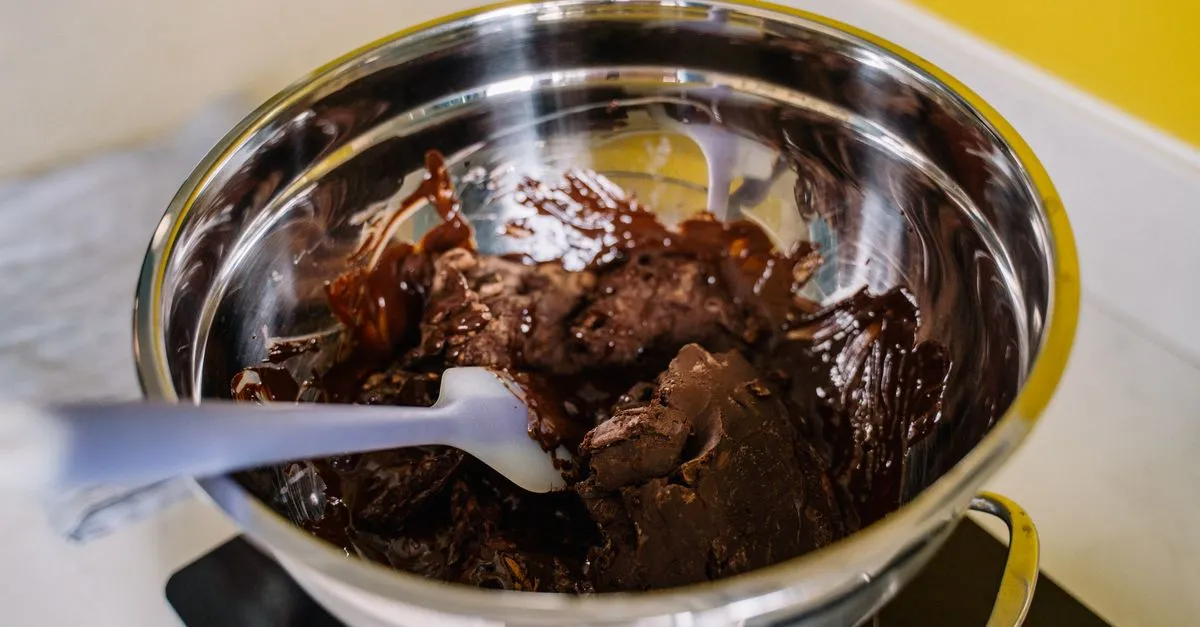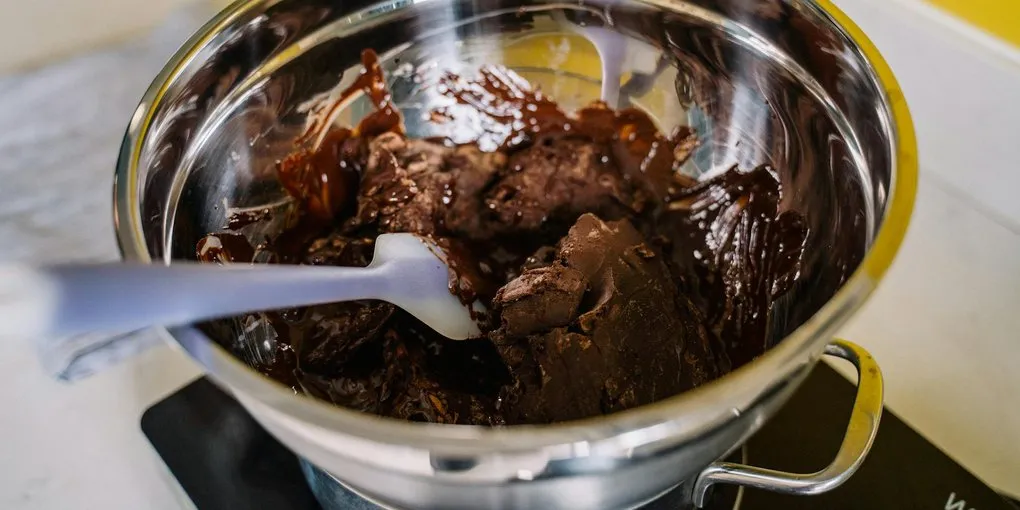
Chocolate that pours well from a warm melanger may become thick during tempering. A different batch may be gritty from the outset, or suddenly clump after a damp utensil touches it. These problems can look similar in a bowl, but they need different responses.
Before adjusting a whole batch, set aside a small weighed trial. Record the chocolate temperature, what you add, and how its flow changes. Compare samples at the same temperature and stage of tempering; otherwise a temperature difference can masquerade as a formulation improvement.
Start with Temperature and Crystallization
If you are molding or dipping with tempered chocolate, do not heat it to 40°C simply to make it pour. That temperature is associated with testing fully molten chocolate in some rheology protocols, not a universal working temperature for tempered chocolate.
Follow the curve for the actual chocolate. For example, Callebaut’s tempering guide gives working ranges of 31–32°C for its 811 dark chocolate, 29–30°C for 823 milk, and 28–29°C for W2 white. These are product examples, not instructions for every recipe.
A bowl can also thicken while held at its stated working temperature because more cocoa butter crystallizes. Callebaut describes this as overcrystallization. Its remedies are to carefully melt excess crystals or blend in suitable untempered melted chocolate. Stir, monitor temperature, and check temper again. If you melt away the seed crystals completely, temper the batch again before molding.
For chocolate still in a melanger, use the temperature and loading limits specified for that machine and formulation. A stalling machine is a reason to stop and troubleshoot its load, not to force more ingredients into it.
What Viscosity Measurements Actually Tell You
Chocolate is a suspension: solid sugar, cocoa particles, and any milk solids are dispersed in a continuous fat phase. Its apparent viscosity depends on how it is made to flow, so a single thickness number cannot describe every application.
The Casson model is one established way to fit rheology data. It reports an estimated yield stress, which describes resistance to starting flow, and a plastic viscosity parameter, which describes resistance once flowing. Yield stress is measured as stress, not simply as force. These are model parameters rather than two independent ingredients in the bowl.
A chocolate can be relatively reluctant to start moving yet flow readily once worked, or show the opposite balance. Molding and enrobing therefore need different flow properties. Palsgaard’s technical guide explains why measurements across multiple shear rates are more informative than one speed. Compare laboratory results only when the temperature, sample preparation, and measurement method are also comparable.
Check for Moisture
A small addition of water can create sticky sugar-rich bridges between particles and turn melted chocolate into a grainy mass. The amount that causes trouble depends on the chocolate and how the liquid enters it; a universal 0.1–0.5% failure threshold is not a useful kitchen rule.
Keep equipment and ingredients dry when making chocolate for bars or shells. Watch for steam, condensation, damp sugar, wet tools, and water-based extracts. Wash and sanitize equipment as instructed, then let it dry completely before production. “Keep water out of the chocolate” does not mean skipping cleaning.
If the batch has seized, adding cocoa butter is not a dependable way to restore it for tempering. An otherwise sound batch can sometimes be repurposed into a sauce or ganache by adding enough liquid and mixing thoroughly. King Arthur’s test kitchen demonstrates this distinction. Make that change in a suitable bowl or pan, not by pouring water into a running melanger. The resulting food needs the storage appropriate to its new recipe; it no longer has a plain chocolate bar’s storage characteristics. Contaminated or spoiled ingredients are not rescued by changing texture.
Check the Actual Formula
Two-ingredient chocolate gets its fat from the nibs. Added cocoa butter increases the fat available around particles; an emulsifier can change how those particles interact. Those facts are more useful than classifying all American craft bars as thick and all European bars as fluid.
Calculate fat from the ingredients you actually have. For illustration, if a batch is 70% nibs and those nibs contain 55% fat, its fat contribution from nibs is 0.70 × 0.55 = 38.5% of the batch. That is a hypothetical calculation, not a claim that every origin supplies a fixed fat percentage. Bean lot, recipe, particle distribution, moisture, and processing all affect the final flow.
If starting from purchased chocolate, use its stated application or fluidity rating. Chocolate intended to hold its shape in baked goods may be a poor starting point for thin shells even when fully melted.
Fix 1: Adjust Cocoa Butter When More Fat Is Appropriate
Cocoa butter is a straightforward formulation adjustment. Test a weighed amount of food-grade cocoa butter, melted and thoroughly mixed into the chocolate. Make the formulation change before the final tempering step so the whole blend can be tempered consistently.
It does not have to be added only at the beginning of refining. The right timing depends on the process. Early fat may help a small melanger establish circulation, while industrial processes can reserve some fat for later flow adjustment. Cacao Barry explicitly describes adding cocoa butter after several hours of conching.
Treat a small addition as a trial, not a guaranteed cure. For example, 5 g added to 1,000 g chocolate is 0.5% of the starting batch weight, or about 0.498% of the final 1,005 g mixture. Some chocolates need a greater change; others need a crystallization correction instead. Callebaut sells cocoa butter for adjusting fluidity, but the desired shell thickness and final flavor still determine whether the adjustment suits your product.
Cocoa butter counts toward cacao content. If you add 5 g to 1,000 g of 70% chocolate, the simple formulation cacao fraction becomes 705 ÷ 1,005 = 70.15%. The percentage rises slightly even though the nonfat cocoa solids are diluted. Increasing the cacao percentage this way does not mean intensifying cocoa flavor.
For more on the tradeoffs, see our guide to adding cocoa butter.
Fix 2: Use Lecithin with a Measured Trial
Lecithin can reduce plastic viscosity as well as yield stress. Its practical role is not limited to getting chocolate started while leaving pouring resistance mostly unchanged. PGPR is the more specialized yield-stress reducer.
Use a food-grade product intended for chocolate and follow its technical guidance. Palsgaard describes a lecithin optimum around 0.35–0.40% in its examples; that is not a universal target for every lecithin or chocolate. Above a formulation’s optimum, more lecithin can increase yield stress. Avoid escalating additions blindly.
Percentage is by mass of the final formula. For illustration, 0.3% means 3 g in a final 1,000 g batch. Account for lecithin already present in purchased chocolate. Use a scale that can resolve the intended addition; guessing a few drops is not reliable formulation.
Late addition is common in conching because emulsifiers alter the consistency being worked. In a small melanger, follow the process specified for the machine and ingredient, then mix long enough to distribute the addition uniformly. Neither a universal ten-to-one replacement for cocoa butter nor a promise of unchanged flavor applies.
The U.S. sweet-chocolate standard permits safe and suitable emulsifying agents with a combined maximum of 1% by weight. This is a product-standard ceiling, not an optimal dosage or permission to use every individual emulsifier at 1%. Check ingredient labeling and allergen requirements when changing a recipe.
Fix 3: Consider PGPR for a Specific Flow Problem
PGPR, or polyglycerol polyricinoleate, is particularly effective at reducing yield stress and has a smaller effect on plastic viscosity. It is often combined with a basic emulsifier such as lecithin. It may help a formulation fill fine mold details, but the lowest possible yield stress is not automatically best for every coating or shell.
Use supplier guidance and the rules for the intended market and food category. 5 g/kg is not a universal permitted dose. For example, FDA’s GRAS Notice 9 covers the notified use in chocolate at up to 0.3%, with an FDA no-questions response. That is 3 g/kg, and the notice should not be confused with a blanket authorization for every product or use. Regulatory permission and the amount that gives the desired flow are separate questions.
For most small batches, correct temperature, crystallization, and the basic formulation first. An emulsifier will not resolve every problem caused by wet ingredients or unsuitable processing.
Fix 4: Improve Loading and Refining Without Chasing a Magic Micron Number
Pre-grinding sugar in a suitable dry-ingredient grinder can shorten its initial breakdown. It is optional, and it does not guarantee a narrow final particle-size distribution. Follow that grinder’s capacity and run-time instructions, contain the dust, and let it settle before opening.
Do not use one or two hours of sugar alone as a general melanger-loading method. Follow the manufacturer’s production sequence. For example, Premier’s chocolate method establishes a flowing nib/cocoa-butter mixture before adding sugar. A cleaning run described in a manual is a different procedure, and its contents must be discarded.
Refining is needed if the chocolate is too coarse for the intended texture. But finer particles create more surface area, and more refining can make an otherwise identical formulation more viscous. Afoakwa and colleagues’ controlled dark-chocolate study found that increasing particle size reduced measured viscosity in the formulations studied, with strong interactions involving fat and lecithin.
A grind gauge can help monitor coarse particles or aggregates. It does not tell you that 90% of the entire distribution lies in a particular range. Nor does a 25- or 30-micron reading establish a universal sensory boundary: primary sensory research finds meaningful differences in people’s sensitivity.
Use the melanger refining guide and the machine’s instructions to evaluate texture, circulation, and flavor together. Fixed claims such as “done after 24 hours,” “best flavor at eight hours,” or “gummy below five microns” are not dependable endpoints for every batch.
A Practical Troubleshooting Order
- Identify whether the problem arose in refining, melting, or tempered work.
- Check the appropriate temperature and, when molding, test temper and consider excess crystallization.
- Investigate moisture if thickening was sudden and grainy.
- Check the formula and intended application before adding anything.
- Test a measured fat or emulsifier adjustment on a small portion, changing one variable at a time.
- Continue refining when texture requires it, while recognizing that finer is not always more fluid.
- Record the successful recipe and loading sequence for the next batch.
For related calculations, see our chocolate recipe formulation guide.
Chocolate Too Thick? Diagnosis Flowchart
01 / Has tempered chocolate thickened?
02 / Did it become grainy after moisture entered?
03 / Is the texture too coarse?
04 / Would added cocoa butter suit the product?
05 / Are you considering an emulsifier?
What Each Adjustment Addresses
- Temperature / crystalsCorrect cold or overcrystallized chocolate before reformulating.
- Product-specific working range
- Cocoa butterAdds fat; changes the formula and cacao percentage.
- Weighed small trial
- LecithinCan reduce viscosity; excess may raise yield stress.
- Product-specific trial
- PGPRPrimarily reduces yield stress.
- Supplier and market-specific
- RefiningReduces particle size; may increase viscosity.
- Texture-based endpoint
Frequently Asked Questions
- Why is my bean-to-bar chocolate so thick?
- Possible causes include low available fat, moisture, excessive particle surface area, temperature, and excess crystallization during tempered work. A country of origin or two-ingredient label does not determine the answer. Diagnose the stage where thickening happened.
- How much cocoa butter should I add?
- Test a small weighed addition appropriate to the recipe and application. Five grams per kilogram is a possible small trial, not a universal cure. It can be added at a suitable later adjustment stage; mix fully and temper the final blend.
- How much lecithin should I add?
- Follow the specific ingredient guidance and count any lecithin already present. As a calculation example, 0.3% is 3 g per final kilogram. More is not always better; an excessive amount can raise yield stress.
- Can water ruin a batch of chocolate?
- It can make chocolate seize and unsuitable for the intended tempering process. An otherwise sound batch may be repurposed into sauce or ganache with sufficient liquid. That is a different food with different storage needs, not restored chocolate for bars.
- What is the Casson model?
- It is a model used to fit flow data, reporting yield stress and plastic viscosity. Measurements depend on method and temperature. A laboratory test temperature is not the temperature to use for molding tempered chocolate.
- Should I pre-grind sugar before adding it to the melanger?
- It can help initial breakdown if done in a suitable separate grinder, but is optional. Follow the melanger loading instructions; do not assume dry sugar alone is an appropriate production load or that pre-grinding guarantees the final particle distribution.
- What is PGPR and when should I use it?
- PGPR is an emulsifier especially useful for lowering yield stress. Use it only with a formulation trial and applicable supplier and regulatory guidance. A universal 5 g/kg recommendation is inappropriate.