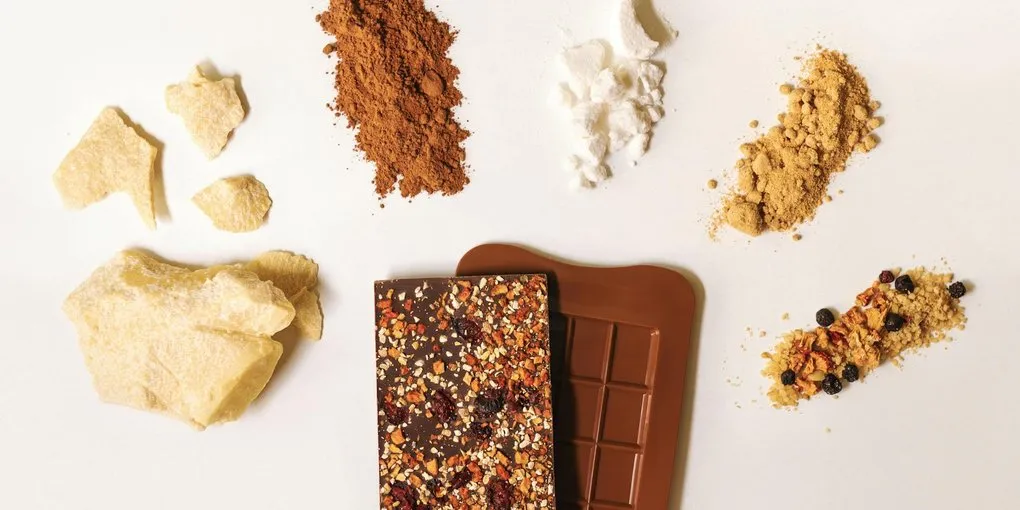
Cocoa butter can improve chocolate that is too thick for molding or dipping. The right amount depends on the starting formula, particle size, moisture, temperature, and the flow you need. A small trial tells you more than a fixed dose applied to every chocolate.
Why Cocoa Butter Reduces Viscosity
Melted chocolate contains solid cocoa and sugar particles dispersed in fat. Adding liquid cocoa butter increases the fat available between particles and usually makes the mixture flow more easily at a comparable temperature. Fat content is one influence on flow; it does not erase differences in particle size or processing.
Cacao percentage and fat percentage are different. As a calculation example, nibs containing 53% fat would give a 70% nib-and-sugar chocolate approximately 37.1% fat. Actual nib composition needs supplier data or measurement. Country of origin is not a precise fat specification.
Nor does “two ingredients” automatically mean thicker than every chocolate containing added butter. Compare the actual recipes and processing. A high-nib recipe may already have more total fat than another bar with a lower nib content and a small butter addition.
Check the Cause Before Changing the Recipe
Adding cocoa butter may help a chocolate that is consistently too viscous for a thin shell or even coating. But first distinguish a formulation issue from chocolate that has become thick while you work:
- Too cool: bring it back toward the appropriate working temperature while stirring.
- Too many crystals: tempered chocolate can thicken even at its working temperature. Callebaut’s overcrystallization guidance describes controlled warming or adding untempered melted chocolate to rebalance the crystals.
- Moisture contamination: a seized, clumpy mixture is a different problem. Extra cocoa butter is not a dependable way to restore it as bar or shell chocolate.
- Formulation or particle-size problem: compare flow before tempering under consistent conditions, then trial an adjustment.
A failed temper, cold mold, or air trapped during filling is not automatically a low-fat recipe. Check those causes before adding more ingredients.
How Much to Add
For a modest adjustment, 5g per 1kg of starting chocolate is a small trial increment. It is not a promise of a perceptible change. Mix completely, compare flow at the same temperature, and record the result before adding more. Further trials of 10g or 20g per kilogram may be useful, depending on the chocolate and intended coating thickness.
These quantities are percentages of the starting chocolate weight. Adding 5g to 1,000g makes 1,005g total, of which the addition is about 0.498%. Adding 20g makes 1,020g, with the addition about 1.96% of the final weight. Keep that denominator consistent in production records.
Callebaut’s cocoa-butter product guidance describes larger additions for thin molding and enrobing. The appropriate amount is application-specific: more fluid is not always better for every mold or coating. There is no universal point at 2% where richness suddenly becomes noticeable, and added cocoa butter does not necessarily make properly tempered chocolate set softer.
Cocoa Butter or Lecithin?
They are not interchangeable on a fixed ten-to-one basis. Lecithin can reduce flowing viscosity, while its effect on yield stress—the stress needed to begin flow—depends on the recipe and dose. In an industrial chocolate study, increasing lecithin reduced plastic viscosity while increasing yield stress. That result does not establish a home recipe’s optimum.
Cocoa butter directly changes fat composition and can change melt and flavor delivery. Choose it when those changes suit the product. If using lecithin, follow its supplier’s guidance and test the actual formulation; count lecithin already present. A universal 0.01–0.05% “ideal” dose is not supported.
When to Add It
During melanger loading: some butter can help establish flow as nibs enter the machine. Chocolate Alchemy’s hands-on guide recommends adding recipe butter early for this purpose. Follow the machine’s loading instructions and avoid stalling it.
Near the end of refining or conching: reserving some butter for final flow adjustment is also valid. Industrial processing commonly includes a later fat addition; thorough mixing can incorporate it fully. Late addition is not inherently less uniform.
After refining, before tempering: melt food-grade cocoa butter, mix it evenly into melted chocolate, then temper the combined batch. This is a straightforward point to make a final formula adjustment.
Adding melted fat to chocolate that is already tempered can alter its crystal balance and temperature; mix thoroughly and check temper again. Do not confuse a bulk fat adjustment with a specific cocoa-butter seeding method. Callebaut’s tempering guidance includes deliberately crystallized cocoa butter used as seed under controlled conditions.
Effect on Cacao Percentage
Added cocoa butter counts as cocoa. What happens to the percentage depends on whether you add it to an existing batch or replace another ingredient.
For example, adding 5g butter to 1,000g of 70% chocolate gives:
New cacao percentage = (700g + 5g) / (1,000g + 5g) × 100 = about 70.15%.
Replacing 5g of nibs with 5g butter in a 700g-nib, 300g-sugar formula keeps it at 70% cacao, but raises fat and lowers non-fat cocoa material.
If you are designing a nib-butter-sugar formula from scratch:
Sugar = Total cocoa ingredient weight / target cacao fraction - Total cocoa ingredient weight.
With 650g nibs plus 5g butter, total cocoa is 655g. At 70%, sugar is 655 / 0.70 - 655 = 280.714g, or about 281g, and total batch weight is about 936g after rounding. That is not a 1kg formula. Milk powder and other non-cocoa ingredients must also be subtracted from the sugar allowance.
Tempering and Mold Release
The adjusted chocolate still needs suitable cocoa-butter crystallization for gloss, snap, and release. Use the chocolate’s tempering guidance as a starting point and check a sample after changing the recipe. Added butter does not guarantee longer working time: temperature, agitation, batch size, and the growing crystal population all matter.
Good contraction helps release chocolate from molds, but extra butter alone cannot guarantee a clean release. Correct temper and suitable cooling remain essential. Judge both the flow while filling and the set product before adopting a new formula.
Natural or Deodorized Cocoa Butter?
Natural cocoa butter retains an aroma that can contribute to the chocolate. Deodorized butter has much of that aroma removed and is comparatively neutral. Neither is automatically the right choice for every craft bar.
If you want your nibs’ flavor to lead, neutral butter may be helpful; a natural butter from another batch can add its own aroma. If you like that added character, choose natural butter. Chocolate Alchemy describes this flavor choice in its own butter range. Taste the ingredient and the finished chocolate instead of assuming “natural” means greater origin transparency.
Use food-grade cocoa butter. For the pressing and deodorizing process, see how cocoa butter is made.
For the complete formulation picture, see our chocolate recipe formulation guide. For flow problems, read our chocolate viscosity troubleshooting guide. For crystallization, see our cocoa butter chemistry guide.
Cocoa Butter Addition Guide
Diagnose First
- Check temperature and excessive crystallization
- Moisture-induced seizing is a different problem
- A formula change will not fix every molding defect
Trial and Record
- 5g per 1kg starting chocolate is a small trial
- Mix completely; compare at the same temperature
- Record additions and new total batch weight
Addition Timing
- Some butter early can help melanger loading
- Later additions can adjust final flow
- Recheck temper after changing the batch
Count Cocoa Butter
- Added butter counts toward cacao percentage
- 1kg of 70% chocolate + 5g butter = about 70.15%
- 655g cocoa ingredients at 70% needs about 281g sugar
Frequently Asked Questions
- Why add cocoa butter to chocolate?
- It increases fat relative to solid particles and can improve flow for molding or dipping. The result depends on the recipe and processing; it is not a cure for every thick or seized chocolate.
- How much should I add?
- Test a small weighed increment, such as 5g per kilogram of starting chocolate, and compare at the same temperature. Record further additions. The useful amount depends on the chocolate and application; 5g is not a guaranteed fix.
- Does cocoa butter count toward cacao percentage?
- Yes. Adding 5g to 1kg of 70% chocolate gives about 70.15% cacao. For a new formula containing 650g nibs and 5g butter at 70%, use about 281g sugar. Replacing nibs with the same weight of butter keeps cacao percentage unchanged but raises fat content.
- Is lecithin a ten-times-stronger replacement?
- There is no dependable fixed substitution ratio. Its effect on flowing viscosity and yield stress differs with composition and dose. Cocoa butter changes the fat fraction directly. Test either ingredient in the actual recipe.
- Must cocoa butter be added at the beginning?
- No. Early butter can help a melanger establish flow, while later additions can adjust consistency. Thorough mixing is essential either way. For a final adjustment, mix into melted chocolate and temper the combined batch.
- Which is better: natural or deodorized cocoa butter?
- Natural butter adds its own aroma; deodorized butter is comparatively neutral. Choose according to the flavor you want. Neutral butter can let the nibs lead, while natural butter may add a welcome additional character.