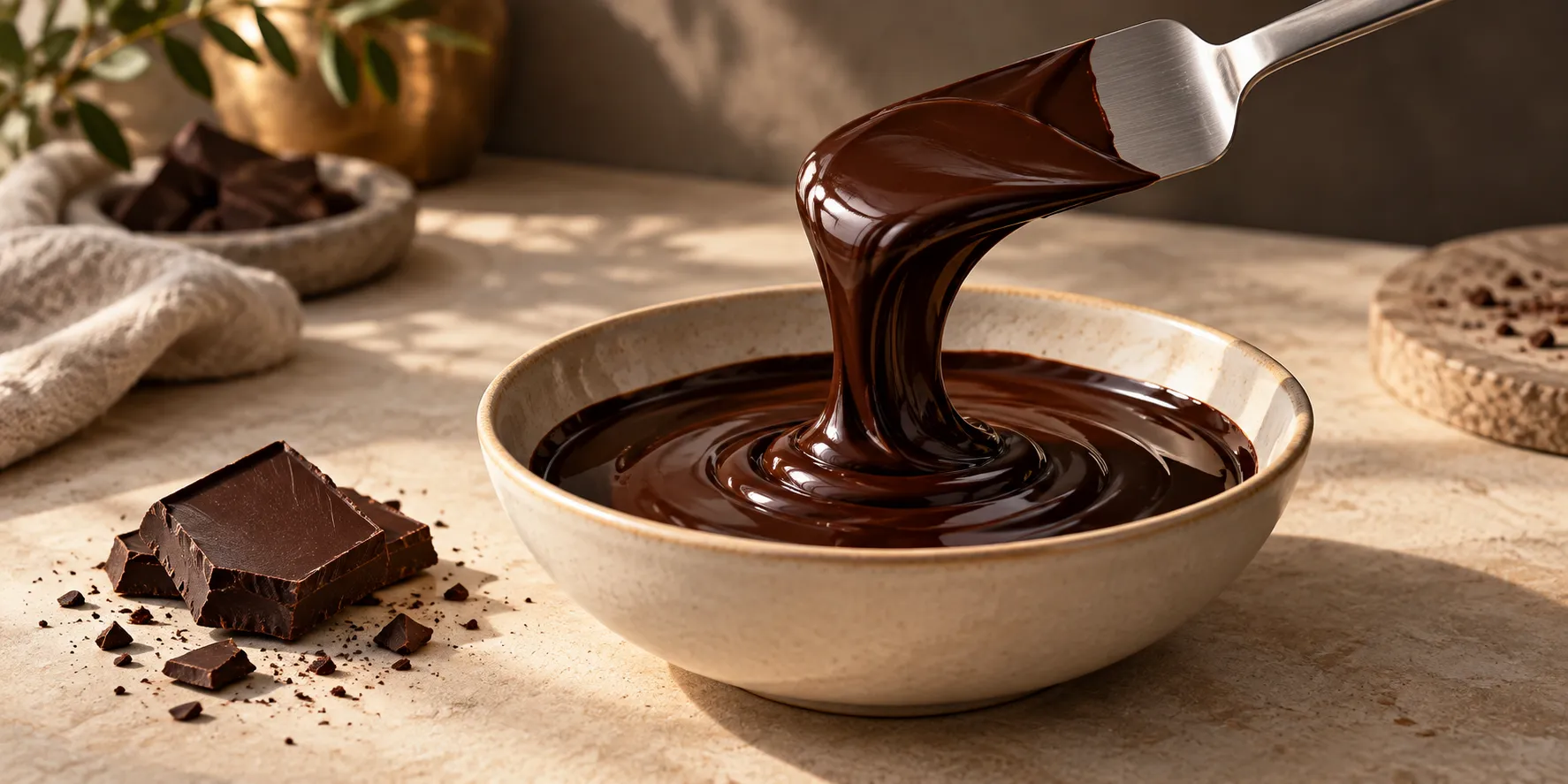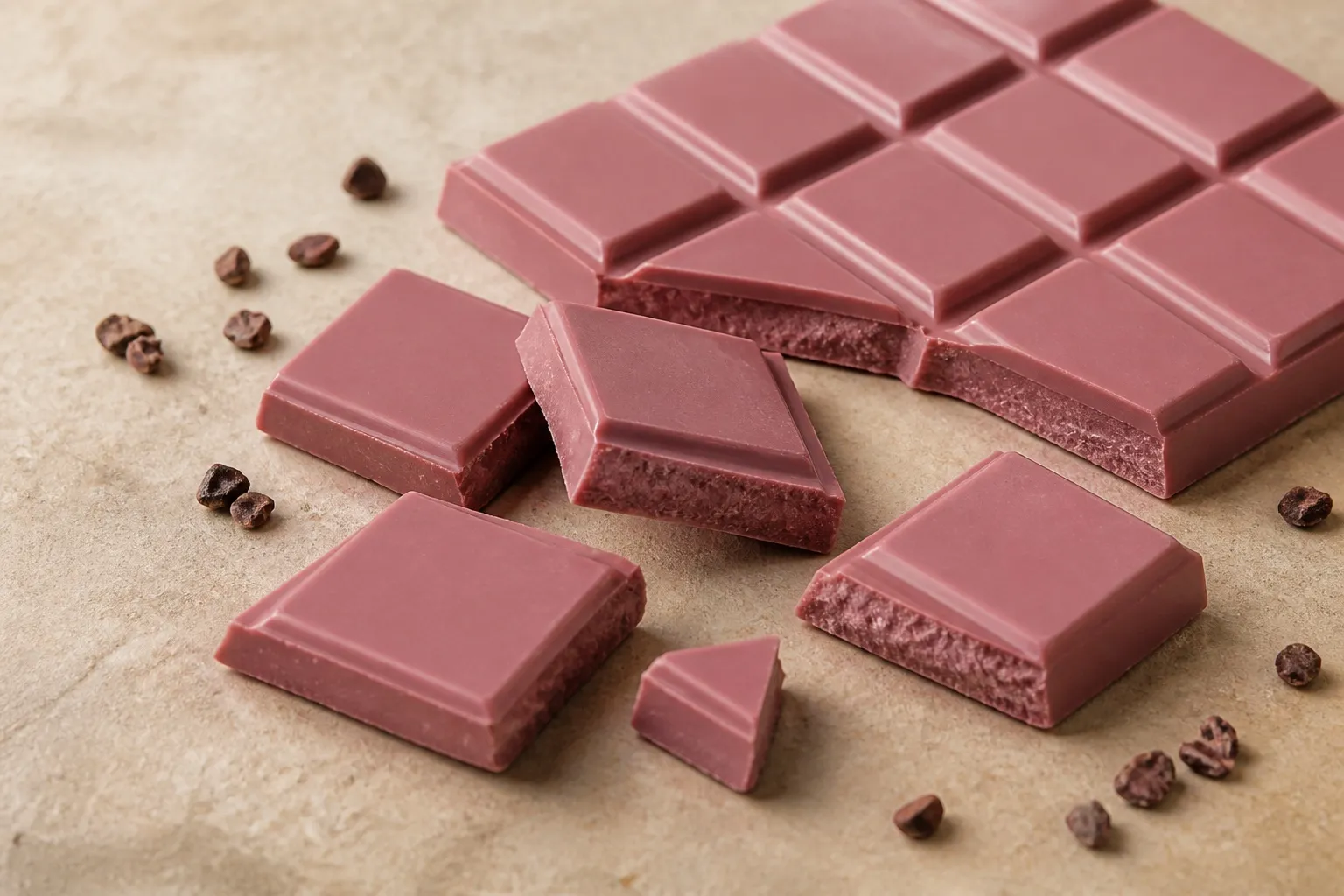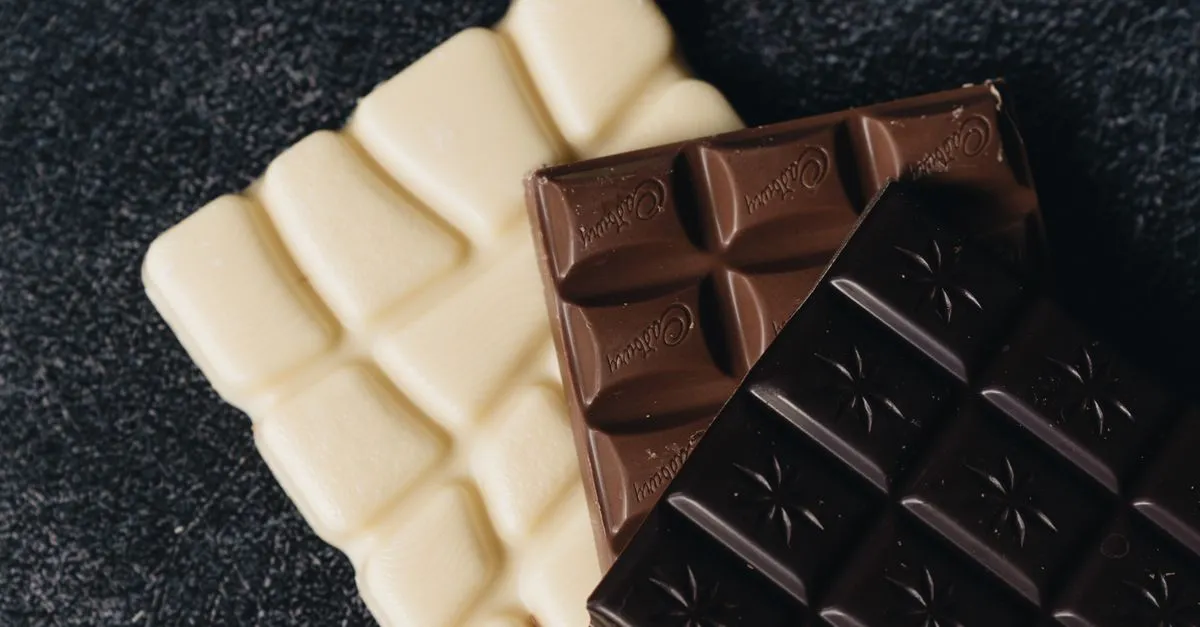
Two bars made from the same chocolate can set very differently because of how their fat crystallizes. That is the practical reason for tempering. Crystal structure matters, but so do the recipe, processing conditions and mold surface. A temperature reading alone cannot describe all of them.
The interactive temper curve illustrates the process. Treat it as a teaching model, not a measurement of the crystal populations in your bowl.
What Cocoa Butter Is Made Of
Cocoa butter consists mainly of triacylglycerols, also called triglycerides: glycerol joined to three fatty acid chains. Minor lipid components are present too. For extraction rather than crystallization, see how cocoa butter is made.
Fatty acids and triglycerides are different descriptions
Stearic and palmitic acids are saturated; oleic acid is monounsaturated. Linoleic acid contributes a smaller polyunsaturated fraction. These are largely bound within triglycerides, rather than existing as a bowl of separate free fatty acids.
One Malaysian cocoa butter analyzed in a 2018 experimental study had the following fatty acid composition. These are sample measurements, not specifications for every cocoa butter:
| Fatty acid | Notation | Reported percentage |
|---|---|---|
| Palmitic | C16:0 | 25.96% |
| Stearic | C18:0 | 37.10% |
| Oleic | C18:1 | 32.49% |
| Linoleic | C18:2 | 2.88% |
| Arachidic | C20:0 | 1.21% |
The same study measured three major triglycerides:
| Abbreviation | Fatty acid arrangement | Reported percentage |
|---|---|---|
| POS | Palmitic–oleic–stearic | 38.9% |
| SOS | Stearic–oleic–stearic | 27.7% |
| POP | Palmitic–oleic–palmitic | 15.2% |
Together, those three represented 81.8% in that sample. Each has oleic acid in the middle position and saturated chains outside. POP and SOS have matching outer chains; POS has different ones. Calling all three symmetrical obscures that distinction. Study and triglyceride analysis.
Why origin matters without supplying a fixed tempering correction
Cocoa butters are not chemically identical. In a study of beans from six origins, researchers found differences in triglyceride profiles and proposed an indicator of softness based on selected unsaturated triglycerides. The amounts also reflected the condition of the beans being analyzed. Sirbu and colleagues, 2018.
That does not establish a universal country ranking or a rule that each change of origin needs a one- or two-degree adjustment. Bean fat yield and the melting behavior of the extracted fat are different measurements. For a new batch, record the actual recipe and processing behavior; check the supplier’s specifications where available.
The Six Crystal Forms
Polymorphism means that molecules can pack into different crystal arrangements. The familiar cocoa butter system numbers these states I through VI. Wille and Lutton’s original X-ray work also warned that some states were difficult to characterize and might contain phase mixtures. The six-form chart is a useful convention, not six visibly identifiable categories of finished bars. Wille and Lutton, 1966.
| Form | Common name | Approximate reference melting temperature | Practical significance |
|---|---|---|---|
| I | Gamma / sub-alpha | 17°C | Very unstable state |
| II | Alpha | 23°C | Unstable state |
| III | Beta-prime-2 | 26°C | Less stable than the tempering target |
| IV | Beta-prime-1 | 28°C | Lower-melting crystals can form during cooling |
| V | Beta-2 | 34°C | Usual target for tempered chocolate |
| VI | Beta-1 | 36°C | More stable; its presence alone does not prove bloom |
These rounded values follow the classic series reproduced in a 2005 pre-crystallization study: 17.3, 23.3, 25.5, 27.5, 33.8 and 36.3°C. Actual melting measurements depend on the sample and method. Do not use the table as a set of exact switches or as a substitute for a chocolate manufacturer’s tempering curve.
Why makers target Form V
A well-managed Form V crystal network supports firmness, snap, gloss and contraction during setting. Those are useful properties when molding bars and shells. They are not independent proof that every crystal is Form V, and a rough mold or poor cooling can still spoil the finish of properly pre-crystallized chocolate. Callebaut’s tempering guidance connects pre-crystallization with hardness, shine and mold release.
Chocolate melts over a range as the proportion of liquid fat increases. Its characteristic mouthfeel comes from that changing fat network as well as the suspended particles. A nominal 34°C melting value is not a promise of instantaneous melting on every tongue, and a nominal 36°C value does not mean chocolate cannot melt in the mouth. Experimental processing work illustrates changing liquid-fat fractions in both cocoa butter and milk chocolate. Engmann and Mackley, 2006.
Tempering primarily controls physical structure. It can therefore change the eating experience without replacing the flavor development achieved during fermentation and roasting. Avoid inferring a single release speed for every tempered or untempered chocolate: their compositions and crystal populations differ.
Fat Bloom Is More Than a Form V-to-VI Transition
Fat bloom is a visible surface defect associated with changes and movement in the fat phase. A transition toward Form VI can accompany it, but the two are not interchangeable descriptions.
Bricknell and Hartel compared chocolates with different sugar microstructures while cycling them between 19 and 29°C. In their special amorphous-sugar control, the fat changed from Form V toward Form VI without visible bloom. Their result demonstrates why a crystal-form transition alone is insufficient to explain the appearance. Original study abstract, 1998.
Other routes include fat migration from a filling and melting followed by recrystallization during warm storage. A white surface can also be sugar bloom: moisture dissolves sugar, which subsequently recrystallizes. Preventing condensation and maintaining appropriate storage conditions address a different problem from adjusting temper. Callebaut bloom troubleshooting and AAK’s discussion of filling-fat migration.
What the rapid-bloom experiment actually tested
Afoakwa and colleagues studied under-tempered dark chocolate, stored at 18 ± 2°C and 50% relative humidity, with particle-size D90 values of 18, 25, 35 and 50 micrometers. D90 describes a distribution, not a batch containing only one particle size.
They reported a Form IV-to-VI progression within 72 hours and rapid changes in whiteness and gloss during the first 96 hours. The coarsest treatment bloomed fastest in that experiment. These findings do not establish a four-day timetable for correctly tempered chocolate, a universal safe boundary at 18°C, or a rule that refining every chocolate to 10–20 micrometers maximizes shelf life. Afoakwa and colleagues, 2009, study abstract.
For makers, the useful distinction is between a particular experiment and a storage specification for your own product. Refining, formulation, temper and storage interact; particle size alone cannot predict bloom.
What Tempering Actually Does
A traditional cooling-and-rewarming method aims to establish an appropriate population of stable seed crystals before the chocolate sets:
- Melt the existing crystals. Use the melting range specified for the product and method.
- Cool while mixing. Crystals form and become distributed through the chocolate. Lower-melting forms can occur alongside the desired seeds.
- Rewarm to the working range. This melts less stable crystals while retaining enough suitable seed for setting.
That is the process described in the pre-crystallization research. It is not a guarantee that a particular thermometer reading leaves only two crystal forms in the bowl.
For concrete product examples, Callebaut lists these curves:
| Chocolate | Melt | Cool | Rewarm for use |
|---|---|---|---|
| 811 dark | 40–50°C | 27°C | 31–32°C |
| 823 milk | 45°C | 27°C | 29–30°C |
| W2 white | 45°C | 27°C | 28–29°C |
These are Callebaut product examples, not universal limits for all dark, milk or white chocolate. Follow the current product instructions and perform a small setting test before filling molds. Manufacturer’s table.
The seed method adds already-tempered chocolate; cocoa butter seeding methods introduce suitable crystals through a prepared cocoa butter product. Follow the method’s dose and temperature instructions. Time and movement matter alongside temperature, as Callebaut emphasizes in its pre-crystallization lesson.
Cocoa Butter Alternatives
The name of a fat category describes processing and compatibility tendencies. It does not establish that every product in it has the same composition or can be substituted gram for gram.
| Category | General behavior | What to check |
|---|---|---|
| CBE — cocoa butter equivalent | Non-lauric fats designed to resemble cocoa butter; typically used in systems that need tempering | Blend performance and applicable chocolate composition rules |
| CBR — cocoa butter replacer | Usually non-lauric compound fats with limited cocoa butter compatibility; commonly require no traditional tempering | Supplier’s cocoa butter tolerance and cooling instructions |
| CBS — cocoa butter substitute | Usually lauric fats based on palm kernel or coconut; limited compatibility with cocoa butter; commonly used without traditional tempering | Fat-phase composition and supplier’s permitted cocoa butter content |
CBRs are not necessarily partially hydrogenated. AAK, for example, identifies its AKOPOL NH range as non-hydrogenated. A non-tempering coating still crystallizes when it sets. Mixing incompatible fats can soften the coating and change its melting behavior, so the supplier’s formulation guidance matters. AAK technical brochure, especially pages 16–21.
The EU five-percent rule has conditions
Under Article 2 of Directive 2000/36/EC, specified chocolate categories may contain the vegetable fats described and listed in Annex II. The maximum is 5% of the finished product after deducting the other edible matter specified in Annex I(B). The addition must not reduce the required minimum cocoa butter or total dry cocoa solids.
Products using that permission also need the prescribed statement, “contains vegetable fats in addition to cocoa butter,” displayed as the directive requires. Thus, “any alternative fat at 5% of any chocolate recipe” is not the rule. EU Directive 2000/36/EC, Article 2.
A maker using only the cocoa butter naturally present in beans will not need a compound-fat process. If you add another fat, however, its compatibility and labeling implications matter regardless of the size of your operation. The cocoa butter alternatives guide discusses the categories in more detail.
Applying the Chemistry
If chocolate will not temper, check the product instructions, thermometer, melting history, mixing and setting test. A correct working temperature is one piece of evidence, not confirmation that the batch has the right quantity and distribution of crystals.
Crystallization also releases heat. The cooling environment must remove it, particularly as a thick piece sets. For example, Engmann and Mackley’s model uses a tabulated cocoa butter fusion enthalpy of 157 kJ/kg, equivalent to 157 J/g, over 10–40°C. That is a cited engineering value for specified conditions, not a universal energy release for every partly crystallized chocolate batch.
When recording a batch, distinguish the melt/cool/work temperatures, the time at each stage, the observed setting behavior and the later storage conditions. Those observations make troubleshooting more useful than assigning a crystal form from a dull surface alone.
Cocoa Butter Crystal Forms: Practical Reference
Form I — Gamma / sub-alpha
- Reference melting temperature: about 17°C
- Very unstable state
- Not the tempering target
Form II — Alpha
- Reference melting temperature: about 23°C
- Unstable state
- Not the tempering target
Form III — Beta-prime-2
- Reference melting temperature: about 26°C
- Less stable than Form V
- Appearance alone cannot identify a form
Form IV — Beta-prime-1
- Reference melting temperature: about 28°C
- Can occur during cooling
- Rewarming helps remove lower-melting crystals
Form V — Beta-2 — TARGET
- Reference melting temperature: about 34°C
- Usual target for tempered chocolate
- Crystal quantity, cooling and formulation also matter
Form VI — Beta-1
- Reference melting temperature: about 36°C
- More stable than Form V
- Can occur without visible fat bloom
Rounded reference values, not exact temperature switches. Use the product's tempering curve and a setting test; a surface appearance is not a crystal analysis.
jayarrchocolate.comFrequently Asked Questions
- What are the six crystal forms of cocoa butter?
- The conventional system numbers them I through VI, with reference melting temperatures from about 17°C to 36°C. Form V, about 34°C, is the usual tempering target. The values depend on the sample and measurement; they are not exact switches.
- Why does chocolate need to be tempered?
- For molded chocolate, tempering establishes suitable seed crystals before setting, supporting firmness, gloss and mold release. Temperature, time, mixing, formulation and subsequent cooling all influence the result. Use a setting test rather than relying on temperature alone.
- What causes fat bloom on chocolate?
- Fat migration and recrystallization can create a pale surface deposit. A Form V-to-VI transition can accompany bloom, but Form VI can also occur without visible bloom. Moisture-related sugar bloom is a separate defect.
- What are the main triglycerides in cocoa butter?
- POS, SOS and POP are major components. All three have oleic acid in the middle position and saturated outer chains. POP and SOS have matching outer chains; POS has palmitic and stearic chains. Their proportions vary between cocoa butters.
- Why does chocolate melt in your mouth?
- As chocolate warms, more of its fat becomes liquid and its solid structure weakens. Cocoa butter has a melting profile suited to this sensory transition. The recipe, crystal structure and piece size affect how the chocolate melts; one nominal melting temperature does not describe the whole process.
- What is the difference between CBE, CBR, and CBS?
- CBEs resemble cocoa butter and typically need tempering. CBRs and CBSs are commonly used in non-tempering compounds, with product-specific limits on cocoa butter compatibility. CBSs are usually lauric fats. CBRs are not necessarily partially hydrogenated. Check the supplier's instructions and local composition rules.
- Does cocoa butter composition vary by origin?
- Yes, but origin alone does not prescribe an exact melting point or tempering correction. Check the actual chocolate's composition, instructions and setting behavior. The amount of fat in a bean and the melting profile of that fat are different measurements.