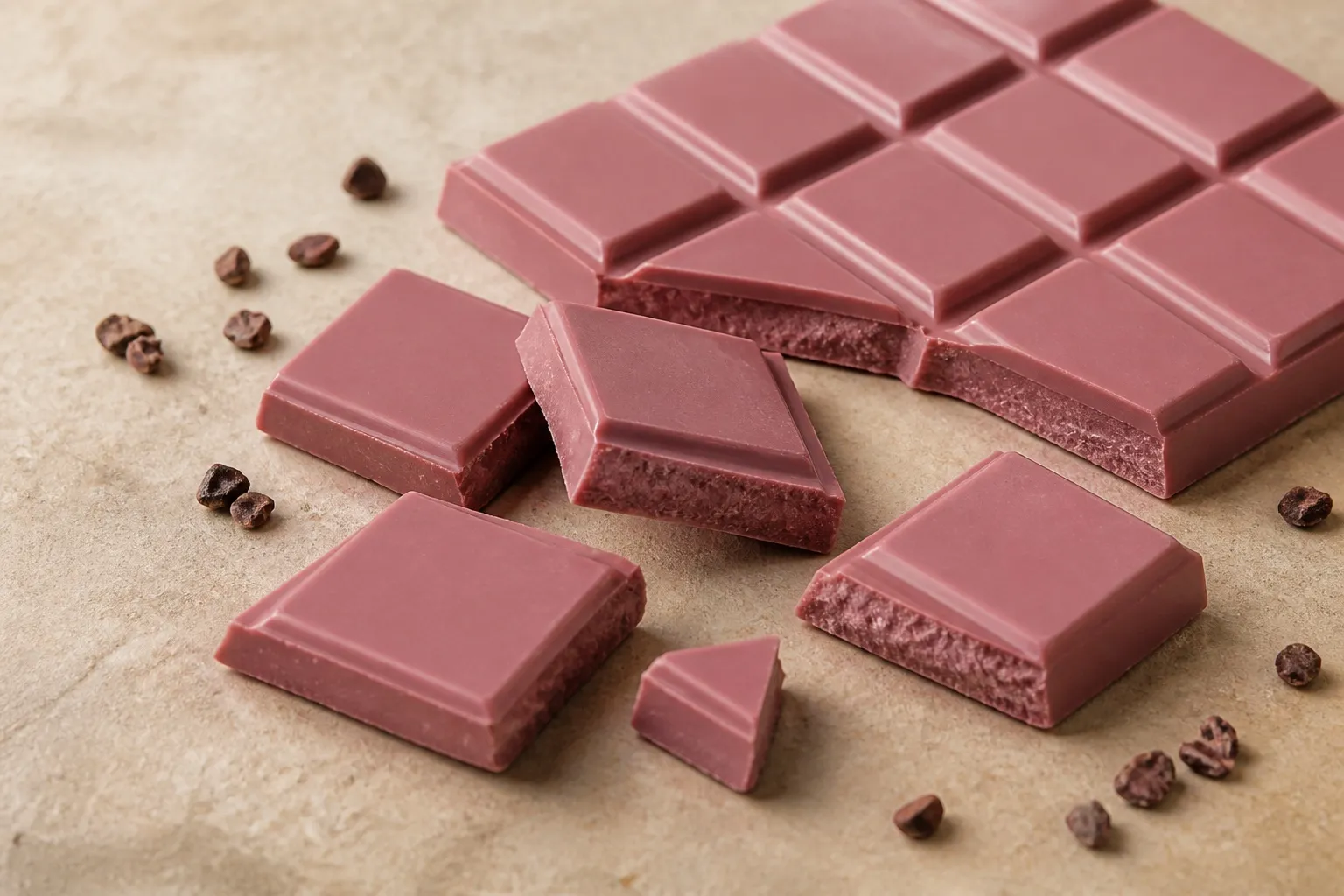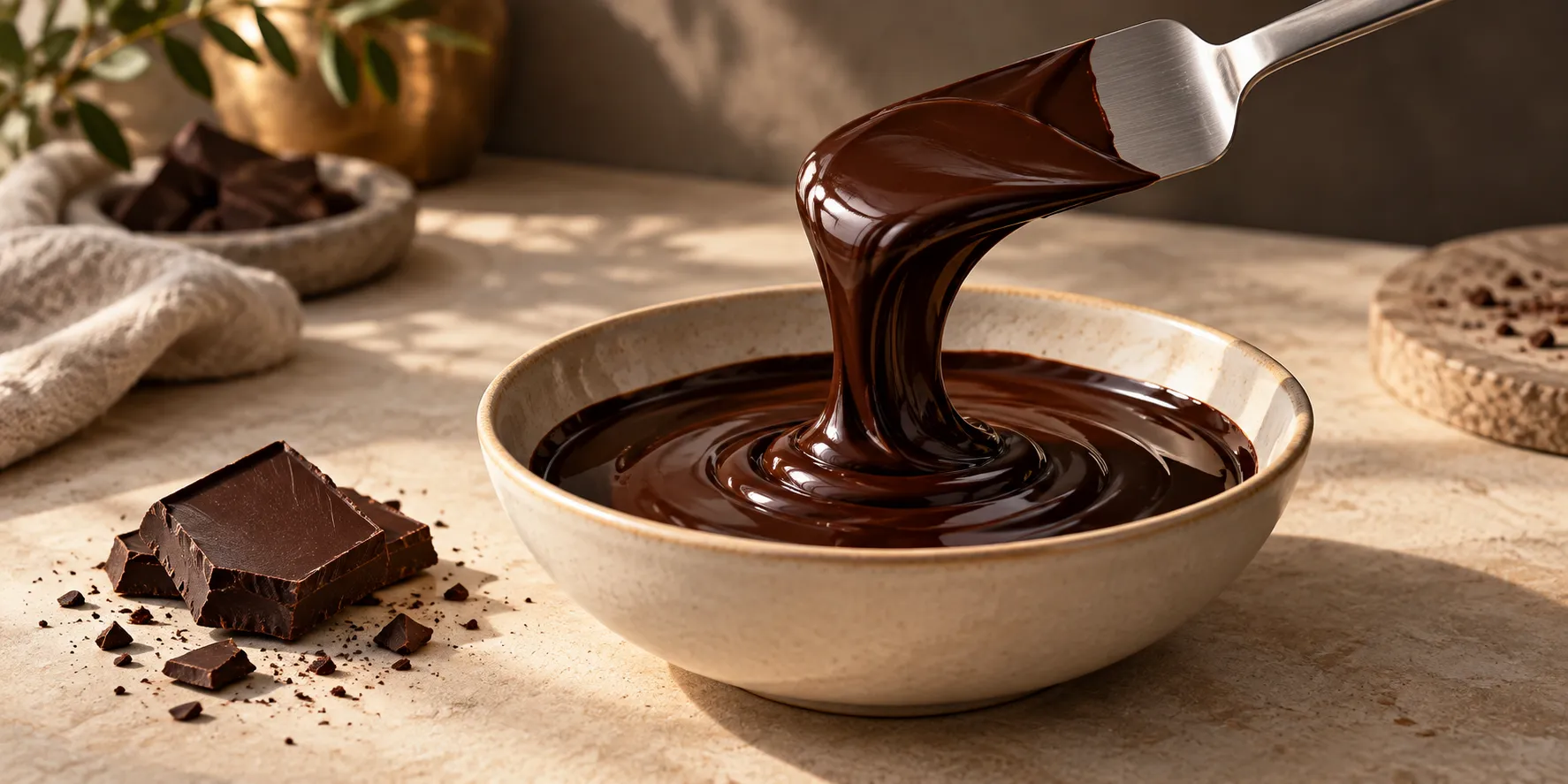
A chocolate coating has to start moving, spread over its target and stop at a useful thickness. Those are related jobs, but they are not the same job. This is why a manufacturer may use lecithin and PGPR together rather than treating them as interchangeable ways to make chocolate “thinner.”
For a reader comparing labels, the important point is simpler: PGPR identifies a functional ingredient, not a verdict on chocolate quality. It does not tell you the quality of the beans, the maker’s skill or the complete recipe.
What PGPR actually is
PGPR stands for polyglycerol polyricinoleate. It is made by esterifying polyglycerol with condensed castor-oil fatty acids. The EU identifies it as E476; its official additive specification describes a clear, highly viscous liquid and specifies that the castor oil used in production is free of ricin. Food-grade PGPR is a specified manufactured ingredient, not raw castor beans or a homemade castor-oil preparation.
Lecithin is a different material: a mixture containing phospholipids, commonly sourced from soy or sunflower. Cocoa butter is neither of these emulsifiers. It is the cacao-derived fat that forms much of chocolate’s continuous fat phase. For the lecithin-specific story and sourcing considerations, see soy lecithin in chocolate.
Two flow measurements, not one idea of “thick”
Molten chocolate suspends solid particles in liquid fat. Rheologists commonly describe its flow using two measures:
- Yield stress, also called yield value: the stress needed to initiate sustained flow.
- Plastic viscosity: the resistance during flow in a model such as the Casson model.
Lecithin is often useful for reducing plastic viscosity. It can also change yield stress, and excess additions can increase yield stress in some formulations. PGPR is especially effective at reducing yield stress; its effect on plastic viscosity is generally more limited and depends on the formulation.
A useful experimental example is Pombal and colleagues’ 2024 study, which tested a 48% cocoa industrial chocolate whose base formula already contained both emulsifiers. Further lecithin additions lowered plastic viscosity over part of the tested range while yield stress increased; PGPR additions reduced yield stress. The researchers changed a particular chocolate under controlled conditions. Their dose-response results are not a universal recipe for every chocolate.
A spoonful that looks thick does not identify one rheological cause. Low working temperature, moisture, fat content and particle-size distribution can all change what you see. Start with the chocolate-viscosity troubleshooting guide before deciding an emulsifier is the missing ingredient.
Lecithin, PGPR and cocoa butter side by side
Three different ways to change chocolate flow
The main effects overlap, but the ingredients are not interchangeable.
| Question | 01Lecithin | 02PGPR / E476 | 03Cocoa butter |
|---|---|---|---|
| What is it? | Phospholipid-containing emulsifier, commonly soy or sunflower | Polyglycerol ester of condensed castor-oil fatty acids | Cacao-derived fat, not an emulsifier |
| Main flow role | Often lowers plastic viscosity; also affects yield stress | Especially effective at lowering yield stress | Adds continuous fat phase and changes the solids-to-fat balance |
| Why combine them? | Helps tune resistance during flow | Helps tune the stress needed to start flow | Can change both flow measures and the final composition |
| What can go wrong? | More can increase yield stress in some formulas | Lower yield stress alone may not solve the actual process problem | More fat changes cocoa percentage, flavor balance and melt |
| What to check | Ingredient grade, source, supplier guidance and label requirements | Food-grade identity, permitted category and process target | Formula arithmetic and the intended finished texture |
Conceptual comparison based on experimental chocolate rheology. It is not a dose-conversion chart or a claim that one ingredient substitutes gram-for-gram for another.
jayarrchocolate.comCocoa butter can improve flow by increasing the liquid-fat fraction, but adding it changes the composition of the bar. An emulsifier may achieve a useful flow adjustment with a much smaller addition, yet that does not make it a fixed-ratio substitute for cocoa butter. See when to add cocoa butter and use the formulation guide to keep the percentages honest.
From a flow problem to a useful endpoint
The practical target is not “the lowest viscosity possible.” It is chocolate that works for the task: filling a mold, covering a center or producing the intended coating thickness without losing the desired finished texture.
Choose the flow target before changing the formula
A decision sequence, not a laboratory measurement from appearance alone.
- 01
Control the starting conditions
Use the appropriate working temperature for the chocolate and check for moisture exposure, coarse particles and formula errors.
Compare like with like. Temperature or handling changes can otherwise masquerade as an emulsifier effect. - 02
Separate starting from flowing
Yield stress concerns starting movement; plastic viscosity concerns resistance during flow.
PGPR is especially useful for the first measure. Lecithin often targets the second, while also influencing yield stress. - 03
Change one documented variable
If an emulsifier is appropriate, use a food-grade product and supplier guidance for the actual formula and market.
There is no universal lecithin-to-PGPR swap or cocoa-butter replacement ratio. - 04
Check the task endpoint
Compare the actual pour, mold filling or coating behavior under the same conditions, then assess the finished texture.
Record the formula and conditions. A desired flow result does not itself prove correct temper, regulatory compliance or shelf life.
For quantitative yield-stress or viscosity values, use a suitable measurement method. A spoon test is an observation, not a rheometer reading.
jayarrchocolate.comWhat US and EU sources say
Source check: September 17, 2026. These are separate regulatory contexts, not one worldwide PGPR allowance.
United States: intended use and the product standard both matter
The FDA response to GRAS Notice 1105, signed June 14, 2023, describes Unilever’s intended PGPR use at up to 0.5% in chocolate and chocolate-type products based on vegetable fats other than cocoa butter. FDA states it has no questions at that time about the notifier’s GRAS conclusion under the intended conditions of use.
The same letter expressly says this is not an affirmation under 21 CFR 170.35, and that an ingredient may be used in a standardized food only if the applicable standard of identity permits it. It also does not recommend “PGPR” as the common or usual labeling name. A GRAS response is therefore not a blanket permission for any formula or label.
European Union: E476 has category-specific entries
The European Commission’s current E476 conditions-of-use entry lists 5,000 mg/kg, or 5 g/kg (0.5%), for category 5.1: cocoa and chocolate products covered by Directive 2000/36/EC. Its entries for categories 5.2 and 5.4 also specify 5,000 mg/kg but restrict those uses to cocoa-based confectionery. Other categories have different limits and conditions.
That is a category maximum, not the amount a recipe necessarily needs. The EU specification amendment, Regulation 2023/1329, separately defines the additive’s identity and purity requirements. Distinguish the identity of the ingredient from whether a particular food category permits its use.
For the wider differences in chocolate names and composition, continue to US, EU and Codex chocolate rules.
Reading a label without overreading it
Lecithin and PGPR together can reflect complementary flow-control choices. The ingredient list does not reveal their exact ratio or establish whether the manufacturer prioritized cost, equipment performance, coating behavior or several goals at once.
Two-ingredient chocolate shows that added emulsifiers are not mandatory for every style of chocolate. Other makers choose lecithin, added cocoa butter or both for their intended process and texture. These choices are useful context, but none independently ranks the quality of a bar.
PGPR is also not a cocoa-butter equivalent, replacer or substitute in the confectionery-fat sense. Those terms concern different fats and their compatibility with cocoa butter; see CBE, CBR and CBS explained.
Frequently Asked Questions
- Is PGPR the same as lecithin?
- No. PGPR is polyglycerol polyricinoleate; lecithin is a phospholipid-containing material commonly obtained from soy or sunflower. Both influence chocolate flow, but lecithin is often used to lower plastic viscosity while PGPR is particularly useful for lowering yield stress. Their effects overlap and depend on the formula.
- Does PGPR replace cocoa butter?
- Not gram-for-gram. It can help achieve a flow target with less added cocoa butter in some formulations, but cocoa butter also contributes fat, composition and finished texture. A PGPR addition is not a universal replacement ratio.
- Why use lecithin and PGPR together?
- They allow a manufacturer to tune different aspects of flow: resistance during flow and the stress needed to start it. The useful balance depends on the chocolate and its intended task, not a universal ratio.
- How much PGPR is allowed in chocolate?
- The jurisdiction and food category matter. The EU Commission entry lists 5,000 mg/kg for category 5.1 cocoa and chocolate products covered by Directive 2000/36/EC. FDA GRN 1105 describes the notifier's intended use up to 0.5% with explicit food-standard and other caveats. Neither statement is a universal recipe dose; the primary sources are linked above.
- Does an E476 label mean the chocolate is poor quality?
- No. E476 identifies PGPR, a functional food additive. Its presence alone does not establish bean quality, production scale, the maker's skill or how the chocolate will taste.
- Should I add PGPR to a thick home batch?
- First check working temperature, moisture exposure, particle size and formula balance. Thick appearance alone does not identify a yield-stress problem. If you choose an emulsifier, use a food-grade ingredient and supplier guidance for the actual formula rather than copying a universal dose.