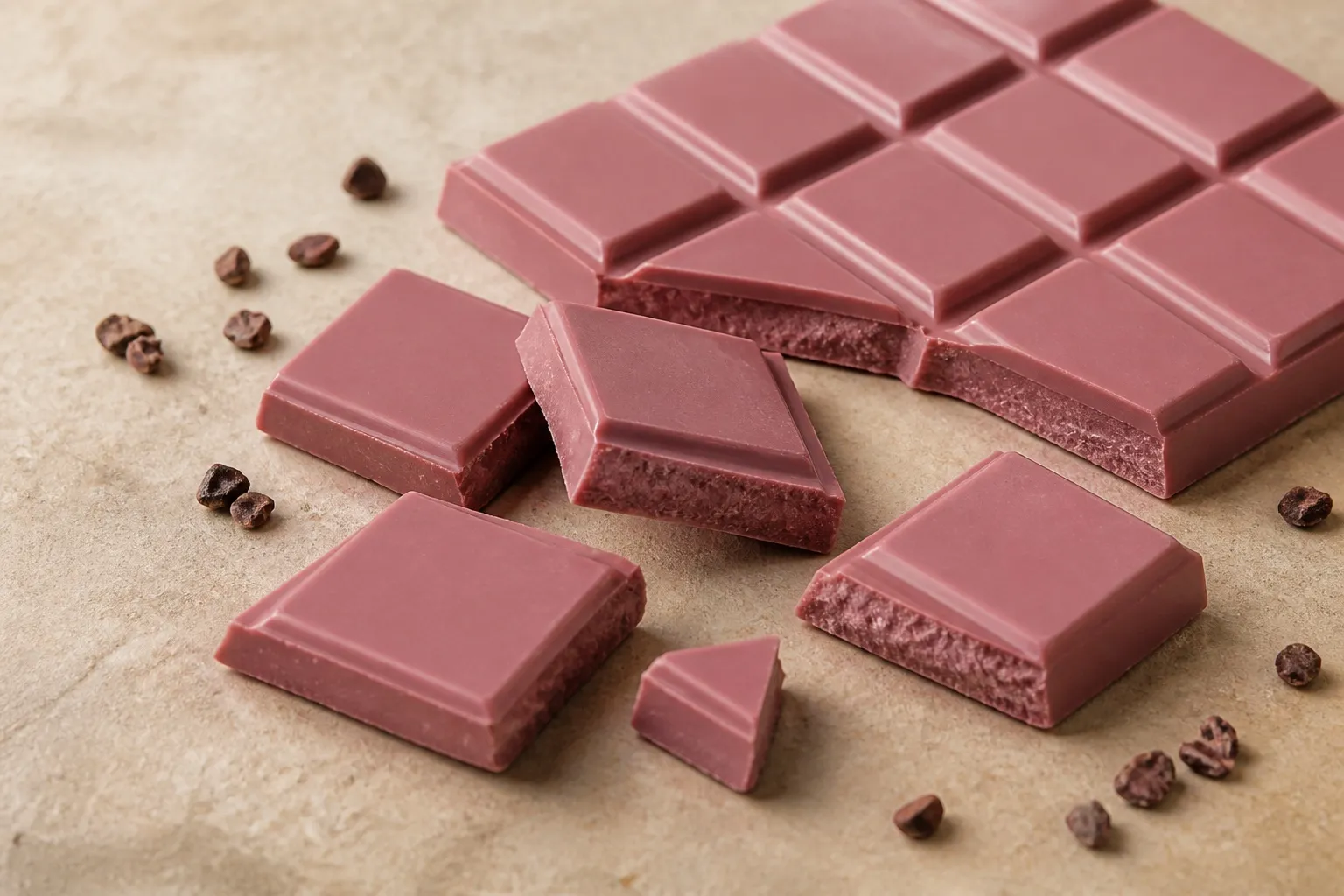
In September 2017, Barry Callebaut — the world’s largest chocolate manufacturer — unveiled ruby chocolate at a press event in Shanghai. They called it the fourth type of chocolate, joining dark, milk, and white in the canonical lineup. The chocolate is pink. It tastes fruity and tart. It contains no added colorants or fruit flavorings. And it has been controversial from the moment it appeared.
Ruby chocolate is now available worldwide under the Callebaut RB1 brand, used by pastry chefs and chocolatiers, and sold in consumer bars by KitKat, Magnum, and other major brands. But the question that has followed it since 2017 remains: is this genuinely a new category, or is it a processing technique dressed up in marketing language?
How Ruby Chocolate Is Made
Barry Callebaut states that ruby chocolate is made from “ruby cocoa beans” using a proprietary process that unlocks the color and flavor naturally present in the beans. The company has never fully disclosed the processing method, but patent filings tell a more detailed story.
Barry Callebaut first filed the patent application in 2009 (claiming a 2008 priority date) for a “cocoa-derived material” made from unfermented cocoa beans — or beans fermented for no more than three days — that are treated with an acid such as citric acid. The application published in 2010, and it describes how controlled acidification of lightly fermented or unfermented beans produces a red-pink color and a fruity, tangy flavor profile. The European patent was granted in June 2012; US patents in the same family followed in 2013 and 2015.
The key processing steps, based on patent disclosures and industry analysis:
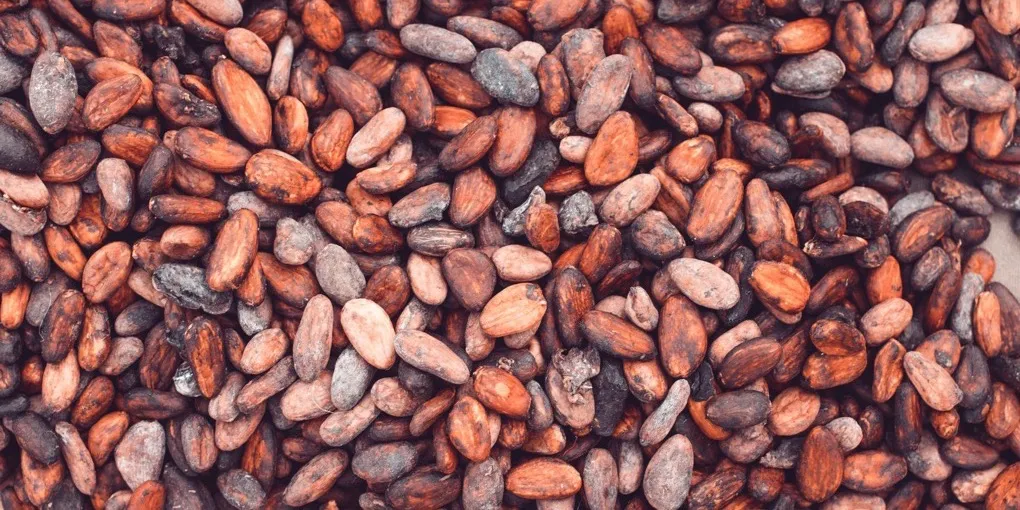
Bean selection. The beans used are not a distinct botanical variety. They come from standard cacao-growing countries including Brazil, Ecuador, and Ivory Coast. What matters is selecting beans with naturally high levels of anthocyanin precursors — the same pigments that give some unfermented cacao beans their purple-red color.
Minimal or no fermentation. Traditional chocolate requires 5 to 7 days of fermentation to develop flavor precursors. Ruby chocolate processing deliberately limits or skips fermentation to preserve the pink anthocyanin pigments that would otherwise be oxidized and degraded during the normal fermentation process. This is a fundamental departure from how all other chocolate is made.
Acid treatment. Citric acid is applied to the beans to stabilize the pink color and develop the characteristic tart flavor. This is essentially the opposite of Dutch processing, which uses alkali to raise pH and darken color. Ruby processing uses acid to lower pH and preserve the pink.
Optional defatting. The patent also describes embodiments where the cocoa material is defatted and recombined — though it covers chocolate made without that step too, and Barry Callebaut has never disclosed which route commercial RB1 production actually takes.
What Ruby Chocolate Tastes Like
Ruby chocolate has a distinctive berry-like fruitiness with a pronounced sour or tart finish. Barry Callebaut describes it as “a tango of berry fruitiness and luscious smoothness.” In practice, the flavor is closer to a mildly acidic berry yogurt than to anything most people associate with chocolate.
The Callebaut RB1 formulation contains:
| Component | Share |
|---|---|
| Sugar | 35.5% |
| Cocoa butter | 29.5% |
| Skimmed milk powder | 16.5% |
| Whole milk powder | 12.5% |
| Cocoa mass | 4.5% |
| Soy lecithin, citric acid, natural vanilla | under 1% each |
Callebaut’s declared “minimum dry cocoa solids” figure is 47.3% on some RB1 product listings and 33.6% on others — market-specific declarations tied to different product codes and local legal classifications, not to package size. Milk solids are declared at 26.3% minimum. Either way, the composition sits closer to milk chocolate than to dark, with significantly more dairy than cocoa mass.
The low cocoa mass content (4.5%) is notable. Most of what you taste in ruby chocolate comes from cocoa butter, sugar, and milk — with the distinctive pink color and tartness contributed by the small fraction of specially processed cocoa mass and the added citric acid.
How Ruby Compares to the Other Three Types
| Dark | Milk | White | Ruby | |
|---|---|---|---|---|
| Min. cocoa solids (EU) | 35% | 25% | none required (≥20% cocoa butter) | ~33-47%* |
| Cocoa butter | min 18% | varies | min 20% | ~29.5% |
| Milk solids | none required | min 14% | min 14% | ~26% |
| Fermentation | full (5-7 days) | full (5-7 days) | full (5-7 days) | minimal (0-3 days) |
| Key flavor | cocoa, roast, origin | creamy, caramel | butter, vanilla | tart, berry-like |
*Ruby has no universal legal standard; figures are the RB1 formulation.
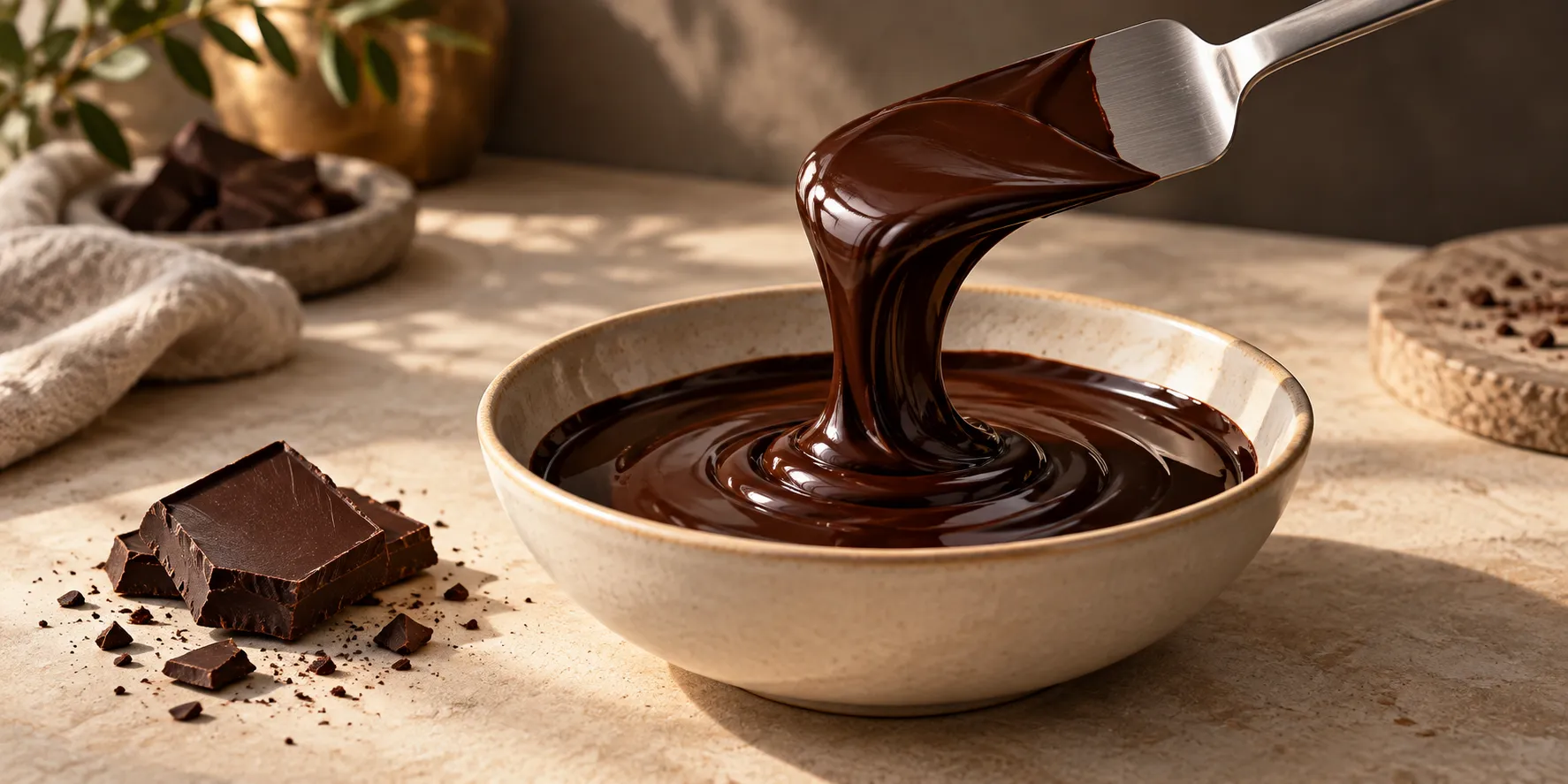
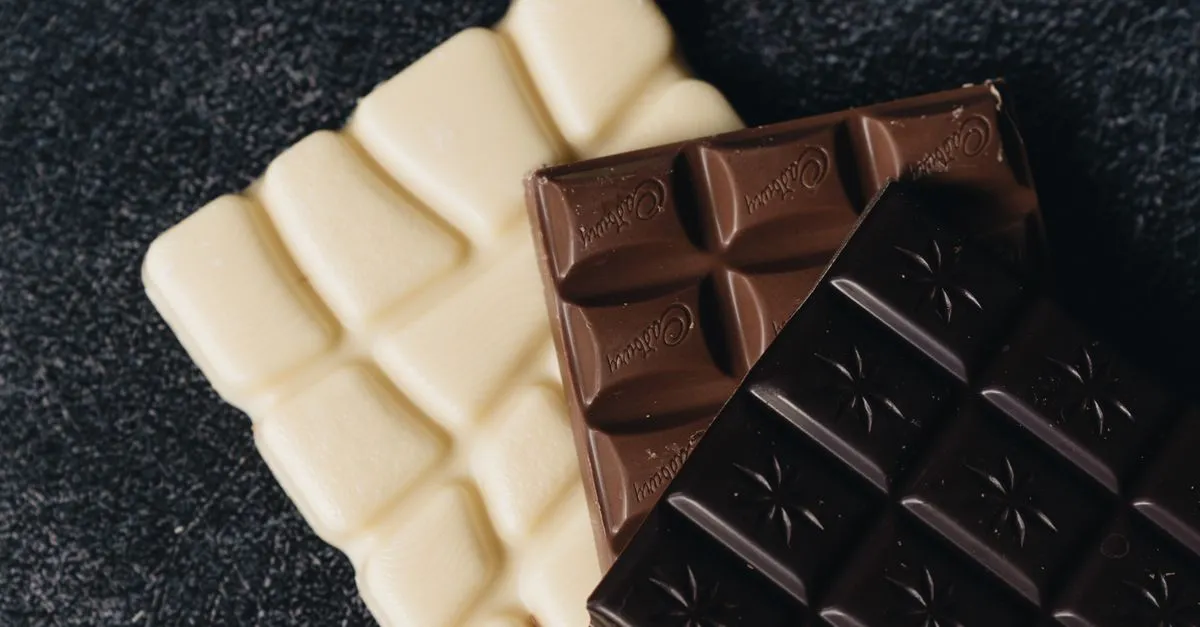
Dark chocolate is the most cacao-forward format. It requires a minimum of 35% cocoa solids under EU law (US rules have no generic “dark” identity — FDA’s semisweet and bittersweet categories require 35% chocolate liquor, while sweet chocolate starts at 15%). The flavor comes primarily from Maillard reaction products developed during roasting and the volatile compounds created during fermentation. Origin character — the berry notes of Madagascar, the floral signature of Ecuador, the smoke of Papua New Guinea — expresses most clearly in dark chocolate.
Milk chocolate adds dairy solids and reduces the cacao percentage. EU regulations require minimum 25% total cocoa solids and 14% milk solids. The milk fat softens the fat phase and the dairy flavors mute the cacao character. Tempering temperatures run lower (29 to 30 degrees Celsius working temperature versus 31 to 32 for dark).
White chocolate contains no cocoa solids at all — only cocoa butter (minimum 20%), milk solids (minimum 14%), and sugar. Its flavor comes entirely from cocoa butter, dairy, and vanilla. Many chocolate purists do not consider it real chocolate because it lacks the fermented, roasted cocoa solids that define the category.
Ruby chocolate contains cocoa mass, cocoa butter, milk solids, and sugar — but the cocoa mass is processed in a fundamentally different way than in any of the other three types. The minimal fermentation and acid treatment produce a product that is chemically distinct from conventionally processed chocolate.
The Controversy
The debate around ruby chocolate centers on several connected questions.
Is it really a “fourth type”? Dark, milk, and white chocolate are defined by their composition — specifically, the ratios of cocoa solids, cocoa butter, milk solids, and sugar. These definitions are codified in law (EU Directive 2000/36/EC, FDA 21 CFR Part 163). Ruby chocolate is defined primarily by its processing method, not by a unique compositional category. Compositionally, it overlaps significantly with milk chocolate.
Is the color natural? Barry Callebaut insists that no colorants are added, and this appears to be technically accurate. The pink color comes from anthocyanin precursors in the beans, preserved through the acid treatment and minimal fermentation. However, critics argue that the specific processing steps required to achieve and maintain that color — acid treatment, controlled fermentation avoidance, possible defatting — make “natural” a stretch. The color is not an inherent property of the bean that survives normal chocolate processing; it exists because the processing was designed to preserve it.
Was it actually new? Industry veteran Angus Kennedy disputed the “fourth type” framing, noting that Peruvian chocolate makers had been producing pink-hued chocolate for years using beans with naturally high anthocyanin content. Unfermented or lightly fermented cacao beans are often purple or reddish — this is well known in the industry. What Barry Callebaut accomplished was systematizing the process and marketing it at global scale.
Does the FDA recognize it? In 2019, the FDA issued a temporary marketing permit allowing Barry Callebaut to sell ruby chocolate in the US, defining it as a food prepared from cacao fat, cacao ingredients, citric acid, optional dairy ingredients, and optional sweeteners. The FDA extended the permit in 2021, and it remains in effect until a final identity rule is issued. It acknowledges ruby chocolate as a distinct product without formally adding it to the standard of identity for chocolate alongside dark, milk, and white.
The Craft Chocolate Perspective
Bean-to-bar makers have largely stayed out of ruby chocolate — partly because they cannot get in, and partly, for many, because they would not want to. The reasons are structural.
The craft movement is built on fermentation as the foundation of flavor. The three-phase microbial succession — yeast, lactic acid bacteria, acetic acid bacteria — creates the amino acid and sugar precursors that drive Maillard reactions during roasting. These reactions produce the pyrazines, aldehydes, and furans that define what chocolate tastes like. Skip fermentation and you lose the chemical foundation for chocolate flavor.
Ruby chocolate trades fermentation-derived complexity for color and tartness. For makers who spend weeks dialing in fermentation protocols and roast profiles to express origin character, this represents a fundamentally different set of values. It is not that ruby chocolate is bad — it is that it is pursuing a different outcome.
There is also the sourcing question. Ruby chocolate requires specific bean selection and proprietary processing. The beans are not available to independent makers through normal specialty cacao channels. The supply chain begins and ends with Barry Callebaut, which is antithetical to the direct-trade, origin-transparent model that defines craft chocolate.
Working with Ruby Chocolate
For pastry chefs and chocolatiers who use ruby chocolate as a professional ingredient, there are practical considerations.
Tempering. Ruby chocolate tempers at slightly lower temperatures than milk chocolate, closer to white chocolate parameters. Callebaut’s guidance for RB1: melt out around 45 degrees Celsius, cool to about 27, and work at 28.5 to 29.5. The cocoa butter crystal behavior is similar to other chocolates — you are still targeting Form V crystals — but the acid content and milk solids affect the temperature window.
Light sensitivity. The pink color fades when exposed to light, heat, or high humidity. Finished products should be stored in opaque packaging, below 18 degrees Celsius.
Flavor pairing. The tartness works well with citrus, berries, passion fruit, and lychee. It pairs poorly with strong chocolate flavors — combining ruby with dark chocolate tends to create a muddy, conflicting profile rather than a harmonious one.
Shelf life. The color degrades faster than the flavor or texture. A bar that has lost its pink hue may still taste fine but looks less appealing. This makes ruby chocolate more perishable from a visual standpoint than the other three types.
Should You Care About Ruby Chocolate?
Ruby chocolate is a genuine innovation in chocolate processing. Barry Callebaut solved a real technical problem — how to preserve anthocyanin color and fruity acidity through chocolate manufacturing — and created a commercially viable product with a distinctive sensory profile.
Whether you consider it the “fourth type of chocolate” depends on what you think defines a type. If you define types by composition and legal standards, ruby is a processing variant of milk chocolate with a novel color. If you define types by consumer experience and sensory profile, ruby tastes and looks like nothing else on the market, which is a reasonable argument for a new category.
For consumers, the important thing to understand is what you are tasting. Ruby chocolate’s fruitiness comes from acid treatment and minimal fermentation, not from origin terroir or masterful roasting. It is a different kind of pleasure — more confection than single-origin expression. Enjoy it for what it is, and judge it on its own terms.
Frequently Asked Questions
- Is ruby chocolate dyed pink?
- No colorants are added. The pink color comes from anthocyanin pigments naturally present in cacao beans. These pigments are normally destroyed during standard fermentation and roasting, but Barry Callebaut's process -- which uses minimal fermentation and citric acid treatment -- preserves them. The color is natural in origin but requires specific processing to maintain, which is why conventional chocolate is never pink.
- Does ruby chocolate contain real cocoa?
- Yes. The Callebaut RB1 formula contains 47.3% total cocoa solids (in the professional format), including 4.5% cocoa mass and 29.5% cocoa butter. However, the cocoa mass is processed very differently from dark or milk chocolate -- it undergoes minimal fermentation and acid treatment rather than the traditional 5-7 day fermentation that develops conventional chocolate flavor.
- Why can't I find ruby chocolate from craft bean-to-bar makers?
- The ruby chocolate supply chain is controlled by Barry Callebaut through proprietary processing and patents. The specific bean selection and acid-treatment method are not available through normal specialty cacao suppliers. Beyond the supply barrier, many craft makers also object on principle: the process skips most of fermentation, the foundational step that creates the flavor precursors their craft is built on.
- Does ruby chocolate taste like strawberry or raspberry?
- The flavor is often described as berry-like, but it is not a specific fruit flavor. It is better characterized as a mild tartness with fruity acidity -- closer to berry yogurt than to actual berries. The sourness comes from citric acid used in processing, not from fruit compounds. There are no fruit flavorings in the formula.
- Will ruby chocolate lose its pink color over time?
- Yes. The anthocyanin pigments responsible for the pink color are sensitive to light, heat, and humidity. Exposure to any of these causes the color to fade. Properly stored ruby chocolate (opaque packaging, below 18 degrees Celsius, stable humidity) maintains its color for months, but it degrades faster visually than dark, milk, or white chocolate under the same conditions.