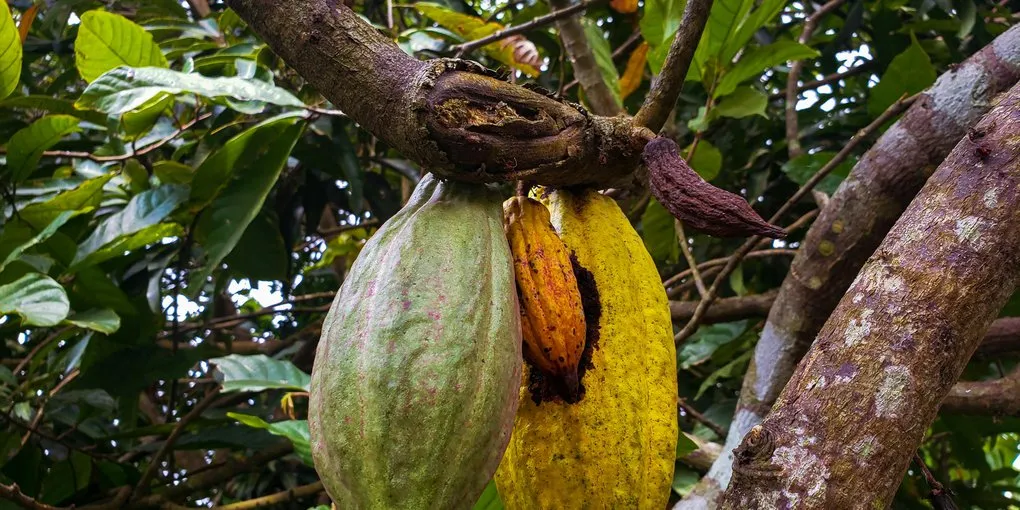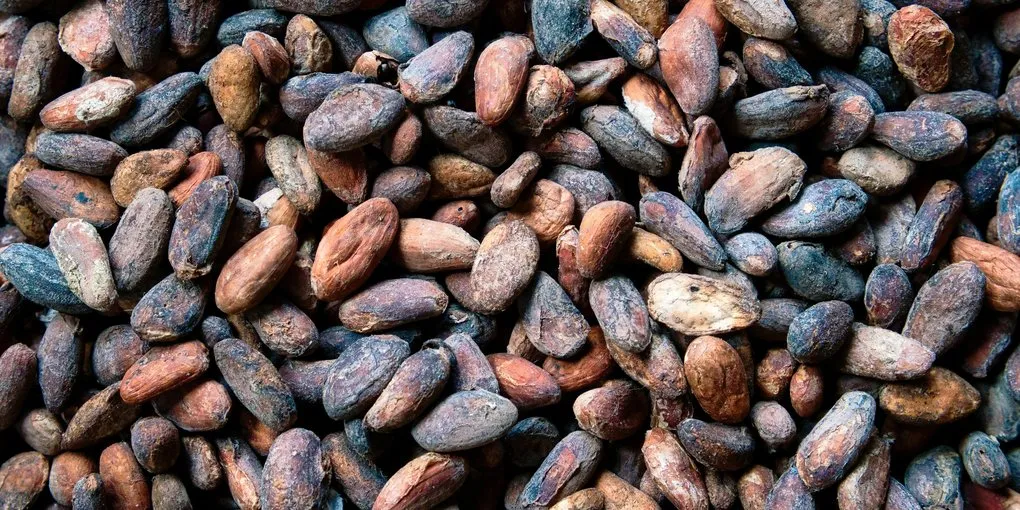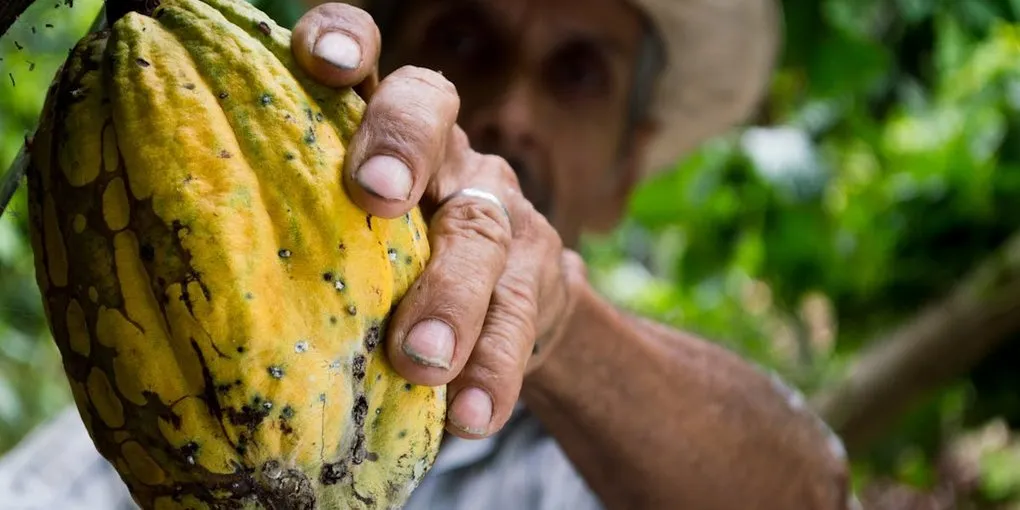
Ecuador’s Nacional heritage has an important place in craft chocolate. Floral aromas can be part of its appeal, alongside fruit, nuts, caramel, and deep chocolate flavors. To understand a particular bag of beans or finished bar, separate three questions: where the cacao grew, what planting material it came from, and how it was processed.
The terms Nacional, Arriba, and Ecuador overlap in the trade, but they do not supply interchangeable guarantees of genetic purity, a particular flavor, or the quality of every lot.
What Arriba Means
The Ecuadorian intellectual-property authority’s history of the name connects arriba with cacao coming from upriver along the Daule. This is a historical geographic association, rather than a reference to all cacao growing in the interior highlands.
The same authority records recognition of Cacao Arriba as Ecuador’s first denomination of origin on March 24, 2008. Arriba is therefore more than a free-floating tasting adjective. The presence of floral notes alone does not establish that a product qualifies to use an origin designation.
In flavor descriptions, Nacional-associated floral character may evoke jasmine, violet, or orange blossom. Those comparisons describe aroma; the flowers are not ingredients. Nor does a floral impression distinguish Ecuador from every other cacao origin. For a useful comparison with Madagascar, choose named bars and comparable recipes, then taste their differences without assuming every Ecuadorian bar is mellow and every Madagascan bar is sharply acidic.
Nacional Genetics and Ancestry
The Motamayor et al. 2008 study proposed ten major genetic clusters, including Nacional. It began with 1,241 accessions and 106 microsatellite markers; after exclusions, the main analysis retained 952 accessions and 96 markers.
Its overall Fst of 0.46 describes differentiation across the studied populations. It is not a Nacional-specific statistic, a measure of flavor quality, or proof that all cacao belongs to unmixed categories. The authors explicitly discuss individuals with mixed ancestry. The study did not conduct a sensory comparison assigning a flavor profile to each cluster.
Nacional’s association with Ecuador’s Pacific-side growing regions also does not establish that it evolved there in isolation. A 2012 genetic study by Loor Solorzano and colleagues compared putative ancestral Nacional material with wild and cultivated accessions. It found the closest relationships with material from southern Ecuadorian Amazonia, in Zamora Chinchipe, and proposed an Amazonian origin followed by movement to the coast. This is a supported migration hypothesis, not a completely documented route for every historical planting.
Modern Nacional-type cacao can include ancestry from introduced material. If a seller claims an unusually pure or specifically identified genotype, ask what supports that claim. A familiar trade name is useful context, but it is not a DNA result for the beans in your shipment.
CCN-51: A Different Cultivar, Not a Simple Quality Verdict
CCN stands for Colección Castro Naranjal. Homero Castro developed this conventionally bred cultivar in Ecuador in the early 1960s; it was not genetically engineered.
The 2014 characterization by Boza and colleagues inferred predominantly Iquitos, Criollo, and Amelonado ancestry, with about 1.1% Nacional. That differs substantially from calling it a simple Trinitario–Nacional hybrid. The study also documented agronomic differences from its Nacional comparators. Productivity and disease-related traits help explain farmers’ interest, but yields remain dependent on site and management.
For a buyer seeking a particular Nacional flavor, cultivar identity and keeping lots separate matter. The ICCO’s 2023 panel and subsequent review recognized work to improve CCN-51 post-harvest processing while requesting clearer evidence about how good-quality lots are segregated and compared with Arriba cacao. That is a more useful sourcing question than assuming that all CCN-51 is poor and all Nacional is excellent.
Ask for fermentation and drying information as well as genetics. Industry fermentation guidance identifies variety, pulp-to-bean ratio, aeration, starter cultures, and local conditions as relevant variables. Neither a universal seven-day CCN-51 ferment nor a universal two-to-three-day Nacional ferment can replace assessment of the actual process.
Growing Areas and Processing Locations
Guayas and Los Ríos
These coastal growing areas are central to Ecuador’s cacao history. A province name does not prescribe a nutty, floral, or caramel flavor, however. Ask which farm, association, and harvest the beans represent, and where they were fermented.
Camino Verde is especially important to identify correctly. Dandelion’s first-party sourcing account describes a former estate near Balao and the move in 2016 to a centralized fermentary in Durán, near Guayaquil, in Guayas. The business then bought wet beans from farms and associations across Ecuador. It is not an Esmeraldas estate whose name identifies a single growing site.
Dandelion’s current Camino Verde 100% bar page still describes that multi-farm sourcing model. For its 2024 harvest, batch 1, the maker lists classic dark chocolate and roasted-peanut notes, with a medium roast and extended conching used to mellow the beans’ tartness. That is one documented approach to one harvest, not a national process specification.
Esmeraldas
Esmeraldas is a separate province in Ecuador’s northwest. Costa Esmeraldas is a distinct producer: Dandelion identifies it with the Salazar family near Esmeraldas. Do not conflate the names Costa Esmeraldas and Camino Verde.
Dandelion’s 2026 collection listing describes its Costa Esmeraldas 70%, 2023 harvest bar with s’more, toasted-almond, and blueberry notes. That example alone shows why even a well-known Ecuadorian source should not be reduced to a floral stereotype.
Beyond a Coastal Ranking
Ecuador’s cacao includes other coastal and Amazonian growing areas. Location can affect growing and processing conditions, but there is no reliable rule here that lowland cacao is necessarily more fermented or that higher-altitude cacao is inherently more complex. A fermentary may also handle beans grown far from its own address.
Fine-Flavor Statistics: Keep the Denominator Clear
The ICCO classification adopted in April 2024, available when checked on September 26, 2026, lists 75% of Ecuador’s cocoa-bean exports as fine flavor. It does not say that Ecuador supplies 75% of the world’s fine-flavor cacao, and it is not a certification of every Ecuadorian shipment.
Ecuador is among the major fine-flavor exporters. A claim about its precise share of the world market needs a defined year and comparable trade data. Production, bean exports, planted area, and the volume purchased by craft makers are different measures; percentages from one should not be substituted for another.
The same care applies to estimates of the land planted with CCN-51. Ask which survey and year a percentage represents instead of treating a historical estimate as a current national inventory.
Roasting and Formulating Ecuadorian Beans
Start with guidance for the specific lot, then compare small batches using consistent equipment and records. Our roasting guide explains the process stages. Record batch size, time, and whether temperatures are oven settings, bean-surface measurements, or probe readings. A country name cannot establish an end-of-roast temperature or finishing time.
Flavor also depends on the finished recipe. The two-ingredient 70% format is a useful starting comparison, but 75% does not guarantee stronger florals and 80% does not create a universal chemical-note threshold. Dandelion’s 100% Camino Verde bar is a concrete example of a maker choosing a much higher percentage for this source; its existence is not a promise that every buyer will prefer it.
Added cocoa butter changes composition and can help fluidity. Rheology research demonstrates interacting effects of fat, particle-size distribution, and lecithin. It does not justify a national three-to-five-percent butter dose, a guaranteed slower melt, or a promise that floral aromas will linger longer. Include added cocoa butter when calculating the total cocoa percentage.
Vanilla is a recipe choice. Compare a plain sample with a small flavored trial if that fits your goal; there is no categorical Ecuador-versus-Madagascar rule about whether vanilla complements the beans.
Texture, Conching, and Off-Flavors
A gritty bar is a reason to examine particle size, refining, and formulation. Country of origin cannot diagnose a proposed interaction between sugar crystals and stearic acid. Research on chocolate grittiness also shows that people differ in their ability to detect particles, so one nominal size threshold is not a complete texture specification.
During refining and conching, check both smoothness and flavor. Time alone does not establish the endpoint. John Nanci’s home-scale conching discussion describes how temperature, beans, equipment, and taste affect the result; it does not prescribe an Ecuador-wide 24–30-hour schedule.
Nor does a loose melanger cover lock in floral aromas. Nanci’s cover guidance explains continuing volatile escape, retained heat, and the risk of condensation dripping back into the chocolate. Follow the equipment instructions and observe the batch instead of relying on a fixed twelve-hour lid switch.
If a sample tastes strongly soapy, chemical, or otherwise objectionable, compare the beans, process, storage, and recipe before assigning a cause. Those descriptions do not identify one molecule or prove that the cocoa percentage is the problem. Diluting a defect with sugar is not the same as understanding it.
Ecuador Cacao: Origin Profile
Flavor
Nacional-associated floral character; fruit, nuts, caramel, and chocolate notes vary by lot and maker.
Nacional
A major genetic cluster; research points to Amazonian ancestry followed by movement to the coast.
Fine-Flavor Exports
ICCO April 2024: 75% of Ecuador's cocoa-bean exports, not 75% of world supply.
Locations
Camino Verde: Durán, Guayas. Costa Esmeraldas: a separate producer in Esmeraldas.
Roast
Develop a profile for the particular lot, batch size, and roaster.
Percentage
Choose by tasting the recipe; no universal 70–75% optimum or 80% defect threshold.
Conching
Track texture, flavor, and temperature; no fixed national time or cover schedule.
CCN-51
A conventionally bred cultivar with complex ancestry. Verify identity, processing, and lot quality.
Frequently Asked Questions
- What does Arriba mean in chocolate?
- The name is historically associated with cacao coming from upriver along the Daule. It is linked with Ecuadorian Nacional cacao and floral character, but it is also a denomination of origin recognized in Ecuador in 2008. Floral aroma alone does not establish entitlement to that designation.
- What is CCN-51 and why does it matter?
- It is a productive conventionally bred cultivar developed by Homero Castro. A 2014 genetic study found mainly Iquitos, Criollo, and Amelonado ancestry, with only a small Nacional contribution. It differs from traditional Nacional, but buyers should assess identity, fermentation, drying, and actual lot quality rather than rely on a blanket quality ranking.
- How much Ecuadorian cacao is classified as fine flavor?
- The ICCO's April 2024 classification lists 75% of Ecuador's cocoa-bean exports as fine flavor. This is a percentage of the country's exports, not Ecuador's share of global fine-flavor supply or a certification of every bag.
- What does Ecuadorian chocolate taste like?
- Some Nacional-associated chocolates show floral character, while others emphasize fruit, nuts, caramel, or chocolate. Named examples differ: Dandelion describes its 2024 Camino Verde 100% bar with dark-chocolate and roasted-peanut notes. Taste the particular bar rather than infer all its flavors from the country.
- What is the best cacao percentage for Ecuadorian beans?
- There is no universal best percentage. A 70% recipe is useful for comparison, but higher or lower percentages can suit particular beans and preferences. An 80% cacao level does not by itself produce chemical or perfumed defects.
- How should I roast Ecuadorian cacao beans?
- Use lot-specific guidance and controlled comparisons on your equipment. Record batch size, time, and the temperature measurement location. Ecuadorian origin alone does not specify an end temperature, finishing time, or validated safety process.
- What is Nacional cacao?
- Nacional is a traditional cacao associated with Ecuador and one of the ten major genetic clusters proposed in 2008. A later genetic study linked its likely ancestry to southern Ecuadorian Amazonia. Its coastal cultivation history should not be confused with a proven Pacific evolutionary origin.