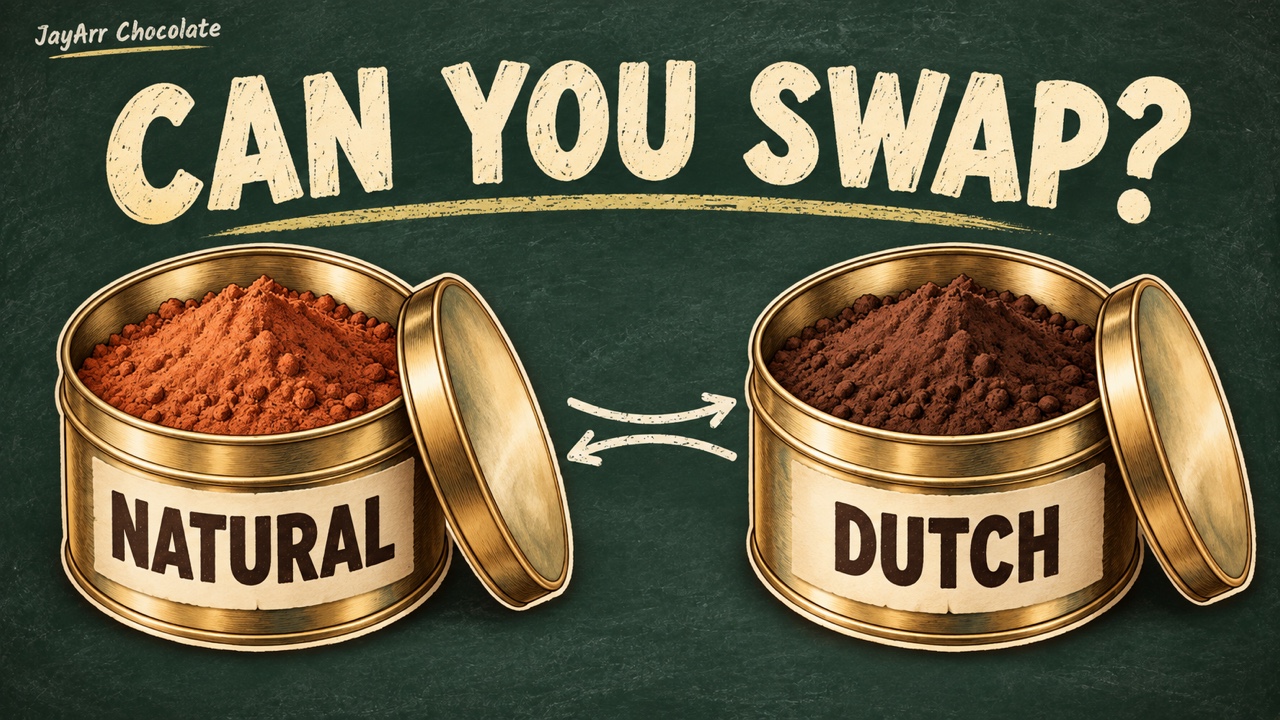
Two cocoa powders can look similar in the pantry and behave differently in a cake. The useful distinction is whether the cocoa was alkalized, followed by how the recipe uses it.
Natural cocoa often appears alongside baking soda, while Dutch-process cocoa often appears in baking-powder recipes. Those are common patterns, not compulsory pairings. A Dutch-cocoa cake can use baking soda successfully when its recipe supplies acid elsewhere.
What Alkalizing Actually Does
Dutch processing treats cocoa with a food-grade alkali to reduce acidity and change its color, flavor, and other properties.
Treatment can happen at different stages, including the nib, cocoa mass, press-cake, or powder stage. Potassium carbonate is one commonly used alkali, but it is not the only option. Conditions depend on the material and intended result; there is no single temperature, duration, or alkali dose that describes every commercial process. A 2024 experimental study by Sahin and colleagues illustrates how changing treatment conditions changes the resulting powder.
Natural cocoa skips alkalization. It still undergoes processing: cocoa powder is produced by removing part of the fat from ground cacao and milling the remaining material. Our farm-to-bar explanation covers the broader sequence. “Natural” does not mean untouched, and it does not establish whether a particular product was roasted.
Natural cocoa commonly measures around pH 5–6. Dutch processing raises pH, but lightly treated cocoa can remain mildly acidic; stronger treatment can produce alkaline powders. Callebaut’s manufacturer guidance describes cocoa powders extending to about pH 8.4. These are approximate product ranges, not a baking formula.
Dutch Process vs Natural Cocoa
Useful tendencies, with recipe-specific exceptions
| Property | 01Natural Cocoa | 02Dutch Process Cocoa |
|---|---|---|
| Processing | No alkalization step | Treated with a food-grade alkali |
| Acidity | Usually acidic; often pH 5–6 | Higher pH; varies with treatment |
| Color | Often reddish-brown; dark versions exist | Often darker; shade varies |
| Flavor | Often tangier or brighter | Often less acidic; bitterness varies |
| Baking | Can supply acid for baking soda | Other recipe acids may support soda |
| In liquids | Forms a suspension; can clump | Forms a suspension; mixing varies |
| Flavanols | Often higher; amount varies | Usually reduced by alkalization |
Use the cocoa named in the tested recipe. Baking powder supplies its own acid and base; using both leaveners does not guarantee an interchangeable cocoa swap.
jayarrchocolate.comColor: A Clue, Not a Test
Alkalization often darkens cocoa, but a dark color does not prove that a powder is Dutch processed.
The starting cacao and its processing also influence the shade. For example, Bensdorp produces a dark cocoa without alkalization. Fermentation and roasting themselves change cocoa chemistry; unalkalized does not mean chemically unchanged.
Nor does a darker powder establish better quality or a higher cacao percentage. Treat the color as a useful description of an ingredient, not a certificate of its composition.
Read the package. Look for “Dutch process,” “alkalized,” or an alkali-processing declaration. Under US cocoa labeling standards, alkali treatment must be declared with the food’s name, using “Processed with alkali” or wording naming the specific alkali. Check the full label, not just a shortened online product title.
Red velvet is another reason to follow the actual recipe. Natural cocoa is not obligatory in every version: King Arthur’s red velvet cake uses Dutch-process cocoa, baking soda, vinegar, buttermilk, and red coloring. Natural cocoa plus buttermilk alone does not promise that vivid modern red.
Flavor: Less Acidic Does Not Always Mean Less Bitter
Natural cocoa often tastes tangier, while Dutch processing can give a less acidic, differently balanced flavor.
Acidity, bitterness, and astringency are separate sensations. A powder can lose some acidic sharpness without becoming less bitter. Stronger alkalization can produce a pronounced bitter cocoa taste; Callebaut’s guidance explicitly distinguishes bitterness from astringency.
The bean, roast, fat content, and processing all matter. There is no sound universal rule that natural cocoa is more complex, that Dutch cocoa tastes better, or that one always makes the best drink. Compare them in the recipe you actually enjoy. Our chocolate flavor guide explains the wider range of aroma compounds behind those differences.
Baking Chemistry: The Whole Recipe Matters
Cocoa is one contributor to a recipe’s acidity, not the sole controller of its rise.
Baking soda is sodium bicarbonate. In a moist mixture, it reacts with acid to release carbon dioxide. Natural cocoa can contribute that acid, but so can ingredients such as buttermilk, yogurt, or vinegar. Their quantities matter: the presence of an acidic ingredient does not establish that it supplies enough acid for any amount of soda.
Baking powder supplies bicarbonate and acidic components together. Double-acting powders release gas during mixing and again during heating. They do not depend on cocoa as their only acid source. King Arthur’s leavener explanation describes these different roles.
A recipe may use soda to change acidity and contribute gas, then powder for additional lift. That combination does not make cocoa irrelevant. Acidity also affects flavor, browning, and texture, and a successful batter need not finish at neutral pH.
A cocoa’s pH is also not a measure of how many teaspoons of soda it can neutralize. Food researchers measure pH and titratable acidity separately: the latter measures the base required to reach a specified endpoint. Neither the color nor a broad cocoa category supplies a reliable pantry conversion.
What Can Happen When You Swap?
A swap can change the result without ruining it.
- Dutch instead of natural: if the original cocoa supplied important acidity, the new batter may rise differently or retain an unpleasant soda taste. Other ingredients can supply acid, so failure is not inevitable.
- Natural instead of Dutch: the result may be tangier or a different color. Cocoa acid does not “compete” with baking-powder acid to automatically create excess lift or a sunken cake.
- A recipe using both leaveners: either cocoa may work if the recipe was tested that way. Merely seeing both ingredients is not proof.
King Arthur’s direct cocoa comparisons show the difference context makes: a soda-and-vinegar cake worked with either type, while natural cocoa gave the highest rise in another tested soda-leavened cake. These are useful examples, not guaranteed outcomes for every cake.
Do not automatically replace soda with powder when changing cocoa. That changes the amount of gas-producing bicarbonate and the acid supplied by the leavener. Prefer the recipe author’s tested substitution, or choose a recipe written for the cocoa you have. Excess soda can produce a soapy taste and change browning, as illustrated in Bake School’s firsthand baking-soda comparison.
Mixing Cocoa Into Drinks
Cocoa powder forms a suspension in a drink; it does not all dissolve like sugar.
Alkalization can change wetting, dispersion, and settling, but those are different properties. A study comparing natural and alkalized powders in a cocoa drink found that its alkalized sample took longer to wet even though the resulting drink had better suspension stability. The powders also differed in fat and particle size, so this is evidence against a universal promise of easier mixing, not proof that natural cocoa always mixes faster.
For homemade hot chocolate, start with a small amount of warm liquid and work the cocoa into a smooth paste before whisking in the rest. Choose the powder for the taste you want; judge its mixing behavior separately.
Flavanols: Composition Is Not a Health Guarantee
Alkalization generally reduces cocoa flavanols, but the cocoa category alone does not establish a health benefit.
A 2008 analysis of commercial cocoa powders found the highest average flavanol content in its natural samples, with lower averages as alkalization increased. That does not mean natural cocoa retains every original flavanol, or that every package contains the same amount.
Claims about actual health outcomes need separate evidence. The FDA’s qualified claim for high-flavanol cocoa powder describes very limited supporting evidence for reduced cardiovascular risk and explicitly excludes ordinary cocoa powder and chocolate from that specific claim.
A label saying “natural,” “raw,” or “lightly Dutched” is not a measured flavanol dose. It is therefore misleading to promise that one pantry cocoa prevents disease, or to describe the choice simply as flavor versus health.
Choosing Cocoa for a Recipe
The recipe’s specified cocoa is the most useful starting point.
- If a type is named, use it. If you need a replacement, look for a substitution tested in that recipe.
- If the recipe only says “cocoa,” check its notes or ask the author. Older American recipes often assumed natural cocoa, but the same assumption does not cover every modern recipe or country.
- For drinks and desserts without chemical leaveners, choose mainly for taste and color. Powders can still differ in fat content, hydration, and texture.
- For very dark results, use a recipe developed for black cocoa. Do not assume every dark powder is equivalent or prescribe a universal blending ratio.
King Arthur’s substitution guide provides examples of how swaps affect particular bakes. Use that kind of recipe context rather than treating natural/soda and Dutch/powder as laws.
What “Natural” Does and Does Not Tell You
Natural cocoa identifies the absence of an alkalization step; it does not specify the entire production history.
Do not use that word to infer a roasting temperature, a raw-food classification, or a verified flavanol content. If those details matter to your purchase, look for the manufacturer’s processing information and relevant product measurements. For handling cacao itself, see our bean-to-bar food safety guide.
For a familiar label example, Hershey’s current US listings distinguish Natural Unsweetened Cocoa, whose ingredient is cocoa, from Special Dark Cocoa, whose ingredient is cocoa processed with alkali. The older description of Special Dark as a natural/Dutch blend does not match that current listing. Always check your own package, since versions can change.
Frequently Asked Questions
- Can I identify Dutch-process cocoa by its color?
- Not reliably. Dutch processing often darkens cocoa, but dark unalkalized powders also exist. Read the full package for Dutch process, alkalized, or an alkali-processing declaration. A shortened product title or the shade of the powder is not enough.
- Can Dutch-process cocoa work with baking soda?
- Yes, in a recipe designed with enough acidity from other ingredients. Buttermilk, yogurt, or vinegar can contribute acid. Their presence alone does not guarantee a successful swap: amounts and the rest of the recipe matter.
- Can I swap cocoas if a recipe uses both baking soda and baking powder?
- Sometimes, but using both does not guarantee interchangeability. Follow the recipe's specified cocoa or a tested substitution. The swap may still change flavor, color, hydration, or texture.
- Does Hershey's offer both natural and Dutch-process cocoa?
- Yes. The current US Natural Unsweetened listing names cocoa as its ingredient; the Special Dark listing names cocoa processed with alkali. Do not rely on the older description of Special Dark as a natural/Dutch blend. Check the package you buy.
- Is natural cocoa healthier than Dutch-process cocoa?
- Natural cocoa often contains more flavanols, but amounts vary and composition alone does not establish a health benefit. The FDA's qualified cardiovascular claim concerns specific high-flavanol cocoa powder, not ordinary cocoa or chocolate. Neither cocoa type is a disease-prevention guarantee.
- What is black cocoa, and when would I use it?
- Black cocoa is a strongly alkalized cocoa used for very dark baked goods. Its flavor and baking behavior vary by product. Use a tested black-cocoa recipe or its recommended blend; there is no universal 50/50 ratio and no rule that every black-cocoa recipe must use baking powder.
- Can I turn natural cocoa into Dutch-process cocoa at home?
- Adding baking soda to a batter is not a controlled reproduction of commercial Dutch processing. It changes the recipe's acidity and leavening. For predictable results, buy the cocoa specified or use a tested recipe-specific substitution rather than adding alkali by guesswork.