A cocoa tin can hide two quite different manufacturing choices. How much fat did the maker remove? And did the cocoa receive an alkali treatment? The first affects its composition; the second changes its chemistry. The Van Houten name became associated with both, which helps explain why the history is so often compressed into a single invention.
The distinction matters beyond history. Natural cocoa is also pressed. Dutch-process cocoa still contains fat. A dark powder is not necessarily the lowest-fat option, and adding water does not turn every cocoa particle into a dissolved molecule.
Chocolate was already solid before the cocoa press
People ate solid chocolate before 1828. A Smithsonian-hosted manufacturing history describes molded cakes, a 1730 account of eating chocolate, and earlier fat extraction. These products differed from modern refined bars. Historical study, pages 612 and 614–615.
For the wider history, see chocolate from Maya to bean-to-bar. Here, the useful question is narrower: what did pressing change about the ingredients available to a chocolate maker?
Pressing separates fat; it does not alkalize cocoa
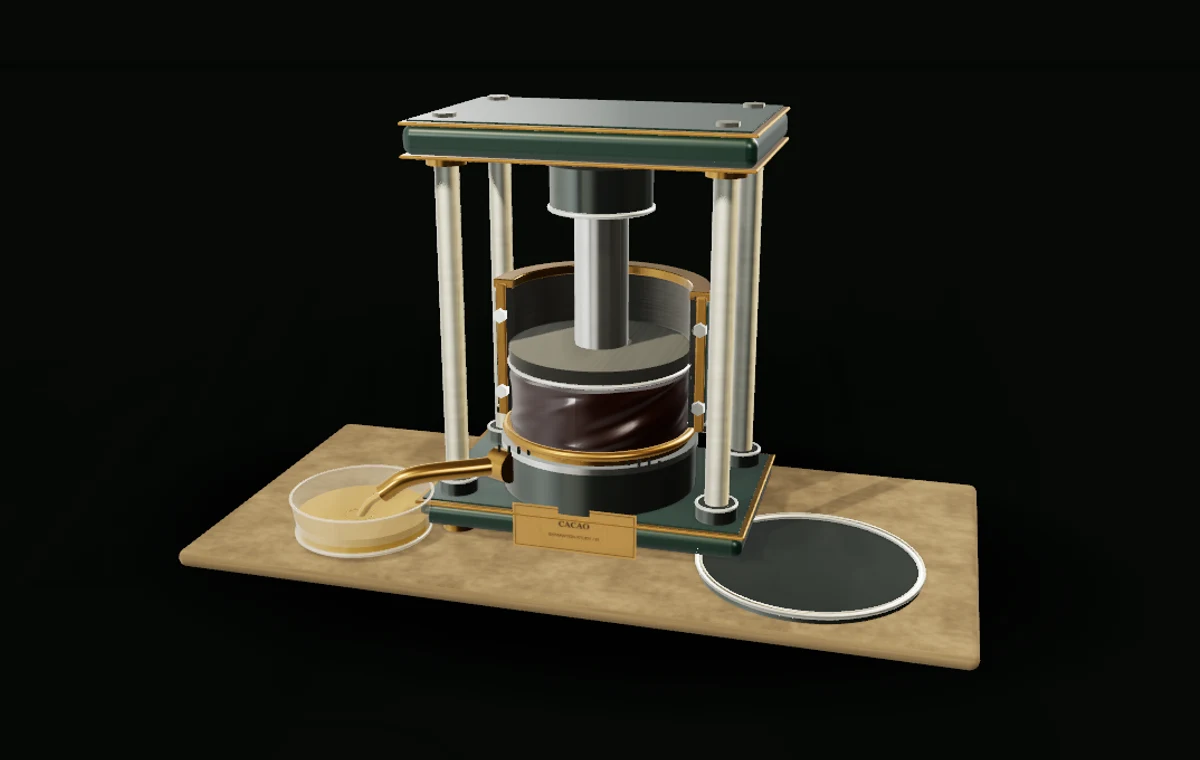
Cocoa, under pressure.
Explore the principle behind the invention: pressure separates cocoa butter from a cake that can be milled into powder. This modern teaching model shows pressing; alkalizing is a separate step.
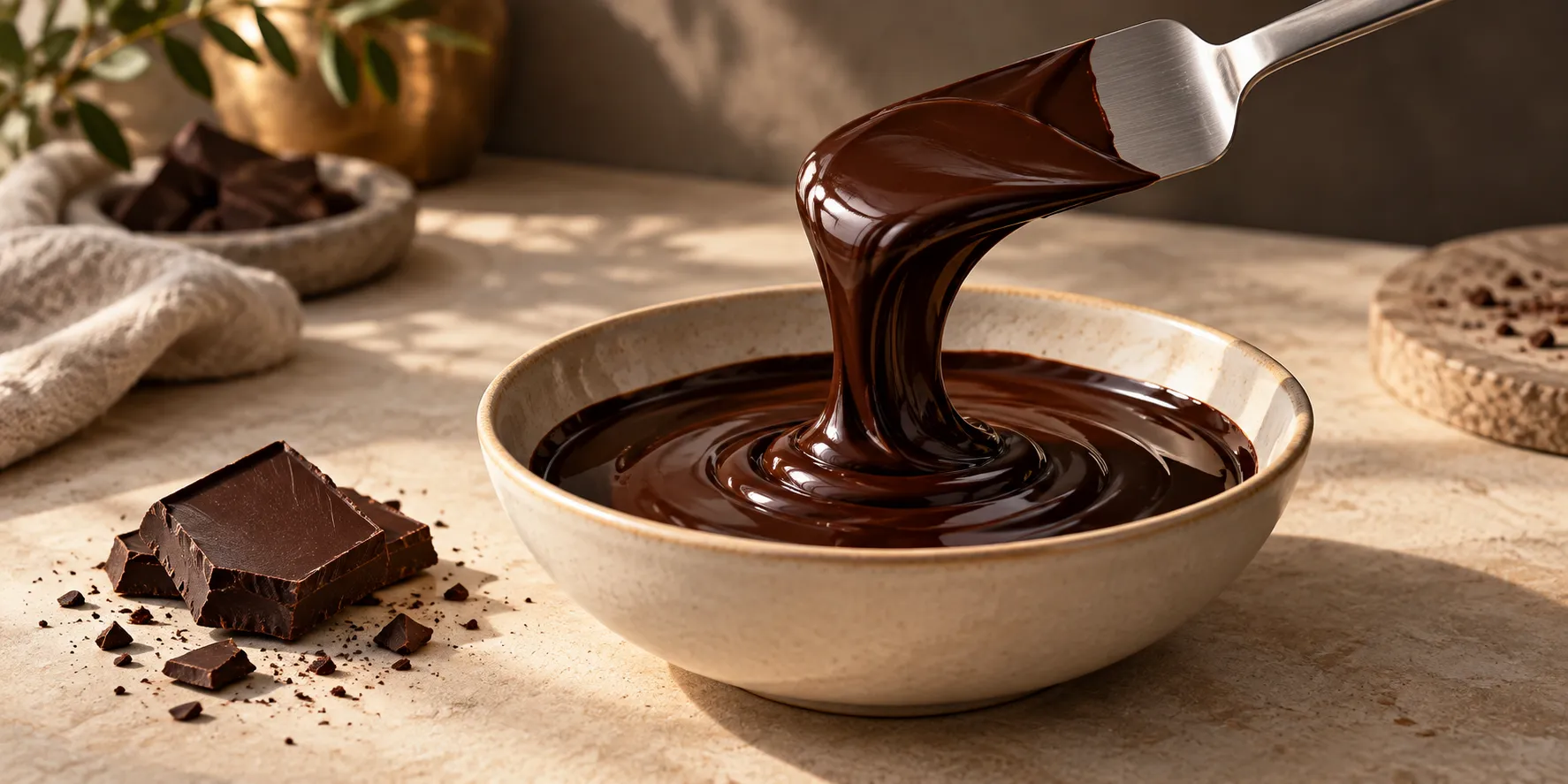
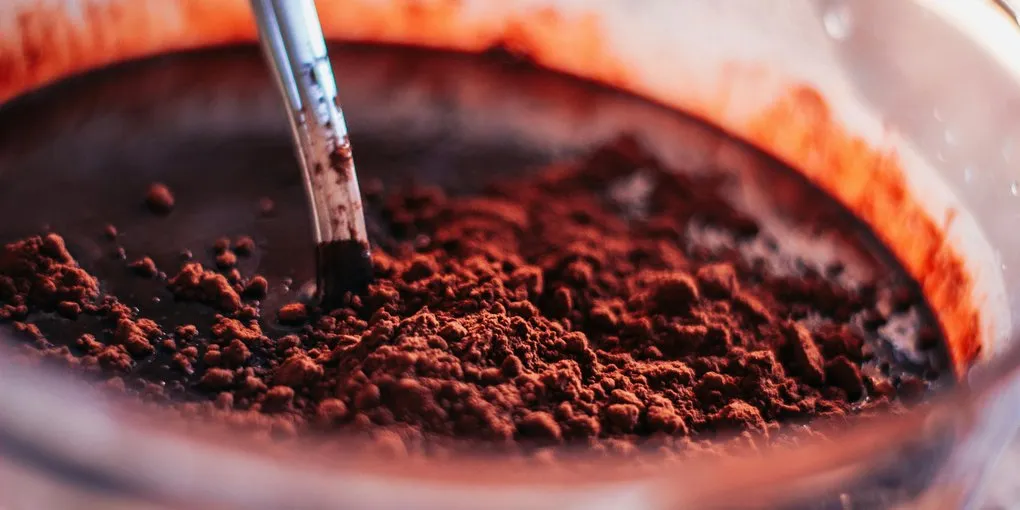
Step inside the press ↗Ground cacao nibs form cocoa mass, also called chocolate liquor; the name does not mean it contains alcohol. In pressing, some of the liquid cocoa butter is removed from that mass. The retained cake still contains residual fat. Breaking and milling it produces cocoa powder. This is a separation process, not the creation of a new kind of fat.
That gives a manufacturer two useful streams: butter that can be used separately, and powder with less fat than the starting mass. It does not establish that every bar must contain added butter, that powder cannot spoil, or that pressing alone makes an instant drink. Our Dutch-process versus natural cocoa guide explains the practical ingredient distinction.
Why a change from 53% to 27% would not mean removing half the butter
Percentages need a denominator. As an illustrative calculation, suppose 100 g of mass contains 53 g fat and 47 g nonfat material. If only fat is removed until the retained cake contains 27% fat, the cake weighs about 64.38 g: its 47 g nonfat portion is 73% of that mass. Roughly 35.62 g fat has been removed, about 67% of the original fat.
This is mass-balance arithmetic, not a verified measurement of the 1828 machine. The often-repeated 53-to-27 figures should not be used to assert that it removed half the butter. Nor should a modern product specification be retroactively assigned to the original press.
What the historical records actually establish
The Dutch National Archives’ company-history introduction places Casparus van Houten Sr. in chocolate manufacturing by 1815, identifies 1828 as the pressing breakthrough, and records Coenraad’s move to a steam-powered Weesp factory in 1850. Its history later records the Weesp closure in 1971. This is an archival finding aid, not the original patent itself. National Archives finding aid, printed page 7.
Individual invention credit is less tidy. Barry Callebaut’s Van Houten timeline credits Casparus with the 1828 press and Coenraad with Dutching in 1846. The Smithsonian-hosted study instead describes Coenraad’s pressing work and reports a ten-year patent awarded to “C. van Houten” on April 4, 1828. The latter is a historians’ account of the records, not our own inspection of the original patent. Brand timeline, historical study, pages 614–615.
It would be misleading to turn that disagreement into a confident claim that all authoritative sources have recently corrected the credit to the father. Patent recipient, inventor and later commercial developer are also different roles. Resolving those roles requires more than repeating a modern timeline.
The 1846 date should likewise be attributed. The brand’s page calls it Coenraad’s Dutching innovation; it does not supply an 1846 patent document or patent number. This article therefore does not present two separately verified patents, exactly eighteen years apart, as settled fact.
Pressing, Alkalization, and the Van Houten Business
A short chronology, with source limits kept visible
- 1815
Chocolate manufacturing in Amsterdam
The National Archives records Casparus Sr. as active in chocolate manufacturing.
- 1828
Van Houten pressing milestone
A major development in separating cocoa butter. Individual father-versus-son attribution differs between accounts.
- 1846
Dutching in the brand's chronology
Van Houten's current brand timeline credits Coenraad with the innovation in this year; a separate patent has not been verified here.
- 1847
Fry's molded eating bar
The Smithsonian identifies this as a landmark molded bar, not the first occasion on which chocolate was eaten solid.
- 1850
Production moves to Weesp
The archival company history records Coenraad moving production to a steam-powered factory.
- 1971
Weesp factory closes
The brand and its later businesses continued beyond the original factory.
Sources: National Archives company finding aid; Van Houten/Barry Callebaut brand timeline; Smithsonian collection and historical research. The 1846 patent claim remains unverified.
jayarrchocolate.comDutching changes acidity, color and flavor
Alkalization treats cocoa with an alkaline agent. Its effect depends on the starting cocoa and processing conditions; there is no single universal Dutch-cocoa pH or one historical recipe that covers today’s products. A modern experimental study varied temperature, alkali concentration and treatment duration and found that these choices affected the resulting cocoa and drink aroma. Its laboratory settings are evidence of process dependence, not a home Dutching recipe. Alkalization study.
The term Dutch refers to the Netherlands. It does not mean that every alkalized powder was manufactured there. Amsterdam is in the Netherlands; calling all of that country “Holland” is geographically imprecise.
Dispersing is not the same as dissolving
Cocoa drinks contain suspended particles. Alkali treatment can improve how cocoa disperses and how a drink stays mixed, but it does not make the entire powder soluble like sugar. Research comparing natural and alkalized cocoa in a cinnamon drink still investigated sedimentation and stabilizers: alkalization did not eliminate the suspension problem. That distinction is why “water-soluble cocoa” is an unreliable literal explanation of Dutching. Suspension study.
pH figures describe a measurement, not a universal ranking
A 2008 survey reported natural powders at extractable pH 5.3–5.8 and grouped alkalized samples as light (6.50–7.20), medium (7.21–7.60) and heavy (7.61 or higher). Those are the study’s sample categories, not mandatory definitions for every manufacturer. The survey also found lower measured flavanols with greater alkalization; that alone does not establish the health effect of a finished recipe or make a darker cocoa nutritionally superior. Miller and colleagues, abstract.
For baking, use the type called for in a tested recipe. Natural cocoa can contribute acid to a baking-soda formulation, but the other ingredients and the complete leavening system matter. “Natural with soda, Dutch with powder” is a useful starting explanation, not a rule that overrides the recipe. King Arthur’s own cocoa comparisons discuss recipes with baking powder, soda, or both. King Arthur’s cocoa guide.
Pressing helped expand chocolate making; it did not invent every later product
The Smithsonian credits J. S. Fry & Sons with a molded eating bar in 1847. That milestone belongs in this story, but it does not prove that earlier chocolate could not be molded or eaten, or that every later maker used Van Houten-supplied butter. Smithsonian Fry collection record.
The practical value of separating butter is flexibility: a maker can adjust a formulation rather than being limited to the composition of the original mass. Sugar and milk ingredients change the denominator as well. A mass containing roughly half fat can yield a finished sweetened chocolate with a lower fat percentage; adding some butter does not mean that 30–40% is “higher than” the starting 50%.
Milk-chocolate development and conching have their own histories. Our Daniel Peter article examines the 1875 milestone and the limitations of the familiar Nestlé and Gala Peter stories. The history of caramelized blonde chocolate is another example of later ingredient and process development. Neither needs to be described as chemically impossible before one particular patent.
The name outlasted the original factory
Van Houten became an international business with extensive advertising; the archival account documents that expansion without establishing “the first global chocolate brand.” Barry Callebaut’s timeline records its acquisition of the vending business in 1998. That is a narrower claim than saying it acquired every Van Houten operation or every trademark right everywhere. The brand continues on current drink products. Brand history.
What current cocoa labels tell you
Manufacturer information checked September 26, 2026, gives a better buying guide than estimated pH values assigned from a product’s color. Product names and formulations can change; match the actual package and product code.
Cacao Barry Extra Brute — The manufacturer’s 2026 catalogue lists Botanical Extra-Brute at 22–24% fat and gives a pH specification of 7.8–8.1. These are specifications for that listed product, not all Dutch cocoa. Current catalogue.
Check price on Amazon →Valrhona Cocoa Powder — Valrhona identifies its standard powder as Dutch processed and lists 21% fat. Match the product name and specification on the package; the manufacturer does not list a pH for this powder on that page. Manufacturer product page.
Check price on Amazon →Hershey’s Special Dark — The current U.S. 8 oz cocoa listing has one ingredient: cocoa processed with alkali. Check the package when comparing it with a natural cocoa: this U.S. listing is alkalized, and its nutrition figures are rounded label values. Current label.
Check price on Amazon →King Arthur Black Cocoa — King Arthur describes it as ultra-Dutch processed and recommends combining it sparingly with other Dutch cocoa. Use the manufacturer’s recipe guidance; darkness alone does not establish a precise pH or fat content. Manufacturer listing. Our black cocoa guide discusses its baking role.
Check price on Amazon →Choose a powder for the recipe and the result you want, rather than treating Dutching, darkness or a historic brand name as a universal quality score. Pressing and alkalization give makers choices. Understanding which choice a label describes is more useful than a single-invention legend.
Some links above are affiliate links — if you buy through them, we may earn a small commission at no extra cost to you.
Frequently Asked Questions
- Who invented Dutch process cocoa?
- The process is associated with the Van Houten family. Pressing and alkalization are separate operations. Modern histories differ on individual credit for the 1828 press; the brand attributes Dutching to Coenraad in 1846. An original 1846 patent has not been verified here.
- What does a cocoa press do?
- It removes some cocoa butter from cocoa mass, leaving cake that can be ground into powder. The cake retains fat. Pressing is not an alkali treatment and does not make all cocoa particles dissolve in water.
- Why is it called Dutch process?
- The name reflects its association with the Netherlands and the Van Houten business. Modern Dutch-process cocoa can be manufactured in other countries.
- Did Van Houten invent solid chocolate?
- No. Solid chocolate preceded 1828. Fry's 1847 molded eating bar is an important later commercial milestone, not the first time anyone ate chocolate in solid form.
- Was Dutching patented in 1828 or 1846?
- 1828 is the documented Van Houten pressing milestone. The current brand chronology dates Coenraad's Dutching innovation to 1846, but it does not provide a separate patent record. These should not be described as two independently verified patent dates.
- Was the press invented by Casparus or Coenraad?
- Accounts disagree. The brand credits Casparus; a Smithsonian-hosted historical study describes Coenraad's work and a patent granted to C. van Houten. This article does not claim that those conflicting accounts settle individual invention credit.
- Is Van Houten cocoa still sold?
- Yes. The name continues on cocoa and chocolate-drink products. The Weesp factory closed in 1971, and the brand timeline records Barry Callebaut acquiring the vending business in 1998.
- What pH is Dutch-process cocoa?
- It varies by product and treatment. A powder's manufacturer specification is more useful than a universal range inferred from its color. Follow the cocoa type specified in a tested baking recipe rather than choosing solely from its pH.