Fermentation is one of the most consequential steps in chocolate making. Poorly fermented cacao can be excessively bitter, astringent, or lacking in desirable cocoa character, and a different roast cannot reliably repair it.
But fermentation does more than prepare flavorless ingredients for the roaster. It generates some aromas directly while changing the mixture of amino acids, peptides, sugars, acids, and polyphenols that enters roasting. In a starter-culture experiment, researchers found that yeast selection changed aroma-active esters in cocoa liquor and that some of those esters survived chocolate processing. The original study demonstrates why fermentation and roasting cannot be assigned completely separate jobs.
Unfermented beans already contain some free amino acids and aroma compounds. Fermentation changes their amounts and balance; it does not turn an otherwise empty chemical inventory into chocolate at a single moment.
What Ferments: Pulp Outside, Reactions Inside
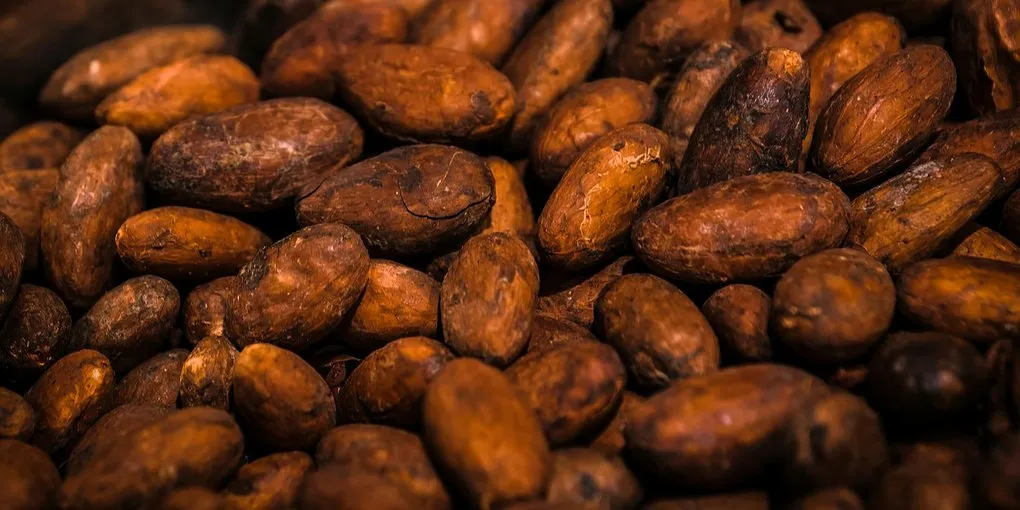
Fresh cacao seeds sit in a sugary, acidic pulp. The seed coat surrounds the cotyledons, which supply most of the nib, and the embryonic axis. In the living seed, cellular organization limits contact between some enzymes and their substrates.
Most of the microbial growth takes place in the pulp surrounding the seeds. Inside, a different set of changes follows as acids, ethanol, and heat affect the tissue. Keeping those locations separate is essential: pulp pH and cotyledon pH are not interchangeable measurements.
One Ghanaian field study observed an initial pulp pH near 3.5 that rose during fermentation. Meanwhile, acids entering the seed can lower its internal pH. The pulp therefore need not become steadily more acidic just because the beans are acidifying. Camu and colleagues tracked this process across seven heap fermentations.
Yeasts: Sugar, Ethanol, and Aroma
Early in fermentation, thick pulp limits oxygen movement, especially within the mass. This favors alcoholic fermentation, but the entire heap is not a perfectly sealed anaerobic chamber.
Yeasts convert pulp sugars into ethanol and carbon dioxide. Some also contribute enzymes that help break down the pulp, allowing liquid to drain and air to penetrate. Yeasts can produce alcohols and esters that influence aroma as well.
Saccharomyces cerevisiae is one important cacao-fermentation yeast, but it is not the universal dominant species. Research on West African fermentations found different yeast communities in heaps and trays. Origin, season, handling, and starter cultures can all change which strains thrive.
Think of the first day or two as a useful teaching window for strong early yeast activity, not a schedule that switches all yeasts off at midnight on day two.
Lactic Acid Bacteria: An Overlapping Community
Lactic acid bacteria, or LAB, can be active alongside the yeasts from the early stages. Frequently studied species include Limosilactobacillus fermentum and Lactiplantibacillus plantarum, called Lactobacillus fermentum and Lactobacillus plantarum in older research.
These bacteria use sugars and, depending on the strain, citrate and other substrates. Their products can include lactic acid, acetic acid, ethanol, and mannitol. They are not simply a group that turns the yeast’s ethanol into lactic acid.
Experiments with cocoa-pulp simulation media demonstrate that different strains follow different metabolic patterns. A separate metabolic study explains how citrate consumption can counter some of the pulp’s acidity, even while bacteria are producing acids. The balance of production and consumption matters more than the label “acid bacteria.”
Acetic Acid Bacteria: Oxygen, Acidity, and Heat
Acetic acid bacteria, or AAB, use oxygen to oxidize ethanol to acetic acid. Acetobacter pasteurianus is one well-studied participant. This oxidation releases heat and contributes to the temperature rise in the fermenting mass.
Turning improves aeration and redistribution, but air also enters as pulp drains and the mass becomes less compact. An unturned heap can still contain active AAB. Conversely, more turning is not automatically better: excessive acid production can make the eventual chocolate sour.
Temperature profiles vary. Nielsen and colleagues reported a rise from about 28°C to 46–48°C in Ghanaian fermentations. Other field trials recorded lower peaks. Those observations describe particular systems; they do not establish a universal temperature target or a pathogen-killing treatment.
Microbial processing also matters in coffee production, but coffee and cacao require their own process controls. A successful schedule for one crop cannot simply be transferred to the other.
The interactive lesson illustrates relationships among aeration, microbes, and bean change. Use the evidence and limits discussed here when interpreting such a model; a real fermentation needs observations from the actual batch.
Chocolate tool 02 / fermentation box
Inside a cacao fermentation.
Overlapping microbes transform the pulp. Aeration, heat and acid help drive changes inside the beans; the process varies with the batch and method.
The phase and cut-test guidance remain usable.
Yeasts and bacteria overlap in the pulp. Acetic acid bacteria use oxygen to oxidize ethanol, producing acid and heat. Heat and acid contribute to seed death and internal changes that support flavor-precursor formation. Turning can alter aeration; unturned batches are not oxygen-free.
What Changes Inside the Bean
Loss of Viability and Cellular Organization
Acid exposure and heating contribute to loss of seed viability and changes in membrane permeability. Substances that were separated can interact more readily. This is a process across tissues and time, not a single whole-batch catastrophe when a thermometer crosses 45°C.
The temperature measured in a heap is also not automatically the temperature inside every cotyledon. Bean size, location, acid exposure, and duration affect the conditions experienced by the seed.
Protein Breakdown Produces Peptides and Amino Acids
Cacao’s own enzymes help break down storage proteins, including vicilin-type proteins. An aspartic endoprotease cuts within proteins; a carboxypeptidase releases amino acids from peptide ends. Both the resulting peptides and free amino acids matter for aroma formation during roasting.
Voigt and colleagues’ laboratory experiments showed why this cooperation matters. The enzymes had different pH optima, and digestion at pH 5.2 generated a precursor mixture with cocoa-aroma potential on roasting. Digestion at pH 3.5 did not produce the same result. The lowest pH is therefore not necessarily the most useful condition, and the endoprotease alone does not explain the entire process.
During roasting, amino-acid chemistry can contribute familiar aroma compounds:
| Precursor amino acid | Associated Strecker aldehyde |
|---|---|
| Leucine | 3-methylbutanal |
| Isoleucine | 2-methylbutanal |
| Phenylalanine | Phenylacetaldehyde |
These relationships help explain malty and floral aroma development. They do not mean that one concentration predicts the quality of every chocolate. Experiments on cocoa and model systems show that reaction outcomes depend on the system. Work on fermentation and roasting also detected these aldehydes before roasting, with further changes afterward.
Polyphenols, Color, and Astringency
Polyphenols undergo oxidation, diffusion, and other changes during fermentation and subsequent processing. Anthocyanin pigments decline, and many initially purple beans become browner. These changes can reduce astringency and bitterness, but a percentage loss in an assay is not a percentage reduction in perceived bitterness.
There is no universal 80–90% reduction to promise. The starting material, individual compounds, sampling method, and processing conditions matter. A study across three Colombian production locations found different biochemical and sensory outcomes as fermentation progressed.
Browning is useful evidence, particularly in pigmented beans, but it does not measure protein breakdown directly or show that every desirable reaction has “run to completion.”
Acidity Needs Context
The cotyledon usually acidifies during fermentation, but it does not always finish at pH 4.0–4.5. The Colombian study above reported final values around 5.1–5.6 under its methods and conditions. Measurement procedures also matter: a ground-bean water extract is different from a probe reading in pulp.
Acidity affects enzyme activity and flavor. It should be interpreted alongside temperature history, aroma, physical condition, and the flavor of safely processed samples. A universal final pH cannot select the best fermentation for every cacao.
Methods, Duration, and Batch Size
| Method | Practical considerations |
|---|---|
| Heap | Pulp-covered beans are collected in a covered mass. Drainage, insulation, shape, and turning influence conditions. |
| Box | Containers can make batch identity, drainage, and transfers easier to manage. Size and construction affect heat retention. |
| Tray | Shallower layers alter drainage, aeration, and heat exchange. A tray protocol needs its own timing and handling. |
None of these methods guarantees good flavor simply by its name. The same method can produce different results when the beans, weather, load, or handling change.
There is no universal 300 kg minimum. A Ghanaian experiment followed approximately 150 kg heaps through fermentation and chocolate evaluation. Smaller masses can lose heat rapidly, but insulation, container geometry, and purpose matter. Specialized small-scale protocols are different from leaving a few handfuls of wet beans in an open container.
Commercial fermentation often lasts several days. Some operations use around three to five days, while five or six days are common in other systems. The industry’s fermentation guidance emphasizes matching the method to the material and conditions. Extending a batch merely to reach a calendar target can introduce defects.
Kokoa Kamili in Tanzania provides a concrete example: its published protocol describes wet-bean buying, a three-tier cascade box system, six days of fermentation, temperature monitoring, and evaluation of daily lots. This is evidence of that producer’s practice, not proof that every smallholder must centralize production to make good cacao.
Genetics Changes the Starting Point
Cacao varies in pigmentation, pulp characteristics, storage proteins, and flavor potential. Some lightly pigmented Criollo-type material is traditionally fermented for less time than strongly pigmented material. Yet “Criollo” and the broad trade term “Forastero” are not precise instructions for a fermentation schedule.
Pale beans, including material associated with Venezuelan Porcelana and Peruvian cacao, need interpretation that accounts for their starting color. White cotyledons alone do not establish genetic purity or a guaranteed two-day process.
Likewise, Nacional and CCN-51 in Ecuador should not be assigned universal durations or flavor rankings solely from their names. Producers need lot-specific evidence. Good fermentation cannot be reduced to “less pigment means fewer days”: precursor formation, acid movement, and drying also matter.
Assessing Fermentation Quality
The Cut Test
Cutting beans lengthwise reveals internal color, fissuring, insects, and visible mold. A quick look at a handful can help a producer follow a batch, but a purchase or grading decision needs representative sampling and an agreed method.
The Cacao of Excellence guide describes a formal procedure using 300 beans. Record the proportion in each relevant category rather than reporting an unexplained “fermentation percentage.” Slaty beans indicate poor fermentation; purple color can indicate limited fermentation in pigmented material. Ivory or white beans require attention to their natural pigmentation.
There is no universal rule that 75% brown proves optimal flavor. Trade specifications distinguish categories such as slaty and defective beans, and the applicable contract matters. Brown beans can still have unwanted acidity, smoke, or other flavor defects.
Visible mold and putrid odors warrant rejection or investigation under the lot’s quality and safety procedures. They are not merely a signal to choose a darker roast, and color cannot identify a particular spoilage organism.
Fermentation Index
A common laboratory fermentation index is the absorbance of a specified extract at 460 nm divided by its absorbance at 530 nm. It follows pigment changes; it is not a direct measurement of aroma, complete proteolysis, or safety.
Values above one are sometimes used as a fermentation criterion for suitable pigmented material. A primary study using this method explicitly notes limitations for white beans and mixed material. Comparisons need the same analytical method and an appropriate reference population.
Taste After Appropriate Processing
The industry’s flavor-assessment guidance explains that cut tests cannot establish complete flavor quality. Evaluate representative samples after suitable processing into cocoa mass or chocolate, alongside physical and analytical checks.
Fermentation, a pleasant aroma, and a dry appearance do not establish that raw beans are safe to eat. Makers need an appropriate food-safety process; the handling and thermal controls are separate from deciding which fermentation tastes best. Research on Salmonella during cacao processing is one reason not to treat fermentation heat as a validated kill step.
Drying Continues the Changes
Drying reduces moisture for storage while chemical changes and acid movement continue. Excessively rapid drying can retain acidity; excessively slow drying or rewetting can encourage mold. Lactic and acetic acids do not behave identically, and retained acidity is not automatically a desirable fruity aroma.
The industry drying guidance calls for controlled drying, protection from rain and contamination, and separation from combustion gases. Sun drying can work well, but a properly managed artificial dryer can be necessary when the weather is unsuitable.
Aim for the buyer’s measured moisture specification, commonly around 7%, rather than assuming that a certain number of sunny days is sufficient. The industry moisture guidance identifies mold risk at excessive moisture and breakage when beans become too dry. Moisture content alone is not proof of microbiological safety.
What the Chocolate Maker Can Control
Many beginning makers buy beans that were fermented and dried at origin. They can ask for processing records, inspect representative samples, compare safely prepared cocoa mass, and give suppliers useful feedback. Makers working at origin may manage fermentation themselves or collaborate directly with a fermentary.
Roasting and conching then develop and adjust what the beans provide. Neither is a reliable rescue for every fermentation defect. Genetics, growing conditions, fermentation, drying, and manufacturing interact; assigning each a fixed one-quarter share of flavor implies a precision the evidence does not support.
Cacao Fermentation: Overlapping Microbial and Bean Changes
- 01
Yeasts
Often strong early activityPulp sugars support ethanol, carbon dioxide, and aroma production; some yeasts help pulp break down.
- 02
Lactic Acid Bacteria
Overlap with yeastsStrain-dependent metabolism of sugars and citrate changes acids and other products in the pulp.
- 03
Acetic Acid Bacteria
Oxygen-dependent oxidationEthanol oxidation produces acetic acid and heat. Drainage and turning influence aeration.
- 04
Changes Inside the Bean
Dependent on exposure and timeAcids and heat affect viability and membranes; enzymes form peptides and amino acids, while pigments and polyphenols change.
Timing, temperature, and flavor depend on the batch. A cut test supports assessment but does not prove complete flavor development or safety.
jayarrchocolate.comFrequently Asked Questions
- Why is cacao fermented?
- Fermentation changes aroma, bitterness, astringency, and roasting precursors. Microbes produce some flavor compounds directly, while acids and heat alter the seed tissues. Poor fermentation can limit chocolate quality, but unfermented beans are not chemically devoid of amino acids or aroma compounds.
- What are the three phases of cacao fermentation?
- Yeasts, lactic acid bacteria, and acetic acid bacteria provide a useful teaching framework. Their activities overlap rather than following a fixed calendar. Yeasts produce ethanol from sugars, LAB alter sugars and acids, and oxygen-dependent AAB oxidize ethanol to acetic acid and release heat.
- What is bean death and why does it matter?
- Heat and acid exposure contribute to loss of seed viability and membrane changes that permit biochemical reactions inside the bean. It is not a guaranteed switch at 45°C. Enzymes then act under changing conditions; protein breakdown involves both peptides and free amino acids.
- How can I tell if cacao beans are well-fermented?
- Combine a representative cut test with processing records, physical condition, moisture assessment, and the flavor of appropriately processed samples. The Cacao of Excellence formal cut-test procedure uses 300 beans. A handful of brown beans or a 75% brown result cannot establish optimal flavor or food safety.
- How long does cacao fermentation take?
- Usually several days, with the protocol depending on the material, climate, mass, vessel, drainage, and aeration. Some systems use three to five days and others five or six. Kokoa Kamili describes a six-day process. There is no universal duration or 300 kg minimum that guarantees success.
- What amino acids does fermentation release?
- Protein breakdown can release amino acids including leucine, isoleucine, and phenylalanine, alongside peptides. These participate in later aroma chemistry. The mixture and subsequent processing matter; one amino acid or aldehyde is not a universal predictor of chocolate quality.
- What is the difference between heap and box fermentation?
- Heaps collect beans in a covered mass, while boxes contain batches and may facilitate drainage and transfers. Their geometry and handling affect heat and aeration. Both can work well with suitable protocols; neither guarantees uniformity or better flavor.
- How does drying affect cacao flavor?
- Drying changes moisture, acid movement, and continuing reactions. Overly rapid drying can retain acidity; overly slow drying or rewetting can promote mold. Use controlled sun or artificial drying and verify the buyer's moisture specification, commonly around 7%. Dryness does not itself establish pathogen control.