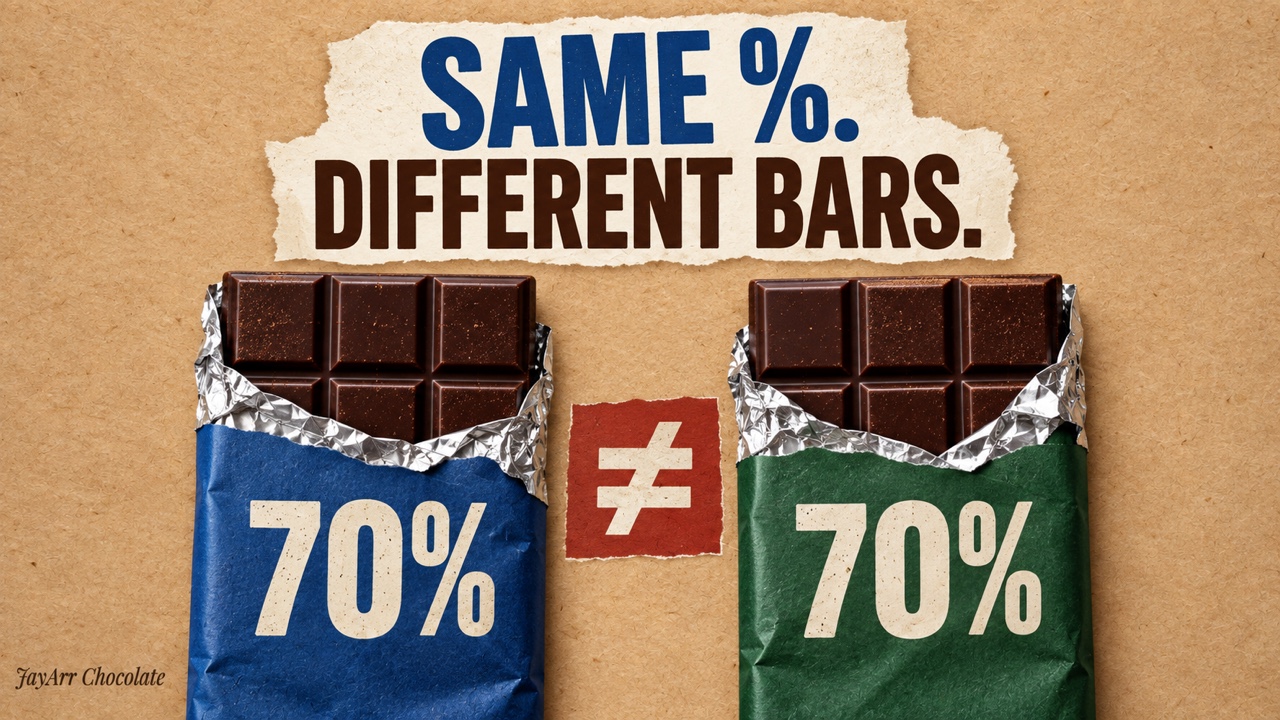
Two bars can both say 70% cacao and contain different amounts of the brown cocoa material that contributes much of chocolate’s flavor. The reason is easy to miss: cocoa butter counts too.
Percentage is useful for comparing recipes. It becomes misleading when we treat it as a flavor score, a sugar analysis, or a quality grade.
What Counts Toward Cacao Percentage?
The cocoa portion can include cocoa mass, added cocoa butter, and cocoa powder. Added cocoa butter belongs on the cocoa side of the calculation, even though it is pale and fatty. Guittard’s ingredient glossary explicitly includes it in the cacao percentage.
Three terms make the label easier to understand:
- Cocoa mass, or chocolate liquor: finely ground cacao nibs, containing both cocoa butter and non-fat cocoa material. Despite the name, chocolate liquor is not an alcoholic drink.
- Cocoa butter: the fat from cacao. Some is already present in cocoa mass; a maker can add more separately.
- Cocoa powder: material left after removing part of the butter, then grinding it. Powder still contains fat; it is not synonymous with pure non-fat cocoa solids.
For context, the US standard for chocolate liquor specifies 50–60% cacao fat. Its neighboring cocoa provision also makes clear that pressing removes only part of the fat.
Be careful with the phrase cocoa solids. Total cocoa solids includes cocoa butter; non-fat cocoa solids excludes it. Confusing those terms makes a white chocolate label seem contradictory, even though its cocoa butter really does come from cacao.
Two Different Recipes, Both 70%
Imagine two plain, 100-gram dark chocolate bars:
| Ingredient | Bar A | Bar B |
|---|---|---|
| Cocoa mass | 70 g | 55 g |
| Added cocoa butter | 0 g | 15 g |
| Sugar | 30 g | 30 g |
| Total | 100 g | 100 g |
| Cocoa ingredients | 70 g | 70 g |
Both are 70% cacao. Both contain the same amount of added sugar. Bar B replaces some cocoa mass with extra cocoa butter; it does not replace sugar.
To see what changes inside the cocoa portion, assume the mass in both recipes contains 55% cocoa butter. This is an illustrative calculation, not a measurement of a particular brand:
- Bar A contains 38.5 g cocoa butter and 31.5 g non-fat cocoa material.
- Bar B contains 45.25 g cocoa butter and 24.75 g non-fat cocoa material.
Bar B has 6.75 g more cocoa butter, not 15 g. The 15 g of cocoa mass it replaced already contained 8.25 g of butter.
That is a meaningful recipe difference hidden behind the same front-label number. More butter changes the balance of fat and particles, but the percentage alone cannot predict the finished texture: particle size, processing, emulsifiers, and tempering also matter.
Here is the same accounting with a small emulsifier addition. Every recipe below totals 100 g and contains 70 g of cocoa ingredients.
Three Ways to Make a 70% Bar
| 01Recipe per 100 g | 02Cocoa butter | 03Added sugar | |
|---|---|---|---|
| Mass + sugar | 70 g mass + 30 g sugar | 38.5 g | 30 g |
| With extra butter | 55 g mass + 15 g butter + 30 g sugar | 45.25 g | 30 g |
| With lecithin | 55 g mass + 15 g butter + 29.5 g sugar + 0.5 g lecithin | 45.25 g | 29.5 g |
The table assumes cocoa mass is 55% cocoa butter. The butter column is not a nutrition-label measurement of total fat; other ingredients can also contribute fat.
Does 70% Mean 30% Sugar?
Only for a simple recipe where sugar is the entire non-cocoa portion. In a bar containing milk powder, nuts, vanilla, or emulsifiers, those ingredients take up some of the remaining weight. Milk ingredients can also contribute naturally occurring sugars, so recipe sugar and the nutrition panel’s total sugars are different measures.
There is a labeling caveat too. A label may declare a minimum, rather than an exact recipe percentage. Under EU chocolate rules, Article 3 and Annex I(C), the minimum contents for specified chocolate categories are calculated after deducting the additions allowed in Section B. For filled chocolates and pralines, the filling is deducted too. Their separate chocolate-content percentage, however, uses the whole finished product, including the filling. These are particular EU rules, not a worldwide formula for every front-label claim. The hypothetical recipes above use the whole recipe as their denominator.
For a sugar comparison, use the nutrition labels on the same basis, such as grams per 100 g. Do not calculate sugar by subtracting the front-label number from 100.
On US panels, Total Sugars includes Added Sugars; the added-sugars line is a subset, not an extra amount to add on. If you convert rounded per-serving figures to per-100 g figures, treat the result as an approximation.
Is 70–75% Really the Best Percentage?
It can be a useful place to begin a tasting, but there is no universal best percentage.
We checked 2,841 review rows in the Flavors of Cacao database on September 24, 2026. Bars at 70–75% averaged 3.23 out of 5, compared with 3.19 below 70% and 3.07 above 75% but below 100%. The groups contained 2,092, 415, and 313 reviews respectively.
Those are observations about the bars reviewed, not a controlled comparison of otherwise identical recipes. They do not prove that changing a bar to 70% improves it, or that every consumer prefers that range. The site’s review guide also explains that a rating describes a particular bar and batch, with subjective interpretation involved.
A more useful experiment is to taste different percentages from the same maker and origin when available. You still may not be holding every processing variable constant, but you can discover which balance you enjoy. Our guide to tasting craft chocolate gives you a way to record those differences.
What About 100% Chocolate?
A plain 100% bar consists of cocoa ingredients without added sugar. It can contain cocoa mass alone, or a combination of mass, cocoa butter, and cocoa powder. For example, Lindt’s 100% Excellence bar lists chocolate, alkalized cocoa powder, and cocoa butter. It is not fat-free, and 100% does not guarantee either excellence or disappointment.
In the same database snapshot, the 21 reviews of 100% bars averaged 2.29. That is lower than the other groups, but six scored at least 3.0, the review guide’s recommended threshold; one reached 3.5. That small sample does not support saying the format almost always fails.
If you enjoy unsweetened chocolate, taste it on those terms. If you prefer sweetness, a lower-percentage bar may suit you better. Neither preference turns the percentage into a quality ranking.
Percentage Across Chocolate Types
Dark chocolate: the cocoa portion includes both butter and non-fat cocoa material. Check the ingredient list to see whether extra butter is present.
Milk chocolate: milk ingredients share the recipe with cocoa ingredients and sugar. Two milk bars with the same cacao percentage can have different amounts of dairy and added sugar.
White chocolate: cocoa butter supplies the cocoa portion; white chocolate has no non-fat cocoa component. Its stated cacao percentage therefore does not mean the same flavor balance as an equal percentage in dark chocolate.
Ruby chocolate: check the particular product’s ingredients and declaration. One manufacturer’s recipe should not be treated as a universal formula for the category.
The types of chocolate guide covers the categories in more detail. Within any category, compare ingredients as well as percentages.
How Makers Calculate a Recipe
For a two-ingredient batch made from nibs or cocoa mass plus sugar:
Sugar weight = (Cocoa ingredient weight ÷ target fraction) − Cocoa ingredient weight
Use 0.70 for 70%, not 70. With 650 g of nibs:
- 70% needs approximately 279 g sugar.
- 75% needs approximately 217 g sugar.
- 85% needs approximately 115 g sugar.
These are formulation weights, rounded to the nearest gram. The same nibs can become any of those recipes; changing sugar does not change the beans’ origin or quality.
If you keep the 650 g nibs and add 50 g cocoa butter, you now have 700 g cocoa ingredients. At 70%, the total batch must be 1,000 g, leaving 300 g for sugar if there are no other ingredients. Adding butter while holding nib weight and target percentage constant increases the sugar weight needed. That is different from replacing cocoa mass with butter inside a fixed 100 g bar.
For recipes with milk powder or other additions, those ingredients also use part of the non-cocoa allowance. See the recipe formulation guide and recipe formulator for the broader workflow.
Reading the Label More Usefully
Start with the percentage, then read the ingredients and nutrition panel. Look for the form of cocoa used, added butter, milk, sweeteners, and inclusions. Treat origin and process information as additional context, not automatic proof of quality.
Ingredients generally appear in descending order by weight, with exceptions for small quantities under rules such as US 21 CFR 101.4. Our Bar B would list cocoa mass, sugar, then cocoa butter. A separate cocoa-butter entry identifies added butter; it does not tell you the total butter already present in the cocoa ingredients.
Two ingredients do not guarantee a better bar than four. A high percentage does not certify more careful fermentation, better roasting, or a flavor you will enjoy. The number describes part of the recipe; tasting tells you whether that recipe works for you. Our guide to reading craft chocolate labels connects the other label details.
Frequently Asked Questions
- What does cacao percentage mean?
- It counts cocoa ingredients, including cocoa butter. For a simple plain bar, 70% means 70 g of cocoa ingredients per 100 g of chocolate. It does not reveal the split between butter and non-fat cocoa material. Filled products and some legal minimum declarations need additional labeling context.
- Does a 70% bar always contain 30% sugar?
- No. That works for a cocoa-and-sugar recipe, but other ingredients can occupy the non-cocoa portion. Use the nutrition label to compare total sugars.
- Can two 70% bars contain different amounts of fat?
- Yes. Replacing some cocoa mass with added cocoa butter keeps the cacao percentage unchanged while increasing the cocoa butter share. Both bars can still contain the same amount of sugar.
- Is 70% chocolate better than 85% or 100%?
- Percentage is not a quality grade. Ratings of different bars do not establish an ideal recipe for everyone. Compare bars and choose the balance of sweetness and cocoa flavor you enjoy.
- Is cocoa powder the same as non-fat cocoa solids?
- No. Cocoa powder retains some cocoa butter after pressing. Non-fat cocoa solids specifically excludes that fat; total cocoa solids includes it.
- Does white chocolate contain cacao?
- Yes, in the form of cocoa butter. It lacks the non-fat cocoa component, so its cacao percentage cannot be interpreted as the same flavor balance as dark chocolate.