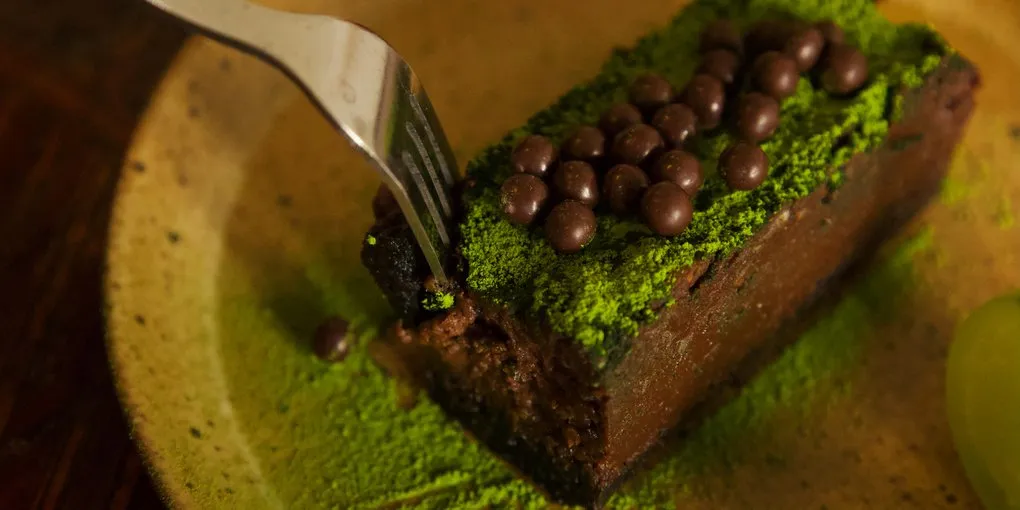
Matcha brings color, aroma, bitterness, and a savory taste to chocolate. Those qualities can stand out against white chocolate or become part of a darker, more roasted flavor. Neither pairing needs a claim that the plants are close relatives, or that shared molecules make a combination inevitably delicious.
This guide covers a small white-chocolate experiment, a documented matcha ganache, the distinction between a filling and a rollable truffle center, and a tasting flight you can build without making confectionery. It also looks at historical tea-chocolate assortments and practical ways to judge a selection box.
How to Make Matcha White Chocolate
White chocolate contains cocoa butter, sugar, and milk ingredients, but lacks the nonfat cocoa material responsible for much of dark chocolate’s color and flavor. It is not cocoa-free. Nor does a useful white couverture have to contain at least 30% cocoa butter: Callebaut W2, for example, is labeled 28% cocoa.
A small trial formulation
The following amounts are a working trial, not a kitchen-validated recipe. They make 208 g before handling losses, or 214 g with the optional cocoa butter. Use a scale and a chocolate sold for molding or confectionery work.
| Ingredient | Amount | Relative to the 200 g chocolate base |
|---|---|---|
| White chocolate couverture | 200 g | 100% |
| Pure matcha powder, sifted | 8 g | 4% |
| Additional food-grade cocoa butter, optional | 6 g | 3% |
Here, 4% means 8 g divided by 200 g of chocolate. It is approximately 3.85% of the finished 208 g mixture, or 3.74% with the added butter. Keep that denominator consistent when comparing batches.
The final flavor and flow will depend on the tea and couverture. More powder is not automatically better: it can make the mixture taste stronger and feel more powdery. Additional cocoa butter changes the formulation as well as the flow; the 6 g option is not a guaranteed cure for every thick mixture. Compare a small batch before committing expensive tea to a large mold.
Method, order, and temperature
- Prepare dry equipment and sift the matcha. Break up visible clumps. Sifting helps dispersion, but does not dissolve the leaf particles or guarantee the smoothness of professionally refined chocolate.
- Melt and temper according to the couverture’s instructions. If using extra cocoa butter, incorporate it before tempering the combined mixture. For a concrete example, Callebaut’s conventional W2 curve is 45°C melt, 27°C cooling, then 28–29°C working temperature. These are W2 instructions, not universal temperatures for every white chocolate or an independently validated curve for this modified formula. Use the method appropriate to your chocolate and test a small smear before molding. Callebaut tempering guide
- Make a slurry. Mix the sifted powder into a small portion of the chocolate, then stir it back into the rest until evenly dispersed. Keep within the chocolate’s working range. Do not add brewed tea or water to thin a solid bar mixture.
- Check flow and temper. Cooling and continued crystallization can thicken chocolate as well as the added powder. If it becomes difficult to mold, assess its temperature and temper before changing the recipe.
- Mold and cool under suitable conditions. A cool, dry room may be sufficient. Follow the chocolate or recipe maker’s cooling guidance; refrigeration is not categorically forbidden. Protect cold chocolate from humid air and condensation when bringing it out.
Avoid unnecessarily prolonged warm holding. Research has identified heat-sensitive, low-boiling aroma compounds in matcha, but that does not establish a single temperature at which all tea flavor disappears, or prove that stirring alone turns a bar brown. Matcha odorant study
Matcha Ganache and Truffles
Matcha is powdered tea leaf, so it can be dispersed into cream rather than steeped and removed like loose leaves. A smooth ganache depends on dispersion and emulsification; a ganache that tastes good is not necessarily firm enough to roll.
A documented white-chocolate ganache
Chef Luis Robledo’s matcha ganache for Callebaut’s An Alfajor Lost in Translation uses the following quantities. It is a cookie filling, not a promise of a rollable truffle center:
| Ingredient | Amount |
|---|---|
| Callebaut W2 white chocolate | 300 g |
| Cream, 35% fat | 145 g |
| Invert sugar | 15 g |
| Matcha powder | 10 g |
Total input is 470 g, before handling losses. The source warms the cream and invert sugar to about 70°C, mixes approximately one-third of that liquid with matcha to form a paste, then combines the remaining cream, chocolate, and paste and emulsifies with an immersion blender. Keep the blender head submerged to reduce air incorporation. See the full chef recipe for its intended assembly.
For home use, transfer fresh-cream ganache to a shallow container and refrigerate promptly. Do not treat the professional recipe’s shelf-life claim or overnight setting instruction as validation of a modified home batch. Use the refrigeration guidance below.
Turning ganache into truffles
Choose a formula developed for the chocolate and final form you want: a soft piped center inside a shell, a cut slab, and a hand-rolled truffle need different handling and firmness. Replacing white chocolate with dark chocolate, or changing from two parts chocolate to one part cream to equal weights, can change the result substantially. A single ratio does not cover all couvertures.
After chilling a small sample, check whether it holds a shape at the intended serving temperature. If the filling remains soft, use it as a filling or spoonable dessert; do not assume longer unrefrigerated setting will turn it into a reliable truffle center. Dusting or enrobing changes the finish, but does not establish shelf stability.
Choosing and Dosing Matcha
Choose the tea by its actual flavor and intended use. Labels such as “ceremonial” and “culinary” do not provide a consistent cross-brand specification for sweetness, particle size, or quality. Ippodo does not use “ceremonial grade” and recommends some of its drinkable matcha blends for baking as well. Taste the tea, check that the ingredient is pure matcha rather than a sweetened drink mix, and compare it in the chocolate you intend to use. Ippodo’s matcha guidance
Record grams and the denominator. The trial bar above uses 8 g per 200 g chocolate. The documented ganache uses 10 g per 145 g cream, or about 2.13% of all its ingredients. Those are different formulations, not competing universal dose limits. Change one variable at a time when adjusting flavor.
Store the powder according to its supplier. Keep it sealed, away from heat, light, humidity, and strong odors. Ippodo recommends using its opened tea within about a month for best flavor; that is a freshness recommendation, not a universal spoilage deadline. If freezing an unopened package, allow it to acclimate while sealed before opening to avoid moisture exposure.
Matcha Chocolate Storage and Troubleshooting
Solid bars and shards: store wrapped or sealed in a cool, dry place away from light and odors. Temperature swings and condensation can damage appearance. There is no evidence here for a fixed four-to-six-month shelf life for every homemade matcha bar, and “contains no cream” does not mean “has zero water activity.” For purchased pieces, follow the maker’s date and storage directions. Callebaut storage guidance
Homemade fresh-cream ganache: unless the exact recipe and process have a validated alternative, treat it as perishable. Keep the refrigerator at 4°C / 40°F or below and chill promptly in a shallow container. FDA’s general guidance is to refrigerate perishables within two hours, or within one hour above 32°C / 90°F. Make small batches for prompt use; this article does not establish a refrigerated shelf life for an altered ganache. Bring out only what you intend to serve, and do not leave the entire batch warming indefinitely to avoid condensation. FDA refrigeration guidance
For troubleshooting, distinguish possible causes from diagnoses:
| Observation | What to investigate |
|---|---|
| Visible green clumps | Powder clumping or uneven mixing; sift and make a slurry in the next batch. Sifting alone cannot remove all leaf texture. |
| Dull color or weak aroma | Tea’s initial character, storage, dose, chocolate color, and heat exposure. Ordinary stirring alone does not identify the cause. |
| Chocolate too thick to mold | Powder loading, base chocolate fluidity, temperature, excess crystallization, or accidental moisture. Do not automatically add more fat. |
| Chalky or strongly bitter taste | Compare a lower powder dose and another tea; the word “culinary” alone does not diagnose poor quality. |
| Pale surface film | Fat bloom and sugar bloom have different causes. Tempering or storage may be involved; condensation can leave recrystallized surface sugar. Retempering is not a universal repair. |
See the manufacturer’s explanation of sugar bloom for the role of surface moisture.
What Flavor Chemistry Can Explain
Matcha is made by grinding tencha, a shade-grown tea material. It adds leaf particles as well as compounds that contribute to taste and aroma. Ippodo’s description of tencha helps distinguish it from simply grinding any green tea at home.
Taste and smell are related but different. A sensory study of prepared matcha identified L-theanine and several other compounds as enhancers of glutamate’s umami taste. A separate study identified dimethyl sulfide and several aldehydes as aroma-active compounds in matcha. Dimethyl sulfide is an odorant; it should not be described as the substance that supplies umami taste. Nor is green color itself proof of a particular aroma or quality. Kaneko and colleagues, 2006, Mizukami, 2019
The recipe changes the experience. A solid chocolate bar disperses dry particles in a fat-rich material. A cream ganache contains both water and fat. A brewed cup extracts part of a tea leaf’s composition and leaves the leaf behind, while matcha remains in the food. These forms will not taste or feel identical at the same nominal tea dose. Cocoa percentage alone does not specify how much cocoa butter a dark chocolate contains or predict which aromas a person will perceive.
A chemical overlap is not a pairing rule. White chocolate’s sweetness and milky character can contrast with matcha; dark chocolate can add roasted and bitter notes. Those descriptions are useful starting points for tasting. They do not establish a 60–70% ideal, a 75% cutoff, or a mechanism that makes bitterness inevitably plateau and reveal floral notes. For more vocabulary, see the chocolate flavor compounds guide and chocolate flavor wheel.
Flavor is not a health outcome. Matcha contains caffeine; L-theanine is an amino acid, not a methylxanthine stimulant. The presence of these compounds does not establish a particular “calm focus” effect from a truffle. Nor do ingredient studies establish that a tea confection improves cardiovascular health. This guide makes no such health claim. Ippodo caffeine information
Tea and Chocolate: Documented Examples
Tea and cacao each have long cultural histories, but those histories do not by themselves date the invention of tea-infused chocolate. The surviving product records are more useful than assigning a single pioneer or imagining a continuous fusion tradition.
In March 2010, a firsthand Coffee & Vanilla review described Matcha Chocolat’s Emperor’s Selection. Its pieces included Uji matcha, jasmine, lapsang, Assam with blackcurrant, and masala chai, using different chocolates. This documents a tea-focused assortment at that time; it does not establish the first tea chocolate or the company’s founding and closure dates. Contemporary review
A 2011 firsthand account identifies Katie Christoffers and describes visiting her chocolate-making premises in Wallingford. Treat Matcha Chocolat as a historical example here, rather than a verified present-day shopping destination. Mostly About Chocolate’s visit account
There are also documented examples in larger product ranges. ROYCE’ Nama Chocolate Matcha combines powdered tea with white Nama chocolate; the manufacturer’s listing includes refrigerated storage instructions and identifies liquor in that product. Hotel Chocolat’s 2025 description of its limited-edition matcha drinking chocolate names 36% white chocolate and matcha from Shizuoka. These show different formats for the pairing, not evidence that either company invented it or is the largest specialist. Product availability and formulations may vary by market. ROYCE’ product range, Hotel Chocolat’s product description
Older reviews also need care when planning visits. Paul A. Young discussed closing his shop business in a 2023 interview; old references to his Soho and City shops should not be used as current travel directions. Interview with Young
Tea-Themed Chocolate Selection Boxes: What to Look For
A useful assortment tells you which teas are in the pieces, which allergens they contain, and how to store them. A theme can make comparison interesting, but neither an expensive tea name nor a large number of cocoa percentages proves quality.
Compare the actual pieces. A collection using one dark chocolate can deliberately isolate differences among teas. A collection using white, milk, and dark chocolates explores differences among combinations. Both are legitimate. Powdered matcha in a shell is also a valid technique; cream infusion is not the sole mark of careful work.
Use origin information as context. Tasting notes vary with the beans and the maker’s choices. Madagascar is not always bright fruit, Bolivia is not always tobacco, and an origin name cannot guarantee a match with Earl Grey or chai. Our guides to Bolivia, Peru, the Dominican Republic, and Papua New Guinea offer background; taste the particular chocolate in front of you.
Choose texture intentionally. An all-ganache box can be an enjoyable comparison. If you prefer contrast, look for a mix of soft centers, solid chocolate, caramel, or crisp inclusions. More textures are an option, not a compulsory quality score.
Read dates and handling instructions. Tea aroma does not universally vanish after two or three weeks, and shelf life cannot be inferred from the words “infused,” “artisan,” or “small batch.” A long date is not proof of inferior flavor; a short date is not proof of good handling. For gifts, make sure the recipient can follow any cold-storage instructions.
Tea-Themed Selection Box Checklist
Compare the product's ingredients, flavors, and handling needs
Tea and theme
- Named teas and clear piece descriptions
- A theme you want to explore
- Actual tea, powder, infusion, or flavoring described where useful
Chocolate choice
- A base chocolate suited to the intended flavor
- One base or several can make a useful comparison
- Origin and percentage are context, not a quality guarantee
Texture and ingredients
- A texture range that suits your preference
- Powdered matcha and cream infusion are both valid methods
- Check milk, nuts, other allergens, and any alcohol
Handling
- Maker-set date and storage instructions
- Shipping suitable for the product and weather
- Refrigeration available for pieces that require it
Seasonal Tea-Chocolate Ideas
Seasonal gifts can take their direction from flavor, color, or format. The following are creative suggestions, not a fixed industry calendar or a claim that a particular harvest always follows Easter.
- Christmas: compare a chai-flavored piece with a smoked-tea ganache and a plain chocolate control. Spice and smoke can be strong, so use small servings.
- Valentine’s Day: explore jasmine, rose-scented tea, or a tea-and-fruit combination if those are flavors the recipient enjoys. Use ingredients sold for food and follow a specific recipe when adding extracts or floral waters.
- Mother’s Day: choose the person’s preferred tea rather than assuming everyone wants pale chocolate or subtle flavors. A tea sampler with a few separately wrapped chocolates can be easier to store than cream-filled pieces.
- Easter: a matcha-colored shell, a tea-filled egg, or a simple shard offers different textures. Green color alone does not demonstrate new-harvest tea.
If buying a collection advertised around a harvest, look for the maker’s actual sourcing and production details. The month of a holiday does not establish the age of the tea or finished chocolate.
Cocoa Nib and Tea Pairings
For this tasting, choose ready-to-eat roasted cacao nibs. Nibs are pieces of the cacao kernel; commercial nibs are not necessarily all roasted, so check the product. They are the material a melanger can refine into chocolate, but eating them preserves a crunchy texture and an unsweetened flavor.
The simplest experiment is to taste a few nibs alongside brewed Earl Grey, chai, hojicha, or matcha. This lets you vary the tea without committing a whole jar of nibs to an infusion. For other serving ideas, see the cacao nibs recipes and uses guide.
Bergamot and other concentrated flavorings
Bergamot-flavored chocolate or nibs can suggest Earl Grey even without actual tea leaves. If using a concentrate, buy one explicitly intended for food and the application, and follow the manufacturer’s dose. Do not use a generic 1–2% essential-oil addition: products differ in strength and suitability, and “food grade” does not supply a recipe.
For example, LorAnn’s chocolate guidance calls for small amounts of its suitable flavorings and specifically urges restraint with bergamot. That guidance is for its products in chocolate; it does not validate an arbitrary dose in dry nibs or establish that two days in a jar fully infuses them. LorAnn food-flavoring guidance
For a simpler variation, pair plain nibs with a vanilla-chai drink, or use a small amount of nibs as an inclusion in a documented spiced-chocolate recipe. Adding water, cream, or other wet ingredients changes storage requirements. Do not assign all flavored nibs a three-to-six-month shelf life.
Tea chocolate shards
Shards are pieces broken from a thin sheet of set chocolate. Spread tempered chocolate, add suitable dry inclusions before it sets, then cool and break it into pieces. The inclusions are not baked into the surface. Matcha chocolate with puffed rice, or spiced chocolate with cacao nibs, offers a straightforward contrast of texture. Use a recipe when changing the chocolate itself, and avoid treating whole coarse tea leaves as a guaranteed pleasant inclusion.
How to Pair Tea with Chocolate at Home
Start with two teas and two chocolates if sixteen combinations feel like too much. For a larger flight, choose white, milk, dark, and a second dark chocolate that tastes noticeably different. No exact cocoa percentages or mandatory origins are needed.
Choose teas that give you a range: a green tea such as sencha or gyokuro; a white tea such as silver needle; a floral oolong or a jasmine-scented tea; and a black, smoked, or spiced tea. Silver needle is white tea, and jasmine describes scenting, not a guarantee that the base is oolong. Read the package.
Brew according to the particular tea supplier’s directions. Broad tea categories do not each have one correct water temperature or infusion time. For matcha, one specific starting point is Ippodo’s usucha method: sift 2 g, add 60 mL water at 80°C, and whisk. It is a whisked powder preparation, not a loose-leaf steep.
Taste each tea and chocolate alone first. Then take a small piece of chocolate and a sip of tea; let very hot tea cool enough to taste comfortably. Record whether sweetness, bitterness, aroma, or texture changes. Water and a short pause between combinations help keep the comparisons manageable.
Pairings to explore
| Pairing | A question for the tasting |
|---|---|
| Matcha and white chocolate | Does the chocolate balance the tea’s bitterness, or conceal too much flavor? |
| Sencha and milk chocolate | Do you enjoy the contrast between green-tea character and milk sweetness? |
| Earl Grey and dark chocolate | Does the citrus scent complement this particular bar? |
| Lapsang souchong and dark chocolate | Does the smoke add interest or dominate? |
| Jasmine-scented tea and milk or dark chocolate | How does the floral scent change across the two chocolates? |
| Masala chai and white or dark chocolate | Which base makes the spices easiest to distinguish? |
These are experiments, not universal winners. Rooibos should not be dismissed as chemically incapable of pairing: chef Clément Louis-Joseph’s rooibos bonbon is a documented professional example with dark chocolate. That is evidence of a maker’s choice, not proof that every person will like it. Likewise, pu-erh and rose can work for some tasters and seem overwhelming to others.
If a combination tastes harsh, compare the tea alone, then vary its strength or serving temperature before changing everything at once. Keep brief notes on the tea, chocolate, preparation, and preference. Repeated comparisons can help you learn your preferences, but no particular number of tastings guarantees an ability to predict a pairing.
Frequently Asked Questions
- What is the best tea to pair with dark chocolate?
- There is no universal best tea or cocoa-percentage cutoff. Earl Grey, Assam, smoked tea, or chai are useful starting points, but taste the particular tea and bar. Brew according to the tea supplier, compare both alone, and adjust strength if one overwhelms the other.
- Why does matcha pair well with white chocolate?
- White chocolate supplies sweetness, cocoa butter, and milk flavors without the nonfat cocoa material that gives dark chocolate much of its roasted character and color. That can make matcha's color and flavor stand out. White chocolate is not cocoa-free, and the result still depends on the tea, its dose, and the chocolate.
- Are tea-infused chocolates healthier than regular chocolate?
- That cannot be concluded from the tea ingredient alone. Studies of tea compounds or cocoa do not establish a health benefit for a particular confection. Matcha also contains caffeine. Choose tea chocolate for flavor rather than an assumed cardiovascular or calm-focus effect.
- What is the difference between tea-infused and tea-flavored chocolate?
- Infusion often means steeping leaves in a recipe's liquid and straining them out. Matcha powder is dispersed and remains in the food. Flavorings or extracts are another option. These labels alone do not determine complexity, quality, or shelf life; the actual ingredients, formulation, and handling matter.
- How long do tea-infused chocolates keep?
- Follow the commercial maker's date and storage instructions. No single shelf life covers bars, wet fillings, and flavored nibs. Homemade fresh-cream ganache without a validated alternative should be refrigerated promptly at 4°C / 40°F or below and made in small batches for prompt use. A chocolate coating does not by itself establish shelf stability.
- Who made Matcha Chocolat?
- Contemporary accounts identify Katie Christoffers and chocolate-making premises in Wallingford, Oxfordshire. A March 2010 review documents the Emperor's Selection with several tea-infused pieces. Those records support its place as a historical example, but do not establish an exact founding or closure date, a seven-year lifespan, or a claim that it invented tea chocolate.
- Can I make matcha chocolate and truffles at home?
- Yes, but distinguish the forms. Solid bars use dry powder dispersed into chocolate and require appropriate tempering. Ganache uses a balanced liquid-and-chocolate formula; the documented white-chocolate example here is a cookie filling, not a guaranteed rollable truffle center. Choose a truffle-specific recipe for rolled pieces, and refrigerate homemade fresh-cream fillings promptly.