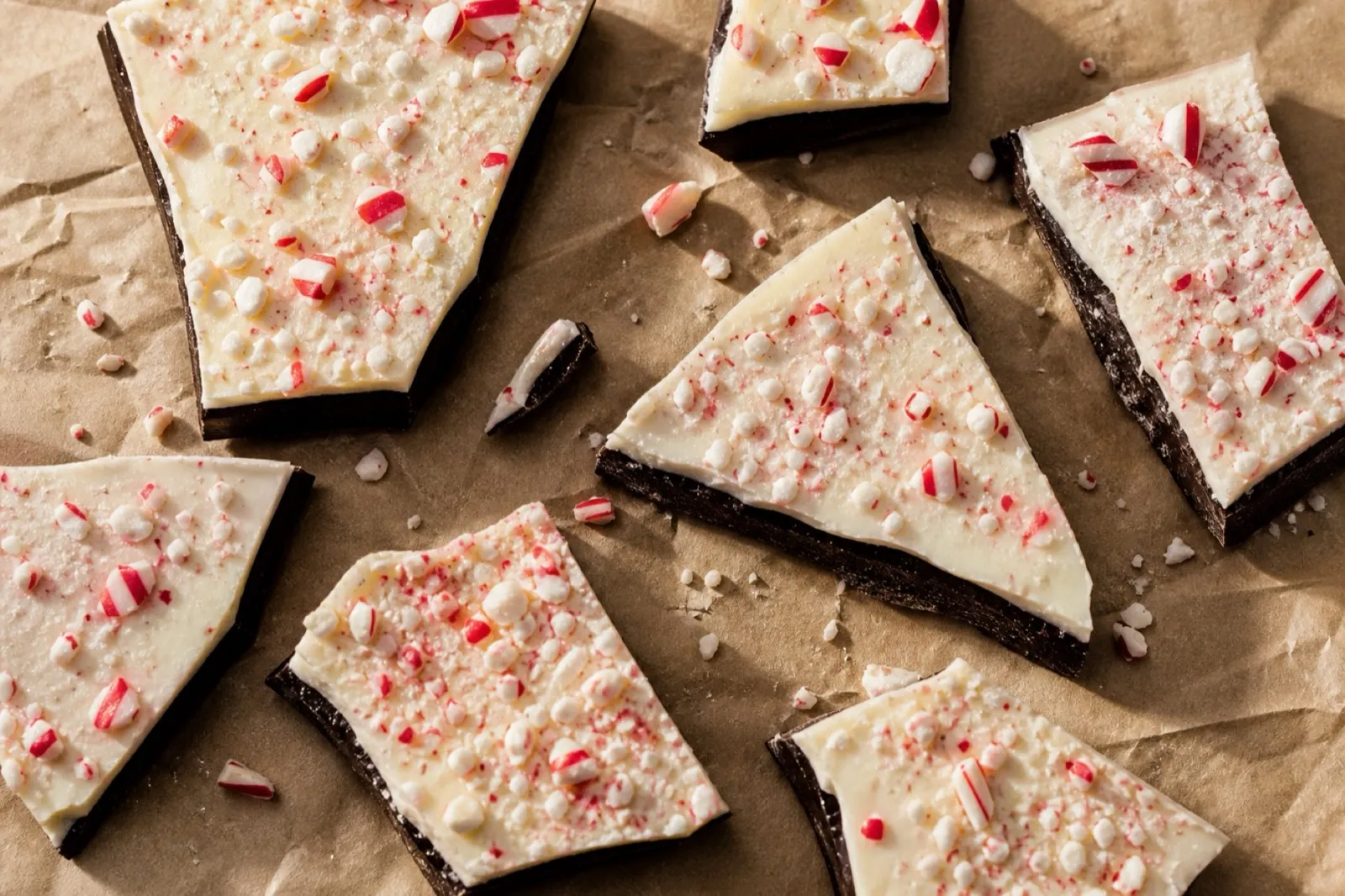
Peppermint bark is the gateway drug of chocolate work: two chocolate layers, no baking, and yet it quietly teaches the two skills that run all of confectionery — tempering and timing. When the temper succeeds, it can have cleaner snap and gloss than a melt-and-pour version. Some commercial versions use compound coating instead of cocoa-butter white chocolate, which follows a different setting process.
This is an application piece. The full technique it applies — what Form V crystals are and how the seed method summons them — lives in how to temper chocolate and seeding vs. tabling. For probe selection and the difference between measuring the chocolate mass and its surface, see the chocolate thermometer guide. ThermoWorks’ chocolate-tempering guide also lays out the seed sequence and smear test.
The Recipe
Flavoring strength and formulation vary, so follow the product maker’s chocolate-use guidance. The exact chocolate maker’s tempering curve and a successful smear test outrank generic temperatures.
Yield: about 650g of bark | Active: 40 minutes | Set: 1-2 hours at cool room temperature
Ingredients:
- 300g dark chocolate (60-70%), chopped, divided for seeding
- 300g white chocolate (containing cocoa butter), chopped, divided for seeding
- food-grade peppermint flavoring explicitly labeled or documented as suitable for chocolate or confectionery; use the product maker’s dose
- 8 mini candy canes or 4 full-size (about 50g), crushed coarse and sifted of dust
Method:
- Line a 9x13 pan with parchment. Crush the candy canes in their wrappers with the back of a knife — coarse shards, not powder — and sift out the fine dust.
- Temper the dark layer by the seed method: melt 225g of dark to 115-120F as a common starting point, remove from heat, add the reserved 75g in pieces, and stir toward 88-90F for standard couverture. Follow the chocolate maker’s curve, stir to even out gradients before measuring, and use an immersed probe. Remove any unmelted seed at the working range rather than reheating past the curve; confirm the temper with a small test dab that sets promptly without streaking. Set time depends on room temperature, sample size, and chocolate.
- Stir a small, measured amount of food-grade peppermint flavoring into the tempered dark chocolate. Use only a product whose maker approves it for chocolate or confectionery and follow that product’s dose; LorAnn’s flavor FAQ, linked below, is one example of product-specific guidance. Strengths and solvent systems vary.
- Spread evenly in the pan, about 3-4mm. Tap the pan flat. Let it set at cool room temperature until firm to a light touch but still dentable; in a cool room this may take roughly 15-20 minutes, but the cue matters more than the clock.
- Temper the white layer: melt 225g slowly in short bursts with frequent stirring, seed with 75g, and work down to 82-84F only if that matches the chocolate maker’s curve. Remove any unmelted seed at the working range rather than reheating past the curve, then stir in the product-specific peppermint flavoring.
- Pour the white chocolate over the dentable dark layer and spread to the edges quickly. If the dark layer has set completely hard, the bond is less predictable.
- Immediately scatter the crushed candy canes and press them in gently with a flat palm.
- Set at cool room temperature until fully hard; the time depends on room temperature, layer thickness, and chocolate. Break or cut into rough pieces.
Why Temper Bark At All?
Untempered bark still sets, but its finish and room-temperature behavior are less predictable. The comparison:
| Tempered | Untempered | |
|---|---|---|
| Snap | Clean crack when the temper succeeds | May bend or break less cleanly |
| Surface | Glossy when the temper succeeds | May be duller or more bloom-prone |
| At room temp | Better snap and bloom resistance | Can be softer or more fingerprint-prone |
| Gift/ship | Better quality margin in cool conditions | Use sooner and avoid warm shipping |
| Effort | More active steps | Fewer active steps |
White or gray streaking can be fat bloom — cocoa butter recrystallizing into a visible surface film. It is generally a quality defect rather than a safety signal; the mechanism is covered in fat bloom vs. sugar bloom. For gift bark where gloss, snap, and bloom resistance are part of the promise, tempering is the appropriate method.
Temperature crib sheet, per the standard schedule: for a standard dark couverture, a common starting point is a melt-out around 115-120F and a working range around 88-90F. Milk and white chocolate use cooler curves, but the maker’s instructions control; any generic range is only a starting point when it matches the product guidance. White chocolate must actually contain cocoa butter — check the label for it. Compound “white coating” made on palm kernel fat sets without cocoa-butter tempering and uses a different fat system. Do not assume it will bond reliably to a real-chocolate base layer; use real white chocolate here unless the coating maker explicitly says the products are compatible. The label-reading guide for that distinction: couverture vs. compound.
The Two Classic Failures, Solved
Failure one: the layers separate at the cut. Cause: the dark layer set completely — cooled, contracted, and sealed its surface — before the white layer arrived, so the white layer is sitting on it, not bonded to it. The fix is the dent test: pour the white layer when the dark is firm to a light touch but still takes a fingernail dent, often roughly 15-20 minutes in a cool room; use the cue rather than the clock. If the layer has already become completely hard, do not force the bond; the finished bark may need to be treated as a less predictable two-layer set.
Failure two: the chocolate seized. Traditional peppermint extracts often carry water and/or alcohol into a fat-based chocolate system, and the added liquid can turn smooth chocolate grainy and stiff. ThermoWorks’ bark guidance calls for peppermint oil rather than extract. Flavor products are not all formulated alike, however: LorAnn’s current flavor FAQ says many of its concentrated Super-Strength flavors and food-grade essential oils are suitable for chocolate, and notes that some products labeled water-soluble can still work at appropriate use levels. Use only a food-grade flavoring whose manufacturer explicitly approves chocolate or confectionery use, follow its dose, and do not assume that the words “extract” or “candy oil” tell you enough. An aromatherapy or fragrance product not labeled for food does not belong in the pan.
Candy cane prep is the third, minor failure: pulverized canes shed pink dust that smears the white layer gray. Crush coarse with the back of a knife, sift the dust out (stir it into cocoa for hot chocolate — it is peppermint sugar), and press only shards into the surface.
Gifting Logistics
For best quality, keep this dry, tempered bark airtight in a cool, dry room and follow the shortest-lived ingredient or package guidance. The candy topping is most useful while its shards are still crisp. Layer pieces between parchment. Refrigerate only if the room is too warm to keep the bark firm, and let the closed container warm before opening to avoid condensation. For gifting, copy the Contains statements from both chocolates, the candy canes, and the exact flavoring, and do not promise allergen-free bark from shared equipment. Cold-weather shipping gives more temperature margin, but tempering cannot protect a package from a warm vehicle or mailbox.
Scale: this roughly 650g finished batch (600g chocolate plus about 50g of candy) fills three modest gift tins. To double while keeping the 3-4mm layers, use two 9x13 pans or one 13x18 half-sheet — doubling in the same pan gives a 12mm-plus slab that fights the bite.
Frequently Asked Questions
- Can I make peppermint bark without tempering?
- Yes -- melt gently and layer with the same timing. The surface, snap, and bloom resistance will be less predictable and may be softer or duller. Refrigerate only if the room is too warm to keep it firm, then let the closed container warm before opening. For gifts where finish and room-temperature stability matter, temper both layers.
- Why did my white chocolate clump when I melted it?
- White chocolate scorches and clumps at temperatures dark tolerates -- its milk solids and sugar are heat-sensitive. Melt it slower and lower, in short bursts with stirring. Confirm that it is real white chocolate with cocoa butter; white coating made with palm-kernel fat behaves differently and should follow its own product guidance.
- Can I use peppermint extract?
- Do not assume that a generic peppermint extract is safe for melted chocolate. Traditional water- or alcohol-containing extracts can introduce enough liquid to seize chocolate, while some concentrated flavor systems are specifically formulated for chocolate. Use a food-grade product whose maker explicitly approves chocolate or confectionery use, and follow its product-specific dose.
- How much peppermint flavoring should I use?
- There is no reliable universal drop count because products vary in concentration and formulation. Start with the amount specified by the flavor maker for chocolate, use a small measured amount, and stay within that product's guidance. Product names such as 'candy oil' do not by themselves establish a fixed dose or oil base.
- Milk chocolate instead of dark for the base?
- Works -- sweeter result, and temper it to the milk schedule rather than the dark schedule. Dark-under-white is the classic because the bittersweet base balances a very sweet top layer plus candy.
- How thick should each layer be?
- Aim for 3-4mm per layer, 6-8mm total. Thicker bark fights the bite and layers can shear at the cut; thinner bark can shatter into slivers. Spread each layer to the target thickness and check it rather than assuming a fixed pan-and-quantity combination will land exactly there.
Once the two-layer timing is in your hands, the whole genre opens up: the single-layer chocolate bark master method uses the same temper with a wider range of dry toppings and no layer-bonding step.