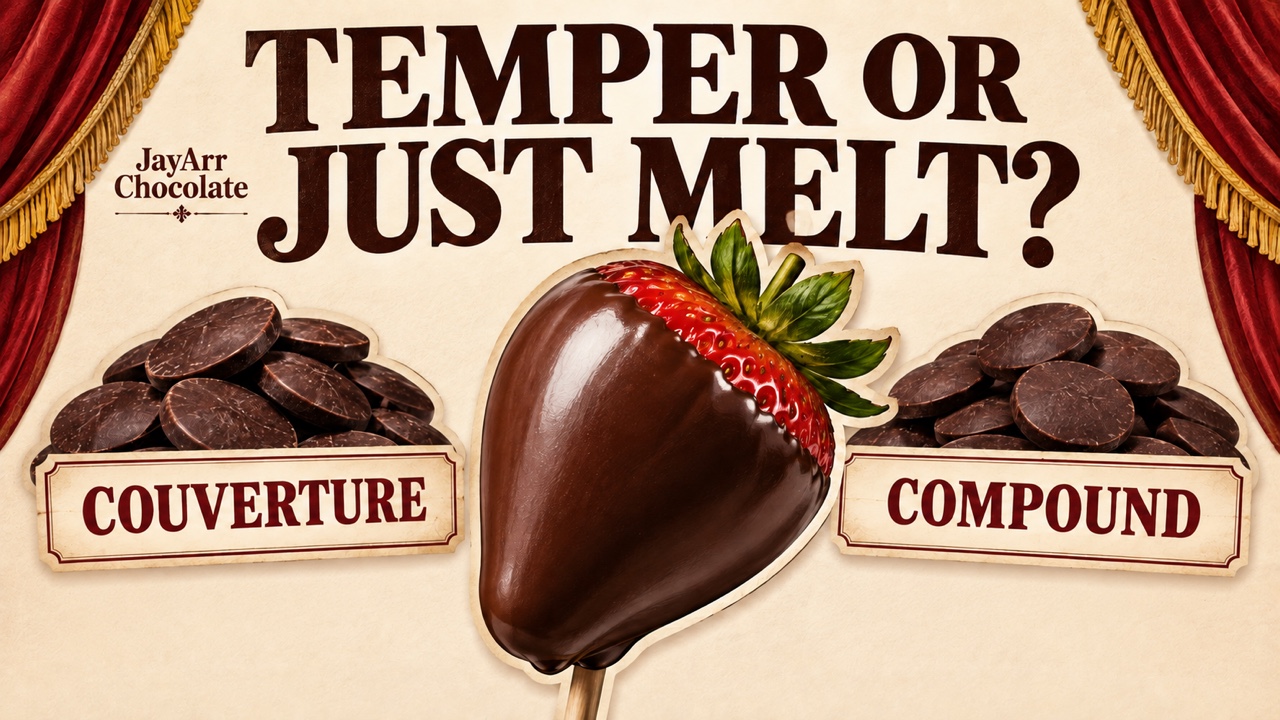
Two bags of brown wafers can look almost identical, yet need different handling. One may be couverture for a thin chocolate shell. The other may be a compound coating designed for convenient dipping. Melt them both, and the difference becomes a question of how the fat sets.
That distinction is useful when choosing chocolate for bonbons, cake pops, cookies or dipped fruit. It does not make one product universally superior. First decide what finish you want, then check the particular product’s instructions.
What Makes Chocolate Couverture?
Couverture is chocolate intended for coating and other confectionery applications, with a cocoa-butter-rich composition. It is not simply any bar that lists cocoa butter.
The EU gives the term a compositional definition: dark couverture must contain at least 35% total dry cocoa solids, including at least 31% cocoa butter and 2.5% dry nonfat cocoa solids. Milk couverture has a different criterion: at least 31% total fat from cocoa butter and milk fat, alongside the milk-chocolate requirements. The dark-chocolate figures should not be applied to every type. These requirements appear in Directive 2000/36/EC, Annex I.
Fluidity still varies from product to product. Additional cocoa butter can make a chocolate flow more readily, but the word couverture does not promise one fixed viscosity or fat percentage above the required minimum. Callebaut’s fluidity guide distinguishes products suited to large hollow figures from those suited to thin shells and fine coating work. Choose a product’s stated application or fluidity rating rather than assuming every couverture pours the same way.
Milk fat is normal in milk and white chocolate. Cocoa butter may also be present within cocoa mass or chocolate liquor, so an ingredient list need not show a separately added portion. For the difference between cocoa content and cocoa butter content, see what cacao percentage means.
Why Couverture Needs Tempering for Shells
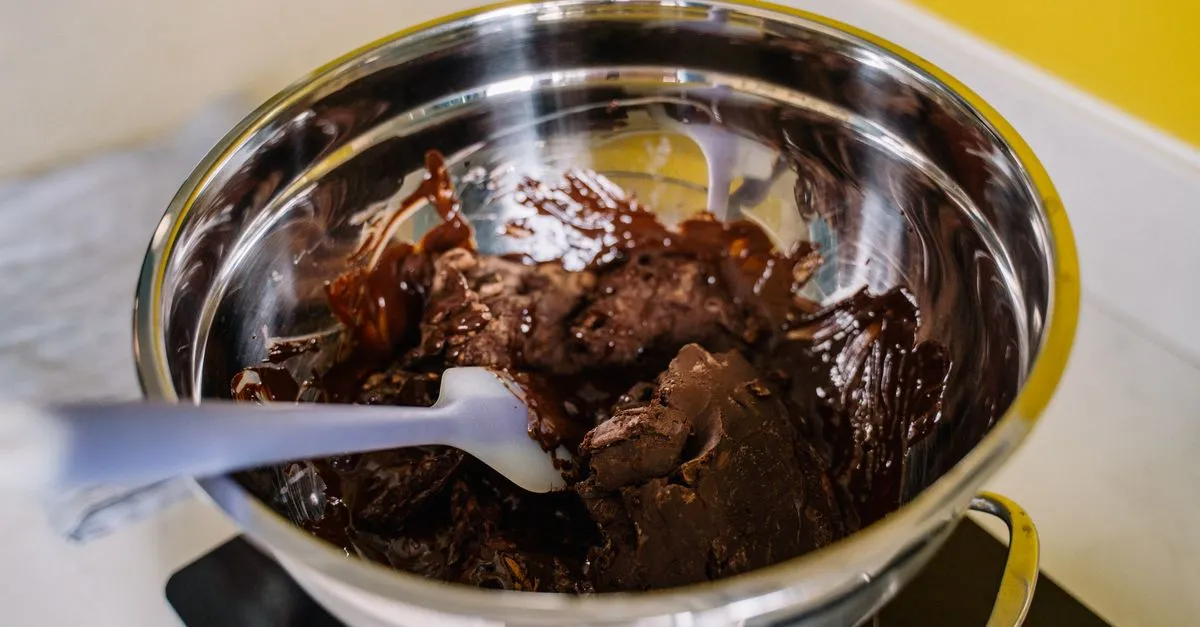
Tempering develops the cocoa butter crystal structure needed for a firm, glossy chocolate finish. It supports snap and contraction during cooling, which helps chocolate release from a mold. Callebaut explains these effects in its tempering tutorial.
For molded bars, bonbon shells and chocolate decorations, the usual target is a suitable population of Form V cocoa butter crystals. Simply letting fully melted couverture cool can produce an uneven finish or poor set. The outcome depends on the chocolate and its temperature history; bloom is not guaranteed to appear on a universal timetable.
Tempering matters to the finished application, not just the name on the bag. If chocolate is being incorporated into a cake or sauce, follow that recipe rather than automatically adding a shell-making tempering cycle. Ganache has its own formulation and crystallization choices: Callebaut explicitly teaches both tempered and untempered ganache methods.
For a practical shell-making method, use our tempering guide and your chocolate manufacturer’s temperatures. Good tempering is a learnable process, not a reason to rule out couverture for a home project.
What Compound Coating Changes
Common compound coatings replace much or most of the cocoa-butter fat system with other vegetable fats. The selected fats let the coating set without the usual cocoa-butter tempering process. Chocolate-flavored versions contain cocoa ingredients; white or colored candy coatings may have no nonfat cocoa solids.
These are formulated products, not a single universal recipe. Barry Callebaut’s compound-coating range includes firm coatings, flexible glazes and different fluidities for different jobs. A donut glaze and a crisp molded coating need not behave alike.
Common fat categories include:
- CBS, or cocoa butter substitutes: generally lauric fats derived from sources such as palm kernel or coconut. These typically tolerate little cocoa butter.
- CBR, or cocoa butter replacers: non-lauric fats with greater, but product-dependent, compatibility with cocoa butter.
- CBE, or cocoa butter equivalents: fats designed to behave more like cocoa butter. These generally still require tempering; they are not the same as ordinary no-temper CBS or CBR coatings.
AAK’s technical guide distinguishes these categories and their processing requirements. The broad claim that all compound fats have only one crystal form is inaccurate: experimental research has examined polymorphic behavior in lauric-rich fats. The useful kitchen distinction is the handling process the supplier specifies.
No Tempering Still Requires Care
A no-temper coating still needs appropriate melting, cooling and storage conditions. It does not become immune to moisture, overheating or an unsuitable room temperature.
Wilton’s Candy Melts instructions call for dry equipment and gentle heating. Its troubleshooting guidance warns that moisture and overheating can spoil consistency and that adding arbitrary oils can change how the coating sets. Use the supplier’s approved thinning method instead of treating every fat as interchangeable.
Mouthfeel, gloss, snap and heat resistance also vary. Some coatings can feel waxy; others are formulated for a quicker melt and a crisp bite. For example, Callebaut describes its Hard Coating Top Extra Dark as a no-temper product with a hard crack and gives specific cooling instructions. That is a manufacturer specification, not a comparative tasting we performed.
Do not infer that a compound coating will survive a hot car. Check its storage and service conditions. The category name alone does not establish a melting point or transport guarantee.
Read the Full Label, Then the Instructions
A product’s complete name, ingredients and handling directions are more reliable than its shape or one isolated word.
- Find the product description. Couverture, chocolate, confectionery coating and candy coating give useful clues, but not every product called chocolate is couverture.
- Identify the fat system. Cocoa butter or cocoa mass points toward a cocoa-butter system; palm-kernel or other replacement fats can point toward compound. Milk fat, nuts and fillings need to be understood in context.
- Check the intended use and setting instructions. Look for tempering directions, a no-temper statement, fluidity information and suitable applications. Ask the supplier if the description is unclear.
US 21 CFR Part 163 does not define a separate couverture identity. Its sweet, milk and white chocolate standards differ from the vegetable-fat coating standards. Crucially, sections 163.153 and 163.155 permit names such as sweet chocolate and vegetable fat coating and milk chocolate and vegetable fat coating. Seeing the word chocolate beside vegetable fat is therefore not, by itself, proof of mislabeling. Nor does permitted dairy fat make milk chocolate a compound coating.
The EU allows certain specified vegetable fats in addition to cocoa butter, subject to a 5% limit, a required declaration and retained minimum cocoa-butter and cocoa-solids contents. That percentage is calculated after deducting qualifying added edible matter; it is not permission to replace 5% of the required cocoa butter. Article 2 and Annex II set the conditions. Such a permitted addition does not automatically turn chocolate into a no-temper compound.
Chips and wafers are shapes. A chip can be cocoa-butter chocolate, a baking formulation with different flow, or a confectionery coating. Our chocolate-chip melting guide explains that distinction in more detail.
Which Should You Choose?
Choose a specific product for the result you want, then test a small amount before committing the whole batch.
For a cocoa-butter chocolate shell: choose couverture with suitable fluidity and a flavor you like, then temper it correctly. Bonbons, molded bars and dipped sweets are all reasonable uses. Couverture can also coat cake pops; the extra handling is a choice, not a guarantee of failure.
For convenient dipping or colored decorations: a compound or candy coating sold for that application may simplify the work. Follow its melting and cooling directions. Compounds are used professionally as well as at home; ease of handling is not evidence of poor workmanship.
For baking, sauces and fillings: start with a tested recipe. Switching fat systems can change texture and setting, so a successful dipping substitution does not prove that the same swap will work in ganache or brownies.
For blending leftovers: check compatibility first. Mixing a lauric CBS coating with cocoa-butter chocolate can produce unwanted softening. Non-lauric products can have different tolerances, so there is no universal safe blending ratio. Our cocoa-butter alternatives guide introduces the terminology; the supplier’s specification decides a particular blend.
The practical question is straightforward: Do you want this chocolate’s flavor and a tempered shell, or this coating’s specified handling and finish? Both can make attractive sweets. Read the bag, choose for the job and give the fat system the conditions it needs.
Frequently Asked Questions
- Does compound chocolate need to be tempered?
- Common CBS- and CBR-based compound coatings are formulated to set without cocoa-butter tempering. They still need the supplier's melting, cooling and storage conditions. CBE-based formulations can require tempering, so read the actual product instructions.
- Does couverture always need tempering?
- For firm, glossy chocolate shells, molded bars and decorations, its cocoa butter needs proper crystallization. Chocolate mixed into a cake, sauce or filling follows that recipe's process; not every application calls for a separate tempering cycle. Ganache methods also vary.
- Can I substitute compound for couverture in any recipe?
- No universal substitution works. A compound sold for dipping can be convenient for coatings, but changing fat systems can change flavor, texture and setting in other recipes. Do not blend it with couverture unless the supplier confirms compatibility, especially for lauric CBS coatings.
- Are chocolate chips couverture or compound?
- Chips describes a shape, not a fat system or grade. Many chips are cocoa-butter chocolate, some have formulations intended to hold their shape in baking, and others are confectionery coatings. Read the product description, ingredients and intended use.
- Does vegetable fat on a chocolate label prove it is mislabeled?
- No. Milk fat is permitted in appropriate chocolate standards, fats may belong to nuts or fillings, and the US recognizes names such as milk chocolate and vegetable fat coating. EU rules also allow specified vegetable fats under defined limits and labeling conditions. Read the full product name and ingredient context.
- Is compound always waxy or more heat-resistant?
- No. Melting profile, mouthfeel and heat resistance depend on the formulation. Some coatings are engineered for a crisp bite and rapid melt; others prioritize flexibility or handling. Check the particular product's specifications rather than assuming every compound behaves alike.
- Is couverture worth using for cake pops?
- It can be if you want that chocolate's flavor and are willing to temper it for a firm coating. A no-temper coating may be more convenient. Neither choice guarantees success: use suitable fluidity and follow the product's handling directions.