Choose your tempering method around the chocolate, equipment, and workspace you actually have. A bowl of reliably tempered couverture makes seeding convenient. Freshly made chocolate without a seed supply may make tabling attractive. Practice matters with either approach; the comparison below is a guide to their demands, not the result of a timed head-to-head trial.
For the fundamentals, start with how to temper chocolate, its interactive temper curve, and cocoa butter chemistry and polymorphism. Use the chocolate manufacturer’s instructions to set your actual process.
What Each Method Does
Tempering controls cocoa-butter crystallization so chocolate sets with a desirable structure. Form V is the usual target for finished chocolate’s gloss, snap, and contraction. It is not cocoa butter’s most stable possible form, and a kitchen thermometer does not identify a crystal form directly.
At working temperature, tempered chocolate contains a small population of crystals within a still-flowing mass. It is not entirely solid Form V somehow remaining liquid. Cooling, stirring, and elapsed time all affect how much has crystallized.
Seeding introduces suitable existing crystals from tempered chocolate. Some seed melts while helping cool the batch; enough suitable crystals must remain or develop to establish temper. Tabling cools part of a melted batch on a stone surface. Returning that portion to the warm reserve brings the combined chocolate toward its working condition. Cooling can produce more than one crystal form; tabling does not exclusively create Form V the moment the chocolate looks thicker.
These practical distinctions follow the manufacturers’ tempering guidance. Temperature guides the process, while a set sample checks the result.
Seeding: Choose One Complete Protocol
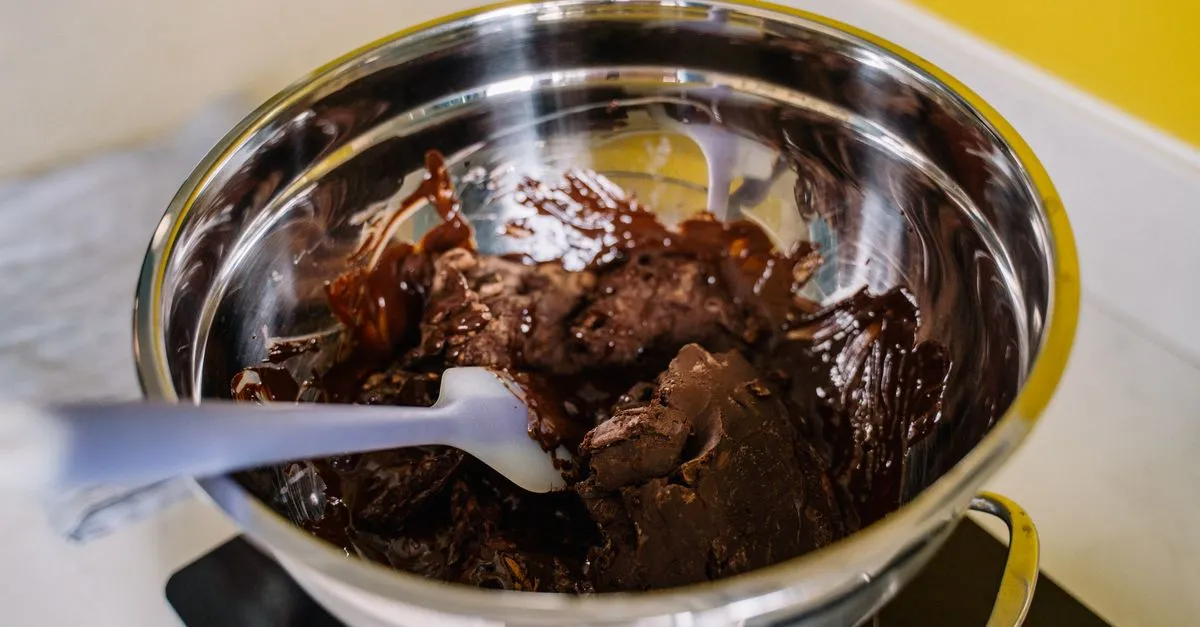
Have a dry bowl, a spatula, a gentle heat source, and a reliable thermometer. Use seed that is in good condition and compatible with the batch. A bar that has melted during storage is not automatically reliable seed because its label names a reputable maker.
Seeding protocols differ. Some cool toward working temperature while seed is stirred in; others cool farther and then rewarm. Do not combine one method’s seed quantity with another’s cooling target. Callebaut’s Callets method, for example, adjusts seed quantity to the temperatures of the melt and seed. Its rule of thumb of about 5% at a melt temperature around 40°C is a specific starting condition, not a replacement ratio for every recipe.
Seeding Workflow
Follow the complete method for your chocolate and seed
- 01
1. Prepare
Check the product's method and reserve suitable tempered seed.
Keep the bowl, spatula, and thermometer dry. - 02
2. Melt Gently
Use the prescribed melting temperature.
Avoid local overheating; 50°C is not a universal target for every chocolate. - 03
3. Add Seed
Add and stir at the point specified by the chosen protocol.
Account for seed quantity and temperature; do not wait for a universal 27°C trigger. - 04
4. Adjust
Reach the method's working condition while stirring.
A cool-and-rewarm protocol and a direct-to-working-temperature protocol are different routes. - 05
5. Test
Check a thin sample before filling molds or dipping.
Use the sample, temperature, and flow together to assess readiness.
What does a 1:3 seed ratio mean?
One part seed plus three parts melted chocolate makes four parts total. For example, 100 g seed plus 300 g melt is 25% seed in the final 400 g batch, or 33.3% relative to the original melt. Those denominators are not interchangeable. This arithmetic explains the ratio; it does not establish a universal recommended dose.
King Arthur’s semisweet seeding recipe reserves approximately a quarter of the total chocolate and adds it during cooling. That is one workable recipe, with its own cooling and reheating steps. Use a complete recipe like that when learning instead of constructing a hybrid from unrelated charts.
Cocoa-butter powder is a separate seeding method
Mycryo is a crystallized cocoa-butter powder, not ordinary pantry cocoa butter and not simply chopped chocolate at a smaller dose. Cacao Barry’s Mycryo instructions specify melting at 40–45°C, cooling to 34–35°C for dark or 33–34°C for milk and white, then adding 1% powder by chocolate weight: 10 g per 1 kg. Their stated working temperatures are 31–32°C for dark and 29–30°C for milk and white. Follow that product’s current instructions; its addition temperatures should not be swapped into an ordinary chopped-seed recipe.
Seeding’s practical advantages and limits
Seeding needs little counter space and avoids transferring a pool of chocolate onto a slab. It is my suggested starting method for a home kitchen that already has suitable seed. That recommendation reflects convenience, not measured proof that it fails less often in every kitchen.
Seed also changes the batch’s composition. Using the same chocolate preserves the intended flavor, cacao percentage, and allergen profile most closely. Another chocolate’s lecithin does not automatically ruin temper, and inexpensive couverture does not necessarily contain incompatible fats. Read the actual ingredients rather than judging compatibility by price.
Neither a large seed addition nor a warm room makes success automatic. Excess crystallization can thicken chocolate, and a warm environment can make finished pieces difficult to set. Scaling up changes the heat that must be removed, mixing, and handling; no fixed 200 g–10 kg range works with only a token ratio adjustment.
Tabling: Cool Part of the Batch on a Slab
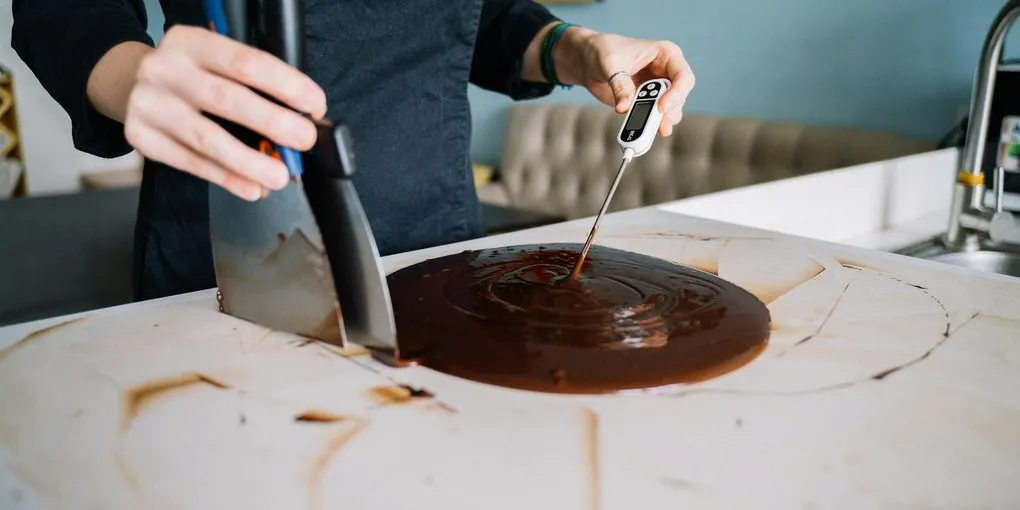
Use a clean, dry, food-contact stone surface, a scraper, and a palette knife. A cool slab draws heat from chocolate; a warm slab is less useful. Refrigerating a slab is not a requirement, and a surface with condensation is unsuitable for chocolate work.
Callebaut’s tabling tutorial works roughly two-thirds of the melt on marble and keeps the rest in the bowl. Move the chocolate continuously, then return the thickening portion to the reserve. Follow the product’s cooling and working targets rather than assuming every dark chocolate must hit the same number.
Tabling Workflow
Cooling and movement build crystals before recombination
- 01
1. Melt
Melt according to the chocolate's instructions.
Keep the equipment dry and prepare the slab before pouring. - 02
2. Divide
Work about two-thirds on the cool slab; reserve the rest.
The warm reserve helps bring the cooled portion back toward working temperature. - 03
3. Move
Spread and gather the chocolate continuously.
Monitor temperature and thickening; appearance does not identify a polymorph. - 04
4. Recombine
Return the cooled portion and mix thoroughly.
Use the chosen product curve; do not leave the chocolate to solidify on the slab. - 05
5. Check
Confirm temperature, flow, and a thin temper sample.
Correct cautiously before committing the batch to finished pieces.
Tabling gives immediate feedback about flow as the chocolate cools. That can help you learn how crystallization affects handling, but a ropy or matte appearance is not proof of good temper. Nor does excessive cooling uniquely diagnose Form III or IV: the chocolate may simply contain too much solid material to work comfortably.
The method requires space and transfers chocolate across more surfaces. A small pool may cool too quickly; a large pool may exceed the slab’s useful area or cooling capacity. There is no universal 2 kg limit or 22°C room-temperature failure threshold. Match the batch to the surface and your ability to keep it moving.
Poor temper can contribute to fat bloom, but visible bloom is not evidence that a particular crystal transition happened within a fixed number of days. Storage temperature changes and fat migration from fillings also matter.
Compare the Demands, Not Invented Timings
Seeding vs. Tabling
Choose around your seed supply, workspace, and handling preferences
Seeding
- Workspace
- Bowl and heat source
- Seed supply
- Required
- Batch capacity
- Equipment-dependent
- Main handling task
- Stir and monitor
- Convenient when you have compatible, well-tempered chocolate.
- Use a complete seeding protocol, with a clear ratio denominator.
- Watch for both insufficient and excessive crystallization.
Tabling
- Workspace
- Cool, dry stone slab
- Seed supply
- Not required
- Batch capacity
- Surface-dependent
- Main handling task
- Spread and gather
- Useful when your batch has no ready supply of tempered seed.
- Thickening is useful feedback, not a crystal-form measurement.
- Plan the transfer and cleanup before starting.
Practical method-selection guidance; no comparative speed or failure-rate test is claimed.
jayarrchocolate.comChoose seeding when a bowl-based process fits your kitchen. Choose tabling when you have the surface, space, and interest in learning the handling technique. Both can prepare chocolate for filled bonbon shells or bar molds. For repeated failures, work through chocolate won’t temper before buying more equipment.
Product Examples for a Three-Stage Curve
The following are named examples from Callebaut’s tempering guide. They illustrate melting, cooling, and warming for these products; they are not mandatory cooling steps for every seeding method.
Example Three-Stage Tempering Curves
Callebaut 811, 823, and W2; use your own product's instructions
| Product | 01Melt | 02Cool | 03Work |
|---|---|---|---|
| 811 dark | 50°C / 122°F | 27°C / 80.6°F | 31–32°C / 87.8–89.6°F |
| 823 milk | 45°C / 113°F | 27°C / 80.6°F | 29–30°C / 84.2–86°F |
| W2 white | 45°C / 113°F | 27°C / 80.6°F | 28–29°C / 82.4–84.2°F |
The guide lists 40–50°C for 811's melt; this example uses its upper endpoint. These are process targets, not universal instant-loss-of-temper thresholds.
jayarrchocolate.comMilk fat and the rest of the formulation affect handling and suitable temperatures. Cacao percentage alone cannot calculate a validated tempering curve. Crossing the upper working target briefly is not equivalent to instantly destroying every useful crystal; the temperature reached, time, and state of the batch matter. Stay within the supplier’s method and test after an adjustment.
Test and Correct the Batch
Spread a thin smear on a dry knife, spatula, or suitable paper. Under a suitable cool room condition it should set evenly without obvious streaking. A few minutes is a useful observation window, not a universal pass/fail deadline: sample thickness and room temperature affect the result. A test also does not guarantee long-term storage stability.
If the chocolate thickens while you work, do not automatically reset the entire batch. Callebaut’s overcrystallization guidance describes gentle warming or adding suitable melted, untempered chocolate to reduce excess crystals. Stir, control the adjustment, and test again. Thick or grainy chocolate can also reflect unmelted pieces, moisture, or overheating; those need a different diagnosis.
A poorly tempered, otherwise sound batch can usually be remelted and retempered. Burned flavor and contamination are not repaired that way. Adding enough liquid can turn seized chocolate into a usable sauce or filling, but that changes its use; it does not restore ordinary molding chocolate.
For measurement, stir the bowl thoroughly and use a suitable probe without touching the bowl. An infrared instrument reads the surface it is aimed at—including chocolate, not only the slab. ThermoWorks explains the surface limitation. Surface readings can be useful on thin chocolate being moved across a slab; they do not automatically represent the center of a deep bowl.
When a Machine Helps
Distinguish a melter, a batch temperer, and a continuous tempering machine. A Mol d’Art dry-heat melter supplies controlled heat; it is not an automatic cooling-and-seeding system. ChocoVision’s Revolation line uses a different batch process with seeding prompts. Its manufacturer FAQ explains that chocolate can still overcrystallize during holding and that its overnight melt mode is not the same as holding tempered chocolate.
A machine can reduce repetitive handling, but it does not eliminate formulation, environment, or maintenance requirements. Compare minimum batch size, usable capacity, cleaning time, and the steps you still perform. There is no defensible universal rule that 15 kg per month pays for a machine. Base the purchase on your actual labor and output needs; the tempering-machine guide is a starting point for comparing equipment categories.
Frequently Asked Questions
- Can I temper chocolate without a thermometer?
- Experienced makers may judge a familiar process by feel, but a suitable thermometer makes learning and troubleshooting much easier. Neither a temperature reading nor a visual texture change replaces a temper sample.
- Is seeding more reliable than tabling?
- Seeding is a convenient starting point if you have suitable seed and limited counter space. Both methods can work well, and neither is guaranteed. This guide does not claim a measured failure-rate comparison.
- Why does tabling use marble?
- A cool stone slab can absorb heat while providing a smooth surface for spreading and gathering the chocolate. Its temperature, thickness, and working area matter. Visible thickening shows a change in the batch, not a direct identification of Form V.
- What if my seed is a different chocolate?
- It changes the recipe, including flavor and potentially allergens. The same chocolate is the simplest choice. Lecithin or a lower purchase price does not by itself make another couverture unsuitable; check composition and temper.
- Can I remelt a batch that did not set properly?
- Usually, if the problem is temper and the chocolate is otherwise sound. Repeat the product's method. Retempering does not remove burned flavor, moisture damage, or contamination.
- How much seed should I add?
- Use the quantity in your selected protocol. A 1:3 seed-to-melt ratio means 25% of the final batch, not 25% of the melt. Crystallized cocoa-butter products have their own doses and addition temperatures.
- Why did my chocolate become thick or grainy?
- Excess crystallization is one possibility; unmelted pieces, moisture, and overheating are others. Check the cause before adding more seed or restarting. A controlled warming adjustment can sometimes correct overcrystallization.
- Can I combine seeding and tabling?
- A planned hybrid can work, but an arbitrary extra pinch of seed is not insurance. It changes the crystal population and can worsen thickening. Learn one complete method first, then adjust deliberately and test.