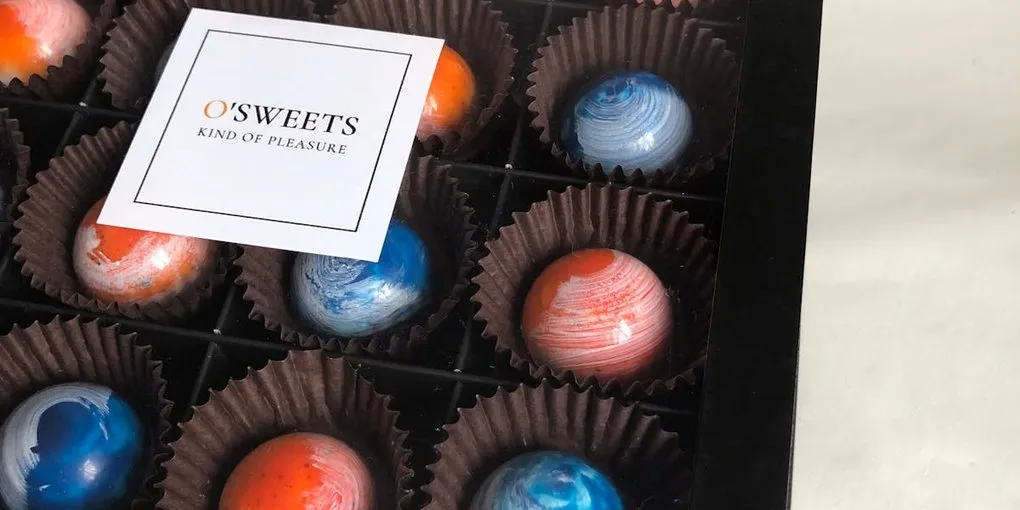
Colored cocoa butter can turn a plain molded bonbon into a pattern of dots, brushstrokes or swirls. The cocoa butter helps the decoration adhere to a chocolate shell, but good results still depend on the product, mold, layer thickness, crystallization and cooling conditions.
This guide covers the decorating material and five hand techniques. For spray equipment and its setup, use our companion airbrushing chocolate bonbons guide. You can learn the essentials with a small bottle and a food-contact brush before buying an airbrush.
What Is in Colored Cocoa Butter?
Most products combine cocoa butter with fine colorant particles. Fat-dispersible is often a more accurate description than “fat-soluble”: many pigments remain suspended particles rather than dissolving in the fat. Formulations vary, and some products contain sugar, milk ingredients, fruit powders or other solids. There is no useful universal cocoa-butter percentage for every decorating product sold under this name.
Pigment may settle while a bottle stands. Stir or shake as directed during warming so the color is evenly distributed before application. An unmixed bottle can deliver weak color from one portion and a concentrated streak from another. This is dispersion, not proof that the ingredients have spoiled.
Buy by intended food use and the exact label, not just the color’s mineral or plant origin:
- Opaque whites may use titanium dioxide or a different whitening ingredient. Formulations suitable for one country may not be permitted in another.
- Bright synthetic colors, including some FD&C lakes, are available in fat-compatible products. The specific additive and permitted application matter.
- Iron-oxide colors can produce earthy or metallic effects. Their identity and food-use conditions are regulated; a generic mineral pigment is not automatically edible.
- Pearlescent products may use specially manufactured mica-based pigments. Craft mica is not a substitute.
- Colors from plant sources can behave differently in heat, light and different bases. A powder intended for a drink is not automatically suitable for dispersing in cocoa butter.
The FDA’s advice on decorative glitters and dusts is straightforward: look for an edible product with an ingredient list. “Non-toxic” and “for decoration only” do not make a product suitable to eat. Keep non-edible display decorations off edible bonbons.
There are also jurisdiction-specific rules. EU Regulation 2022/63 removed the authorization for titanium dioxide, E171, in food. The US titanium-dioxide rule permits specified uses subject to a 1% limit by food weight and restrictions for standardized foods. US rules for synthetic iron oxide and mica-based pearlescent pigments have their own conditions. For products you sell, obtain the supplier’s documentation for the exact color and intended confectionery use rather than assuming that a whole brand or pigment family is universally approved.
Choosing a Brand and Product
These suppliers offer different formats. The comparison is based on published product information, not a hands-on ranking.
Roxy & Rich Artist Collection
Roxy & Rich Artist CollectionRoxy & Rich sells pre-mixed, pre-tempered colors for molding and direct decoration. Its Artist Collection information explicitly notes that food-use standards differ by country. Check the actual bottle’s formulation, size and regional labeling, including whether it is the E171-free version where that is required. Do not infer grams from fluid ounces: colorant loading changes density.
The maker’s product sheet describes short microwave intervals with shaking, stopping when the quantity needed has melted. That is a partial-melting approach, not a requirement to take every bottle to 45°C.
Chef Rubber
Chef RubberChef Rubber’s collection guide distinguishes opaque Artisan colors, shimmering Jewel colors and Decor products for non-consumable display work. Choose an edible line and check each color’s label. Decor-only cocoa butter should not be painted onto something that will be served and eaten.
The brand’s preparation instructions differ from a complete melt-and-retemper cycle; see the warming section below. Its wider range also includes natural-origin and infused products, so the collection name alone does not specify every ingredient or allergen.
Mona Lisa / IBC Power Flowers
Mona Lisa Power FlowersPower Flowers are concentrated cocoa-butter-based color portions for mixing into a base. The manufacturer lists AZO, non-AZO and natural-origin ranges; its red and yellow non-AZO examples specify 40% pigment. Do not apply that number to every product bearing the name or use a “handful” as a dosage.
Use the matching color chart or recipe, the specified base quantity and the instructions for that formulation. Pre-tempered concentrate does not automatically put an entire hot mixture into temper. These are useful when you want to reproduce a mixed shade; ready-mixed bottles are simpler when you want to start with one color.
PCB Création
PCB CreationPCB offers ready-mixed colored cocoa butters, including products for brushing and spraying. Check its product-specific ingredient, allergen and export information. For example, its 200 g Shiny Ruby listing lists E172 and marks US exportability “No.” That is a reason to check the exact SKU with a regional supplier, not to assume all PCB products share the same status.
Warming and Crystallization: Follow the Bottle
Cocoa butter can form different crystal structures. Controlling crystallization helps a thin decorative film set, release from the mold and adhere to the shell. The familiar Form V discussion is useful background for chocolate, but a universal instruction that every other form must immediately bloom is too simplistic for proprietary colored-cocoa-butter preparations. Our cocoa butter chemistry guide and tempering guide explain the broader process.
There are two different jobs:
- Gently liquefying some of a pre-tempered product while preserving useful seed crystals. This can avoid a complete tempering cycle when the supplier directs it.
- Re-establishing crystallization after fully melting or overheating a product. Cooling to a particular number alone does not prove that the right crystal population has formed.
For a concrete example, Chef Rubber instructs users to warm its pre-tempered bottles in short intervals, shaking between them, keeping the color around 86–90°F (30–32°C). It specifically advises against adding Mycryo or cocoa-butter silk to its colors. Those are brand instructions, not a universal temperature ceiling for every decorating formulation.
Mycryo has a separate, published chocolate-tempering method: 1% powder added at the temperature specified for the chocolate type. “Colored chocolate” in those instructions is not the same thing as a bottle of concentrated colored cocoa butter. Use an established method for the material actually in your bowl.
Measure the mixed material with a suitable thermometer, not just the temperature of the warming surface. Prepare a small amount first and test its set and release in a spare cavity. A temperature reading cannot replace the combination of correct handling, crystallization and a successful test piece.
Five Hand Techniques
Use clean, dry tools made for food contact and reserve them for food. An unused craft brush or painter’s foam is not necessarily suitable just because it has never touched paint.
1. Brush and stipple. Draw a stroke, dab small marks or work two compatible colors together for a soft transition. Use a small amount so the layer does not pool at the bottom of the cavity. Brush marks can be part of the design; a thin translucent color will not necessarily create an even opaque background.
2. Splatter. Flick a small amount from a suitable stiff brush toward the cavity. Practice on a separate surface to judge the dot size and spread before decorating a full mold. Clean the mold’s flat rim without wiping away the design inside. Because the first marks applied will be outermost, visible dots usually go in before their background color.
3. Sponge. Dab lightly with a clean food-contact decorating sponge to make a mottled pattern. Use an applicator intended for that purpose, not general painter’s foam or a bathroom sea sponge. Do not use one that sheds fragments or cannot be kept clean.
4. Finger-paint. With a clean food-safe glove, make a brief swipe or swirl inside the cavity. Body heat can soften the film; avoid repeatedly rubbing an area you want to keep defined. Replace contaminated gloves, and do not use a bare fingertip as a set-test tool.
5. Marbling. Place small amounts of two prepared colors directly in the cavity and swirl gently while they are still fluid, using a suitable small tool or gloved fingertip. Stop before the colors blend into a uniform muddy shade. This deliberately wet-on-wet technique differs from separate, crisp layers that need time to set between applications.
Airbrushing is another option for fine gradients and broader coverage. It is not the only way to make an even background, and it is not necessary for a beginner. Use dedicated food equipment and follow its spray and ventilation instructions; nozzle size and pressure depend on the equipment and product.
Five Hand Techniques
Choose the mark you want to make
| 01Effect | 02Tool | 03Watch For | |
|---|---|---|---|
| Brush and stipple | Strokes and dabs | Food-contact brush | Avoid pooling |
| Splatter | Dots and speckles | Food-contact stiff brush | Details before backing |
| Sponge | Mottled texture | Food-contact decorating sponge | Avoid shedding or contamination |
| Finger-paint | Swipes and swirls | Clean food-safe glove | Body heat softens the film |
| Marbling | Blended swirls | Small food-contact tool | Stop before overmixing |
For separate layers, allow enough set to avoid bleeding. For marbling, work while the selected colors are fluid.
jayarrchocolate.comPlan the Layers from the Outside In
The first layer against the mold becomes the outside of the bonbon. A useful sequence for colored dots on an opaque background is dots first, then a thin background layer, then chocolate. If you put a solid opaque white coat into the cavity first, you may hide colors applied behind it.
For bright colors over dark chocolate, a white backing can help reduce show-through. Apply that backing after the visible color design and before the chocolate, unless the design deliberately calls for white as the outermost color. Callebaut’s Green Apple Caramel bonbon method demonstrates colored details and fields followed by a white coat before shelling.
Opacity, thickness and the shell color all affect the result. Try the pattern in one cavity, fill it with your intended chocolate and unmold it before committing a whole tray. Choose a white formulation permitted for your market; titanium dioxide is not the only available whitening option. Metallic and pearl effects also vary with particle orientation, coverage and lighting, so a sample is more informative than assuming one color will always look better on white or dark chocolate.
A Practical Mold Workflow
- Prepare the mold. Follow its cleaning instructions, dry it completely and polish with a clean lint-free cloth. Avoid fingerprints and loose fibers. See molding and unmolding for the shell workflow.
- Prepare the color. Read the exact product’s warming instructions, mix settled pigment back in, and establish the recommended working condition. Do the mixing before application; heating a finished tempered portion back to 40°C afterward can undo that preparation.
- Test a cavity. Check that a thin film sets properly, then test it with your shell chocolate when trying a new combination.
- Apply the visible details. Brush, splatter, dab or swirl the features that should appear closest to the outside.
- Build the background. Let separate colors set enough to avoid unwanted mixing; keep them wet only for deliberate marbling. Add an opaque backing last if needed. Setting time depends on the product, film thickness and conditions, so use the observed set rather than a guaranteed two- or five-minute timer.
- Keep the rim clean. Remove stray color from the flat mold surface without damaging the cavity decoration.
- Cast the chocolate shell. Use correctly prepared chocolate and the cooling procedure suited to it. Follow the bonbon shell molding guide for filling, draining and scraping.
The decoration is still a thin fat-based layer. Good application can produce an attractive, well-adhered finish; it does not make the surface scratch-proof or guarantee a successful release under every condition.
Troubleshooting the Result
Color stays in the mold. Check both the chocolate and the decoration’s crystallization, then mold cleanliness, layer thickness, room and mold temperatures, and cooling. One symptom does not identify one crystal form.
A dull or streaky finish. Check even pigment dispersion and crystallization first. Moisture and cooling conditions can also affect the surface. You cannot diagnose Form III, IV or VI by appearance or predict a universal progression to bloom in 24–96 hours. Our fat and sugar bloom guide explains the distinction.
The color drags, thickens or clogs. It may have cooled too far, developed too many crystals or contain poorly dispersed particles. Check the measured temperature and manufacturer’s instructions before warming or diluting it. More heat is not always the answer.
Layers run into each other. Wait longer between separate layers and use a lighter application. If marbling is the aim, some mixing is intentional.
Weak color or sediment. Redisperse the product as instructed. Do not solve weak coverage by adding arbitrary quantities of concentrated pigment: permitted use levels and surface texture still matter.
Thick ridges or flakes. Use a thinner film and check the complete setting and shelling process. Do not assume flaking proves the cocoa butter contained seed crystals too early; controlled seeding is normally part of successful crystallization.
Storage and Leftovers
Follow the bottle’s storage conditions and date, keeping it closed, dry and protected from heat and light. There is no universal 6–12-month shelf life: for example, IBC’s White E-Free product lists 24 months. That specification is not a fresh 24-month allowance after opening, contamination or repeated mishandling.
Avoid unnecessary temperature swings. If a sealed bottle has become cold, allow it to warm while still closed and dry its exterior before opening, so condensation does not enter. Moisture on the outside of a closed bottle does not permanently destroy the cocoa butter’s ability to crystallize. Keep water out of decorating mixtures and away from chocolate nevertheless.
Pour out only what you need into a clean, dry vessel. Keep used portions separate if they have picked up chocolate, other colors or debris. Do not scrape mold residue back into a clean stock bottle. Reuse clean leftovers only in line with the supplier’s handling guidance; neither overnight storage nor reheating automatically proves that a product is ready to use.
A Small Starter Palette
Start with one accent color and, if the design needs opacity, a suitable white backing color. Add an edible pearl or metallic only when you want that effect. Three colors offer many combinations, but they do not cover every design, and none is mandatory for learning brushwork.
For a repeated logo or a detailed pattern, a food-grade chocolate transfer sheet can be more convenient. These carry a transferable edible design; they are not ordinary laser-printer sheets. Use the supplier’s application method and approved ingredients. Direct decoration after unmolding is also possible with suitable products, although it follows a different layering order from painting inside a cavity.
Some links above are affiliate links — if you buy through them, we may earn a small commission at no extra cost to you.
Frequently Asked Questions
- Can I color regular cocoa butter at home?
- Yes, using an edible colorant formulated for fat-based confectionery and permitted for the intended use. Follow its dosage and dispersion instructions. Standard water-based icing colors are not interchangeable with fat-dispersible colors; choose a compatible product rather than adding water.
- Do I need to temper colored cocoa butter?
- It needs a suitable crystallized state for the application. A pre-tempered bottle may only need careful partial melting, while an overheated or fully melted mixture may need retempering. Follow the product maker rather than applying one temperature cycle to every brand.
- What happens if colored cocoa butter is not properly prepared?
- It may set poorly, look dull or remain in the mold, but the symptom is not a diagnosis of a particular crystal form. Check color preparation, chocolate temper, layer thickness, mold conditions and cooling.
- Should white cocoa butter go into the mold first?
- Only if white is intended to be the outside design. For a colored design with a white backing, put the visible colors in first, then the backing, then chocolate. The first layer against the mold becomes the outside of the bonbon.
- How long does colored cocoa butter last?
- Use the exact product label and storage instructions. Commercial specifications vary, and handling after opening matters. Keep it closed and dry; do not treat cocoa butter or its pigments as indefinitely unchanged.
- Can I mix colors from different bottles?
- Use compatible edible products approved for the intended market and application, observe their dosage limits, and mix a small test portion separately. Record the proportions if you want to reproduce it.
- Which brand is best for beginners?
- Choose a small ready-mixed edible bottle with clear local labeling and preparation instructions. The supplier and exact formulation matter more than an untested brand ranking. Concentrates such as Power Flowers require their own mixing instructions.
- What is the working temperature for colored cocoa butter?
- There is no single validated window for all products and methods. Use the supplier recommendation for the bottle and application, measure the mixed material, and check a test cavity. A generic chocolate curve is not a substitute.