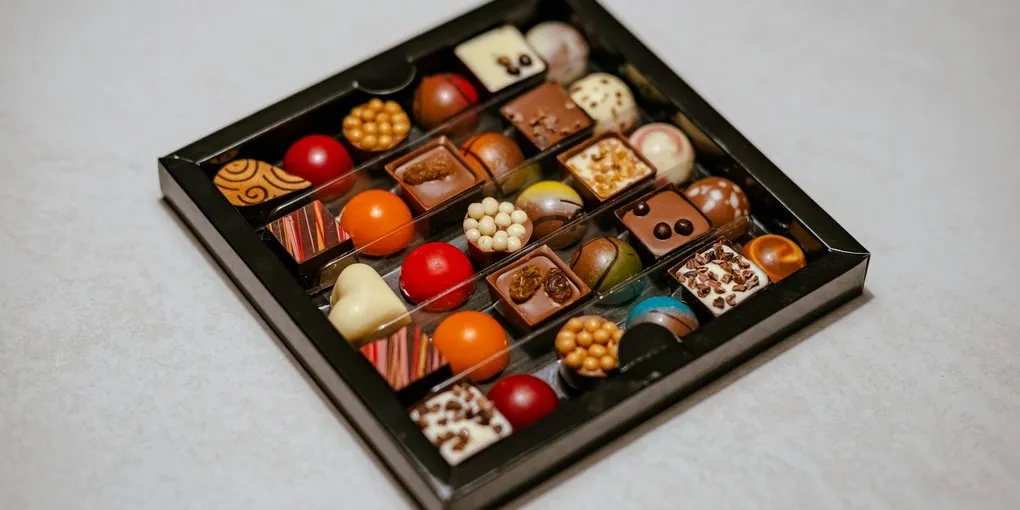
Airbrushing gives useful control over backgrounds, fades, and fine speckling. Brushwork and sponges remain useful for other textures and can be combined with sprayed color. Choose the method for the design, rather than assuming one tool produces every professional finish.
This guide builds on chocolate tempering and bonbon shell molding. Its equipment comparisons use manufacturer specifications, not hands-on performance tests. A mechanical specification alone does not establish that an entire airbrush setup is suitable for food production.
What Goes in the Airbrush
For molded bonbons, the usual medium is colored cocoa butter intended for edible chocolate decoration. It contains fat-compatible color dispersed in cocoa butter. Water-based cake airbrush colors and craft paints are not interchangeable with it.
Some products are sold pre-crystallized for controlled reheating; others are concentrates that must be mixed into a base. Roxy & Rich describes its cocoa butter collections as pre-tempered, while Mona Lisa’s white non-azo Power Flower is a 40% pigment concentrate. That concentration belongs to the specified product, not every bottle of colored cocoa butter. Follow the instructions for the actual color and format. Roxy & Rich, Mona Lisa product information.
Use colors labeled edible, with an ingredient list and directions allowing the intended food use. “Non-toxic” does not mean edible, and a metallic or pearl appearance says nothing about whether the material belongs on food. A manufacturer’s name is not a substitute for checking the particular product and market. The FDA specifically warns against non-edible decorative glitters and dusts. FDA guidance.
For a molded piece, decoration comes before the shell. Start with the molding and unmolding guide for mold preparation, and use the bonbon shell molding guide for the subsequent casting steps.
Choosing Equipment
Start with the colored-cocoa-butter supplier’s equipment recommendations. Food-contact equipment must be cleanable and protected from contamination, including inappropriate lubricants and compressed-air contaminants. 21 CFR 117.40. Confirm the fluid-contact materials, seals, lubricants, cleaning method, and compressed-air requirements for food use. Keep the resulting setup dedicated to food. A previously used craft or automotive airbrush is a poor starting point because its contamination history is uncertain; labeling it “food only” afterward does not resolve that history.
A dual-action airbrush gives separate control over air and material flow. Gravity-feed cups suit small quantities. A wider nozzle can help with coverage and more viscous material, but nozzle diameter alone does not determine cocoa-butter compatibility: pigment dispersion, temperature, nozzle design, and air delivery also matter. There is no defensible universal rule that a 0.2 mm nozzle instantly clogs or every 0.5 mm nozzle works.
The following models illustrate different designs. Check the current configuration and confirm suitability with the supplier before buying:
| Model | Manufacturer information | Practical distinction |
|---|---|---|
| Badger Patriot 105 | The Fine Patriot manual gives a general 15–50 PSI range and describes about 25 PSI as efficient for many uses. | Check the exact needle/nozzle configuration; those figures are not a tested cocoa-butter recipe. |
| Iwata Eclipse HP-CS | Current US specifications list a 7 ml cup, compression-fit E3 nozzle system, and 25–35 PSI optimal working pressure. | Its drop-in nozzle has a different cleaning and assembly procedure from screw-in designs. |
| Iwata Revolution HP-CR | Current US specifications list a 7 ml cup, screw-on R5 nozzle system, and 20–30 PSI optimal working pressure. | Compare replacement parts and cleaning instructions as well as purchase price. |
| Grex Tritium TG3 | The Tritium manual identifies TG3 as the 0.3 mm top-gravity model; the series has a broad 4–80 PSI operating range. | Pistol-trigger handling differs from a pen-style brush. The rated range is not a suggested cocoa-butter setting. |
Sources: Badger manual, Eclipse specifications, Revolution specifications, Grex manual. These sources establish mechanical details; they do not document comparative chocolate tests or certify the assembled food-contact system.
Compressor, regulator, and air quality
Choose a compressor that supplies the airbrush’s required airflow at the operating pressure, with an appropriate regulator and moisture-control system. A high maximum pressure printed on a box does not establish adequate continuous airflow. Tank capacity, duty cycle, noise, and fittings also affect usability. California Air Tools emphasizes matching the compressor to the tool’s air demand. Manufacturer guidance.
California Air Tools and Master Airbrush searches include different models; compare the individual specifications. Oil-free construction avoids one potential source of oil carryover but does not, by itself, establish clean air suitable for direct food contact.
Drain and maintain water separators as directed. Moisture droplets can spoil a sprayed surface, and water contacting sugar-containing chocolate can contribute to sugar bloom. Pure cocoa butter has no sugar to bloom. An ordinary moisture trap also is not a complete guarantee against oil, particles, or other air contamination. Badger’s manual recommends a moisture trap where condensation is a problem.
Prepare the Workspace Before Spraying
Edible does not mean appropriate to inhale as a mist. Arrange capture and ventilation for the material and amount sprayed, keeping the plume away from your breathing zone and other people. A spray booth intended for culinary work can contain overspray; its filtration or exhaust arrangement still needs to suit the product and installation. Do not assume a kitchen hood or open window provides sufficient control.
Read the color’s safety data sheet. Chef Rubber’s cocoa-butter SDS calls for ventilation matched to conditions and suitable respiratory equipment if ventilation is insufficient. That is conditional guidance, not proof that a particular room is safe or a prescription for one universal mask. Use the supplier’s instructions for the actual colored mixture. Chef Rubber safety information, sections 7–8, culinary airbrushing equipment.
Keep food and clean molds outside the overspray path until needed. Protect the work surface, keep electrical equipment away from wet cleaning, and set up a suitable receptacle for flushing material rather than spraying cleaner into the room.
Prepare the Colored Cocoa Butter
Cocoa butter needs appropriate crystallization for a stable, attractive decoration. The exact preparation depends on the product and whether its existing crystals have been preserved or fully melted. “Pre-tempered” on the bottle does not mean it tolerates unlimited heating without further attention.
Follow the supplier’s warming or tempering method, mix the pigment thoroughly, and measure the material’s temperature. Avoid treating 29–31°C as a universal window, 29°C as an instant clogging threshold, or 32°C as the temperature at which every product loses temper. Temperature and crystallization history work together. The cocoa butter polymorphism guide explains the underlying fat behavior; it cannot replace a color manufacturer’s directions.
If flow is poor, check temperature, pigment dispersion, the nozzle, and air supply before adding more fat. Thin with suitable plain cocoa butter only as the supplier permits. Added cocoa butter reduces color concentration; there is no universal 1:3 limit beyond which the fat becomes incapable of setting. Recheck preparation and a sample decoration after changing the mixture.
Apply Thin Layers in the Right Order
A polished rigid mold gives the decoration its contact surface; see choosing chocolate molds. Work with clean, completely dry cavities and a prepared sample mold or test area.
Airbrushing a Bonbon Mold
Confirm the material and setup, then build the design in reverse
- 01
1. Prepare the workspace
Suitable food equipment, clean air, and spray capture.
Follow the color's safety and handling information. - 02
2. Prepare mold and color
Dry cavities; cocoa butter prepared to supplier instructions.
Measure temperature and mix dispersed pigment evenly. - 03
3. Test the spray
Set working pressure with air flowing.
Adjust distance and material flow for the intended pattern. - 04
4. Apply the visible design
The first layer against the mold becomes the outside.
Use thin passes; avoid pooling. - 05
5. Add further layers
Let each layer set before adding the next.
Timing depends on material, thickness, and room conditions. - 06
6. Add backing if needed
Opaque white backing usually follows the visible colors.
It separates translucent colors from a dark chocolate shell. - 07
7. Cast and clean
Cast the shell over set decoration; clean equipment promptly.
Use the airbrush's food-compatible cleaning procedure.
No single pressure, distance, working temperature, or waiting time fits every airbrush and colored cocoa butter. Confirm the setup with a small test.
jayarrchocolate.comSet working pressure with air flowing. Iwata distinguishes this from the higher static reading when the trigger is released. Use the equipment and color supplier’s recommended range, then adjust until the spray pattern is suitable. There is no general 15–25 PSI ceiling: Chef Rubber describes a culinary compressor setup operating at 35–55 PSI. Higher pressure can increase overspray, but cocoa butter does not simply “dry” like a water-based paint above 30 PSI. Iwata FAQ, Chef Rubber setup.
Test distance and delivery together. Start with the brush supplier’s guidance and move smoothly across a test surface. Adjust for a fade, fine line, or background. Use several light passes rather than accumulating a pool; there is no compulsory half-second trigger duration or one correct distance for every cavity.
Plan the design as viewed through the mold. The first deposit touches the mold and becomes the outside of the bonbon. If translucent red should show brightly against dark chocolate, apply the red design first, then the opaque white backing before casting the dark shell. Applying opaque white first can hide the color placed behind it. Light-to-dark is therefore not a universal rule. Chef Rubber explicitly describes either color order depending on the design and recommends backing colors with white. Colored cocoa butter instructions. A Chocovic demonstration also places its final white backing after the colored design; use this older recipe as a layer-order example, not as current color-additive advice. Chocovic, colorful egg by Lluís Costa.
Let each layer set before the next and before casting the shell. Check a spare cavity or sample rather than leaving fingerprints on the intended finish. Layer thickness, formulation, crystallization, and ambient conditions affect the wait; two or five minutes is not a universal readiness test. Test the full sequence through unmolding before decorating a large batch.
Clean Without Damaging the Airbrush
Clean promptly after use so residue does not accumulate. There is no fixed 15-minute deadline after which the equipment becomes irreparable.
For a color change, Chef Rubber suggests running plain cocoa butter through the airbrush before the next color. This helps displace color; it is not a complete end-of-session hygiene procedure. Collect the flush separately, and do not return contaminated or mixed material to the original bottle. Chef Rubber instructions.
For the final cleanup:
- Empty the cup and remove accessible excess material.
- Follow the airbrush supplier’s disassembly instructions for the parts that contacted the medium. Disconnect the air supply before removing the needle or nozzle.
- Use a cleaner and method approved for both those materials and food-contact use, following its dilution, contact-time, rinse, and any required sanitizing instructions.
- Remove cleaner residues as directed and dry thoroughly before storage or reuse with chocolate.
- Reassemble carefully and check the needle, seals, and nozzle for damage or remaining obstruction.
Warm water alone is not a reliable degreasing step: cocoa butter is insoluble in water. Conversely, an airbrush cleaner sold for acrylic paint is not automatically appropriate for food equipment. Use a compatible cleaning process rather than improvising with solvents.
Iwata says not to immerse the entire airbrush body, and recommends deeper cleaning when needed, rather than a universal weekly full teardown. Its generic paint-cleaning products are not recommendations for edible cocoa butter. Do not heat the whole airbrush in an oven, immerse it in a bath, or use isopropyl alcohol as a routine food-equipment solvent without explicit approval for the relevant equipment and use. Iwata cleaning instructions.
Troubleshoot the Actual Symptom
| Symptom | Useful checks |
|---|---|
| Spluttering or interrupted spray | Material cooling or thickening, pigment dispersion, partial blockage, air-pressure fluctuation, water in the line, or an incorrectly seated nozzle. |
| Patchy coverage | Test material delivery, pressure, distance, and sweep speed together. A fixed 5 PSI reduction will not solve every pattern. |
| Pools or runs | Reduce the amount deposited per pass and check distance and preparation. More plain cocoa butter can weaken opacity, but does not inherently stop the fat setting. |
| Color left in the mold | Check the colored layer’s preparation and thickness, mold condition, shell temper, and cooling. The decorative layer is not automatically innocent. |
| White or dull areas | Consider poor crystallization, moisture, storage temperature, or fat migration. Appearance alone does not identify a particular crystal form. |
| Color contamination | Clean between colors and let layers set. Confirm whether an unwanted shade comes from carryover in the brush or from the intended translucent layers. |
Use bloom prevention and tempering troubleshooting alongside these checks. Do not diagnose a guaranteed Form IV-to-VI progression from white streaks, promise bloom within a fixed number of hours, or apply a universal Mycryo dose and temperature to every colored product.
Color Choices and Regional Rules
Translucent colors show the backing beneath them; opaque colors obscure it. A backing layer is useful when that suits the design, rather than obligatory for every finish. Concentrates, pearl colors, and opaque colors can have different preparation and nozzle requirements. Mix only products intended for the same use and test the resulting shade and flow.
Check the actual ingredients and the country where the bonbons will be sold. “Non-azo,” “natural origin,” and “titanium-dioxide-free” describe different properties. One does not imply the others. Titanium dioxide, E171, is no longer authorized as a food additive in the EU under Regulation 2022/63. Do not assume a color sold in another market is permitted there. EU regulation.
In the US, permitted color additives have specified uses and conditions. A generic list of pigments such as mica, iron oxide, or “bronze” is not a list of universally edible ingredients. Buy an edible preparation authorized for the intended application and follow its usage directions. FDA color-additive guidance.
When the Setup Is Worthwhile
Airbrushing is useful when repeatable gradients or broad, light coverage are central to the design. Brushes, splatter tools, stencils, transfer sheets, and piping can complement it. The right choice depends on the finish, setup and cleaning time, workspace, and batch size; there is no evidence-based cutoff at 30 or 50 bonbons.
Start with one color and a few test cavities. Record the product, its preparation, nozzle configuration, working pressure, room conditions, and layer sequence. That gives you a reproducible starting point for your own equipment.
Some links above are affiliate links — if you buy through them, we may earn a small commission at no extra cost to you.
Frequently Asked Questions
- Can any airbrush be used for chocolate?
- No. Confirm the fluid-contact materials, lubricants, cleaning procedure, and air supply are appropriate for food use. Keep the equipment dedicated to food. Nozzle diameter and a food-only label do not establish suitability by themselves.
- Does airbrushed cocoa butter need to be tempered?
- It needs appropriate crystallization for the intended decoration. Follow the actual product's warming or tempering instructions. Pre-tempered material can lose its prepared state if fully melted, and no universal 29–31°C window covers every colored product.
- Why does my airbrush keep clogging?
- Check cooling or thickening material, pigment dispersion, residue, nozzle assembly, and air delivery. Use only supplier-approved warming and cleaning methods. Water alone does not dissolve cocoa butter, and heating a whole airbrush or using a solvent without approval can create new problems.
- What PSI should I use for cocoa butter?
- Use the recommendations for your airbrush and colored cocoa butter, and test while measuring pressure with air flowing. There is no universal 15–25 PSI range; some culinary setups use more. Pressure, airflow, material condition, nozzle design, and distance work together.
- Can I airbrush a finished chocolate bonbon instead of the mold?
- Yes, when the colored product is intended for direct application to chocolate. Use a clean, dry surface and test the finish. Direct spraying follows the visible surface outward; mold decoration is built in reverse because the first layer becomes the outside after unmolding.
- Which colored cocoa butter should I buy?
- Choose an edible product approved for the intended application and market, with clear preparation instructions. Roxy & Rich, Chef Rubber, and Mona Lisa offer different formats and colors; concentrates are not interchangeable with ready-to-use products. Non-azo does not mean titanium-dioxide-free.
- Do I need a moisture trap?
- The air supply needs appropriate moisture control to prevent droplets reaching the work. Maintain separators and other filters according to their instructions. An ordinary moisture trap does not guarantee removal of oil or all other contaminants, and an oil-free compressor is not by itself proof of food-suitable air.
- Should white go into the mold first?
- Usually not when it is an opaque backing for another color. Apply the visible colored design first and the white backing afterward, before the chocolate shell. White applied first becomes the outside and can hide colors deposited behind it.
- Is a kitchen fan enough ventilation?
- It cannot be assumed to be enough. Match spray capture and ventilation to the product, setup, and amount sprayed, following its safety data sheet. Edibility does not establish inhalation safety; suitable respiratory protection may also be needed if ventilation is insufficient.