The best thermometer for tempering chocolate is a fast-reading probe accurate to at least ±1°F. The Thermapen ONE remains the precision pick while closeout stock lasts; ThermoWorks now says the model is being retired. The $39 ThermoPop 2 is the better current-value choice at ±1°F with 2-3 second readings. Infrared thermometers read surface temperature rather than the stirred chocolate mass, so they cannot replace an immersed probe here.
Manufacturer specifications and ThermoWorks product-page prices checked September 17, 2026 (USD). These selections compare published specifications, not our own hands-on tests. Price, probe length, color and stock can change; verify the exact variant before ordering.
Why Accuracy Matters This Much
Dark chocolate does not have one universal working number. Standard commercial couverture generally works at 88 to 90°F (31 to 32°C), while Dandelion’s 70% two-ingredient book protocol commonly works lower at 85.5 to 87°F (29.7 to 30.6°C). The curve printed by the chocolate maker wins. Either way, the useful window is only about 2°F wide.
In a window this narrow, a thermometer that reads 2 to 3°F off cannot tell you whether you are still inside the correct curve. A reading of 89°F may be ideal for standard couverture and too warm for a two-ingredient craft bar; a reading of 86°F may be ideal for that craft bar and too cool and viscous for the couverture.
Accuracy near your working temperature matters more than display resolution or the highest temperature on the box. A calibration check can reveal an offset; it does not turn a ±2°F instrument into a ±1°F instrument.
Why a Probe Is the Primary Bowl Thermometer
Infrared thermometers measure the exposed surface. A stirred bowl needs a reading from within the chocolate: the surface may cool faster than the interior, and an infrared result also depends on the instrument’s emissivity setting, distance and field of view.
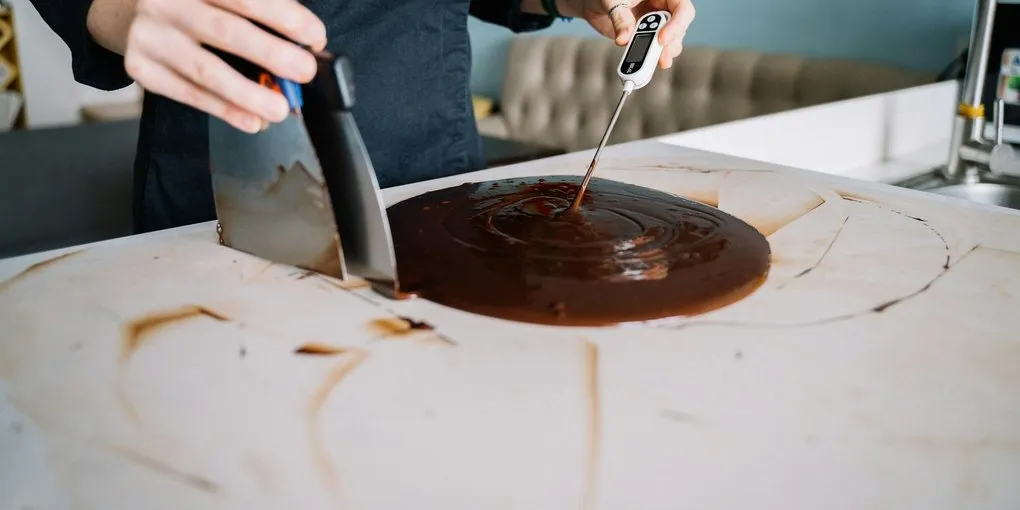
There is a useful exception. ThermoWorks’ tempering tutorial describes infrared checks on the very thin, constantly moving chocolate layer during tabling. Once that chocolate returns to the bowl, the tutorial returns to an immersed probe. That limited surface check does not make an infrared gun a substitute for the primary bowl thermometer.
What to Look for in a Chocolate Thermometer
Speed: Response time of 2 to 3 seconds or less. Tempering is an active process where temperature changes continuously as you stir. A 10-second thermometer gives you historical data; a 2-second thermometer gives you current data.
Range: Needs to cover 70°F to 130°F (21°C to 55°C) comfortably. Dark chocolate tempering spans 85°F to 122°F; milk runs from about 80°F to 122°F; full melt-out goes to 120 to 122°F.
Probe length: At least 3 inches to reach into the chocolate mass without the handle contacting the warm chocolate surface. Shorter probes give surface-biased readings.
Water resistance: IP67 is preferred for rinsing and accidental splashes; IPX6 is an acceptable budget floor. Follow the maker’s cleaning limits rather than submerging a model not rated for it.
Display hold: The ability to freeze the reading after removing the probe from chocolate lets you check the number without rushing.
Recommended Options
This article contains affiliate links. As an Amazon Associate, JayArr Chocolate earns from qualifying purchases at no extra cost to you. Direct-price links below go to the retailer that supports the stated price; Amazon availability and price may differ.
Thermapen ONE Digital Thermometer
The Thermapen ONE reads in 1 second, is specified to ±0.5°F, carries an IP67 rating, and has a rotating display. ThermoWorks listed it at $74 on September 17, 2026, down from $115, while announcing that the model is being retired. It is the precision choice only while genuine remaining stock is available. Check Amazon availability (affiliate; retailer price may differ).
ThermoPop 2 Digital Thermometer
The ThermoPop 2 is slower than the Thermapen ONE (2-3 seconds versus 1 second) and is specified to ±1°F rather than ±0.5°F. Those response figures describe the 4.5-inch probe; the manufacturer gives 3–4 seconds for the longer 8-inch version. For the 4.5-inch probe, the product page displayed $39 direct from ThermoWorks on September 17, 2026. It meets the minimum precision this job needs and is the better current-value recommendation now that Thermapen ONE is in closeout. Check Amazon availability (affiliate; retailer price may differ).
CDN DTQ450X Digital Probe Thermometer
CDN specifies the DTQ450X to ±2°F with a 6-second response, IPX6 water resistance, and one-button field calibration. Check the current price from your supplier. It is a functional fallback, not an equal substitute for the two ThermoWorks picks: ±2°F is as wide as the useful curve itself, so calibrate before use and confirm the result with a smear test. Check Amazon availability (affiliate; retailer price may differ).
What about Thermapen NANO?
ThermoWorks lists the announced Thermapen NANO at $119, with manufacturer specifications of 0.4-second response, ±0.5°F accuracy in the range relevant to chocolate, and IP67 protection. Its FAQ says preorder shipments are scheduled to begin in October 2026. Treat that as a supplier schedule, not immediate availability or an independently tested performance claim. If you need a probe now, check actual ONE stock or the ThermoPop 2; if you can wait, compare the NANO’s eventual delivered price and availability.
Using a Thermometer for Tempering: Protocol
Place the sensing tip in the stirred chocolate to the manufacturer’s required immersion depth, clear of the bowl; keep the handle out of the chocolate. When checking temperature, stir the chocolate first to even out any temperature gradients, then insert the probe, wait for the reading to stabilize (most good probes in 1 to 3 seconds), and read.
For the seed method, check every 2 to 3 minutes after adding solid tempered chocolate to the melt. Stir first, then measure in three locations. Work toward the chocolate’s specified curve: typically 88 to 90°F for standard dark couverture or 85.5 to 87°F for Dandelion’s 70% two-ingredient book protocol. If a few seed pieces remain at the target, remove them rather than heating past the curve.
For tabling: check the tabled chocolate’s temperature on the marble before recombining. You want it at 26 to 27°C (78.8 to 80.6°F) before adding back to the warm portion.
Calibration
A thermometer that reads accurately out of the box may drift over time, especially after impacts. Check calibration by immersing the probe in an ice-water slurry (plenty of ice, just enough water to fill the gaps, stirred well) without touching the vessel. A correctly calibrated probe reads 32°F (0°C). If the offset exceeds the maker’s stated tolerance, recalibrate it if the model allows or replace it; do not rely on mental correction across a narrow tempering curve.
The Thermapen ONE supports calibration trim. The ThermoPop 2 includes a NIST-traceable calibration certificate but is not a substitute for periodic ice-point checks.
The Thermometer in Context
The thermometer works in concert with everything else in the tempering process. For the complete tempering protocol using the seed method, see our how to temper chocolate guide. For understanding what happens at the crystal level when temperature goes wrong, see our cocoa butter chemistry and polymorphism article. For troubleshooting when temper fails despite using the right temperatures, see chocolate won’t temper. For equipment beyond a probe, compare manual tempering and tempering machines.
Thermometer Types for Chocolate Tempering
| 01Accuracy | 02Response Time | 03Measures | 04Suitable for Tempering? | |
|---|---|---|---|---|
| Thermapen ONE | ±0.5°F | ~1 second | Mass temperature (probe) | Yes — precision while stocked |
| ThermoPop 2 | ±1°F | 2-3 seconds | Mass temperature (probe) | Yes — best current value |
| CDN DTQ450X | ±2°F | ~6 seconds | Mass temperature (probe) | Marginal — calibrate first |
| Infrared | Model-dependent | Fast surface check | Surface temperature only | Limited tabling use; not the primary bowl reading |
Frequently Asked Questions
- Can I use an infrared thermometer to temper chocolate?
- Not as the primary measurement. Infrared thermometers read only the exposed surface, while the value you need is the temperature of the stirred chocolate mass. Stir thoroughly and use an immersed probe for the decision that determines whether the chocolate is inside its working curve.
- What accuracy do I need in a chocolate thermometer?
- Use a probe specified to ±1°F or better. Standard dark couverture usually works around 88–90°F, while Dandelion's 70% two-ingredient book protocol may work at 85.5–87°F. Both are narrow curves. Thermapen ONE is specified to ±0.5°F; ThermoPop 2 to ±1°F. A typical ±2°F candy thermometer is marginal.
- Is the Thermapen worth the cost for chocolate making?
- Thermapen ONE remains the most precise pick here at 1-second response and ±0.5°F accuracy, but ThermoWorks says the model is being retired and listed remaining units at a $74 closeout price when checked September 17, 2026. Buy it for precision while stock lasts; otherwise the $39 ThermoPop 2 is the stronger current-value choice at ±1°F and 2–3 seconds.
- How do I calibrate a chocolate thermometer?
- Immerse the probe in a stirred ice-water slurry without touching the vessel. It should read 32°F (0°C). If the offset exceeds the maker's stated tolerance, use the model's calibration function or replace it rather than relying on mental correction. Thermapen ONE supports calibration trim; the CDN DTQ450X has one-button field calibration.
- What temperature range do I need my thermometer to cover?
- A 70–130°F range comfortably covers chocolate work: dark melt-out around 120–122°F, then a working curve around 88–90°F for standard couverture or 85.5–87°F for two-ingredient craft dark. Good instant-read kitchen probes cover far more than this range; accuracy near 80–90°F matters more than maximum range.
- Can I use a candy thermometer for tempering?
- Yes, but check its accuracy specification rather than its display resolution. A typical ±2°F model is marginal against a roughly 2°F working curve. Calibrate it at the ice point, stir before every reading, and confirm the temper with a smear test. A ±1°F ThermoPop 2 provides more margin, though it costs more than the budget CDN pick.