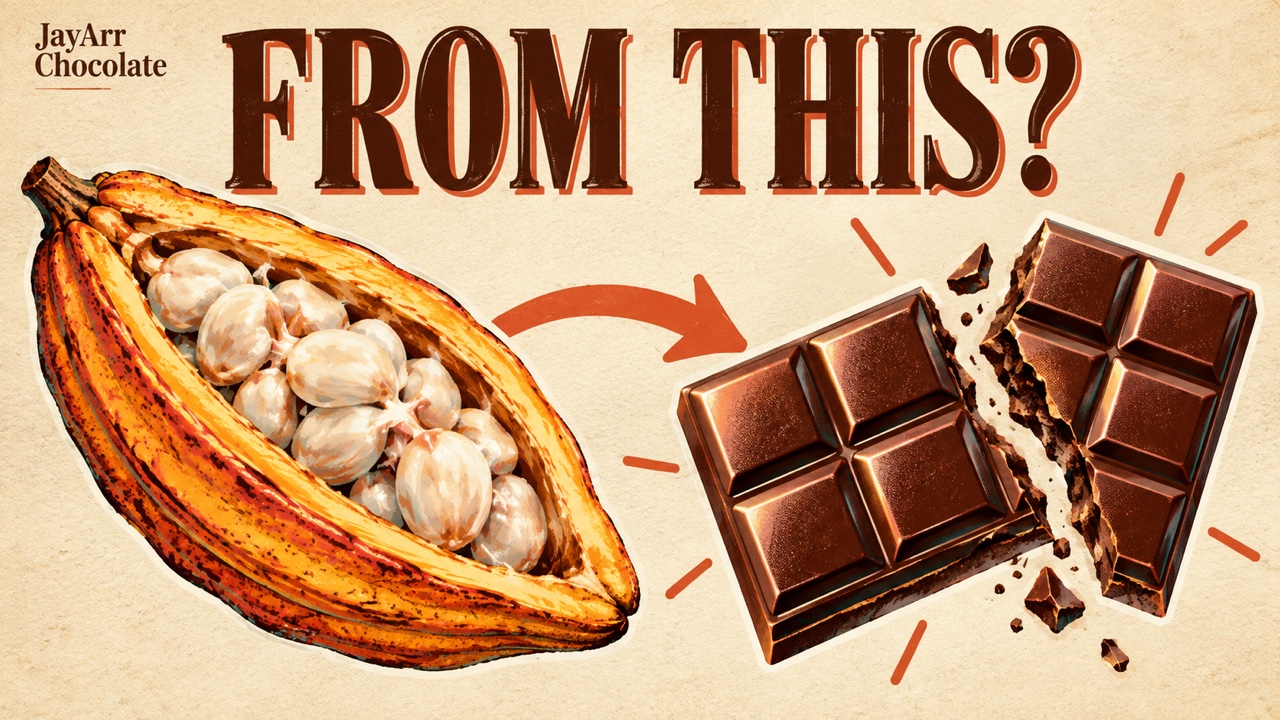
A cacao seed straight from the pod does not taste like a finished chocolate bar. The familiar aroma, smooth texture and clean snap emerge through a series of biological, chemical and physical changes. Farmers develop the raw material; chocolate makers carry that work through to the finished bar.
This guide follows a common whole-bean route in ten stages. It is a useful way to understand the transformation, rather than a rule that every factory uses ten separate machines. Sorting happens at more than one point, some makers roast nibs instead of whole beans, and a craft melanger can refine and conch in the same vessel.
If you want to make chocolate yourself, our bean-to-bar beginners guide covers equipment and a practical workflow. Here, the focus is what each stage changes and why it matters.
How Chocolate Is Made: The Ten-Step Farm-to-Bar Process
A common whole-bean route; sorting can repeat and some stages overlap
- 01
1. Harvest
at originRipe pods are opened to collect seeds and their surrounding pulp.
- 02
2. Ferment
several daysMicrobial activity and changes inside the beans build flavor precursors.
- 03
3. Dry
weather-dependentMoisture is reduced for storage, while further flavor changes take place.
- 04
4. Sort
quality checksForeign material and defective beans are removed; samples are assessed.
- 05
5. Roast
develop aromaHeat transforms precursors into roasted, nutty and chocolate aromas.
- 06
6. Winnow
remove shellBeans are cracked; air separates light shell from heavier nib pieces.
- 07
7. Grind + Refine
add recipe ingredientsGrinding releases fat; refining makes cocoa and sugar particles smaller.
- 08
8. Conch
flavor and flowWarm mixing disperses particles and helps remove moisture and volatile acids.
- 09
9. Temper
control crystalsControlled crystallization prepares chocolate to set with gloss and snap.
- 10
10. Mold + Wrap
finishChocolate is molded, cooled, released and protected in its packaging.
Fermentation and roasting develop flavor; refining changes particle size; conching adjusts flavor and flow; tempering controls how the fat sets.
jayarrchocolate.com1. Harvesting
Cacao pods contain the seeds that become chocolate. The tree, Theobroma cacao, grows in warm, humid tropical regions, and its pods develop directly on the trunk and larger branches. Inside each pod, the seeds sit in a white, sweet-sour pulp. The trade calls them beans, although botanically they are seeds.
Harvesters cut ripe pods carefully to avoid damaging the tree and its flowering sites. Pods ripen at different times, so harvesting involves repeated visits. Opening the pods releases the wet seeds and pulp, which are collected for fermentation. The thick pod wall stays behind: it is different from the thin shell later removed from each dried bean.
2. Fermentation
Fermentation prepares cacao for the flavor development that continues during drying and roasting. Wet beans and pulp are gathered into heaps, boxes or other fermentation systems. Much of the microbial activity takes place in the pulp, while heat and fermentation products change the seeds inside it.
Yeasts consume pulp sugars and produce ethanol. Lactic acid bacteria are active too; as drainage and turning admit more oxygen, acetic acid bacteria convert ethanol to acetic acid and release heat. These populations overlap rather than taking perfectly separate turns. Temperatures commonly rise toward 45–50°C, depending on the system.
Heat and acid kill the seed embryo and disrupt internal cell structures. Enzymes can then act on previously separated materials, producing amino acids and other precursors that contribute to chocolate aroma during roasting. Changes to polyphenols also reduce astringency and alter color. Roasting cannot simply compensate for badly managed fermentation.
Fermentation commonly lasts several days, often around two to seven, but the appropriate endpoint depends on the cacao, batch, equipment and conditions. Batch size affects heat retention, and smaller batches need careful management. For example, a controlled study by Díaz-Muñoz and colleagues investigated 20 kg batches. That is evidence of a particular experimental setup, rather than a universal small-batch recipe.
Our cacao fermentation science guide explores the mechanism in more detail, with an interactive fermentation crate.
3. Drying
Drying reduces the beans’ moisture enough for storage and transport. A common target is roughly 7% moisture, with the acceptable range governed by the buyer’s specification and storage conditions. Beans that remain too wet are vulnerable to mold; excessive drying makes them brittle.
Sun drying uses raised beds, mats or patios, with beans spread and turned. Weather, layer depth and airflow affect the time needed, so one batch may take substantially longer than another. Mechanical dryers offer more control, provided their heat and airflow are managed and combustion smoke does not contaminate the beans.
The rate matters as well as the final moisture reading. Drying too quickly can retain unwanted acidity; drying too slowly encourages mold and off-flavors. Trapped acid is not automatically desirable fruitiness. The ICCO’s post-harvest guide explains this balance. Good drying preserves the work done during fermentation while making the beans suitable for the next stage.
4. Sorting and Quality Control
Sorting removes defective beans and foreign material before they enter the chocolate. Stones, sticks, flat beans, insect damage and visible mold all need attention. Farmers and exporters may sort at origin, and makers inspect incoming lots again; this is not a step confined to one location.
A cut test examines a sample of beans sliced lengthwise. Interior color and structure help assess fermentation and reveal defects such as mold or insect damage. Brown, purple and slaty classifications provide useful evidence, but a single percentage of brown beans cannot establish flavor quality across all cacao types. The Cacao of Excellence protocols combine physical assessment with sensory evaluation.
Makers also roast and taste samples. A lot can pass a basic visual inspection yet still produce unwanted flavors, so physical checks and tasting answer different questions.
5. Roasting
Roasting develops chocolate aroma from compounds already present in the fermented and dried beans. Heat drives Maillard reactions between amino compounds and reducing sugars, alongside related chemistry such as Strecker degradation. These reactions produce families of aroma compounds, including roasted, nutty pyrazines and flavorful aldehydes.
No single molecule accounts for everything we recognize as chocolate. Genetics, fermentation, drying and the roast all influence the eventual aroma. A roast can emphasize bright origin character or deeper roasted notes, but pushing it further can also flatten desirable flavors or introduce burnt ones.
The maker chooses a profile for the beans and equipment. As the ICCO processing overview explains, whole-bean roasting is one option; roasting separated nibs is another. That changes the order of roasting and winnowing. For the practical variables, see our guide to roasting cacao beans.
6. Cracking and Winnowing
Cracking breaks the beans into pieces, and winnowing separates the thin shell from the edible nib. In a common air-based system, lighter shell fragments are carried away while heavier nib pieces fall into a collection container.
Shell typically represents about 10–15% of dried bean weight, although the exact proportion varies. Actual winnowing loss can be greater if useful nib fragments leave with the shell. That process loss should not be confused with the shell’s share of the bean, or with the water and pulp lost earlier on the farm.
The nib is the part that goes into the chocolate. Our cracking and winnowing guide covers separation methods and equipment.
7. Grinding and Refining
Grinding turns cacao nibs into cocoa mass because it releases their own fat. Nibs contain roughly half their weight in cocoa butter. As grinding breaks their structure and the mixture warms, that fat becomes the liquid phase carrying the solid cocoa particles. The resulting paste is called cocoa mass, cocoa liquor or chocolate liquor; the word liquor does not mean alcohol.
Sugar and the other ingredients required by the recipe are then incorporated and refined. A two-ingredient dark chocolate uses cacao and sugar; other formulas may include extra cocoa butter, milk powder, lecithin or flavorings. Addition order varies with the process. Sugar remains as fine particles suspended in fat rather than dissolving as it would in water.
Refining makes those cocoa and sugar particles smaller. Texture depends on the particle-size distribution, not just how long a machine has run. A melanger uses stone wheels against a stone bed; larger producers may use roll refiners, ball mills or other systems. Refining and conching can overlap in a melanger, but they describe different jobs.
Our melanger refining guide covers the equipment and texture targets. The recipe’s cacao percentage counts both nonfat cocoa solids and cocoa butter, including any extra cocoa butter added.
8. Conching
Conching develops chocolate’s flavor and flow through sustained mixing, shearing and controlled warmth. It helps distribute fat around solid particles, break up particle clusters, and remove moisture and some volatile acids. Its effects depend on the recipe, equipment, temperature and exposure to air.
Refining primarily reduces particle size; conching makes the refined mixture behave and taste more like finished chocolate. Describing it only as polishing sharp particles misses much of the process. Blanco and colleagues’ conching study, using a simplified formulation, demonstrates how mechanical treatment and dispersant addition can turn a jammed particulate mixture into a flowing suspension.
More time is not automatically better. The maker balances removal of unwanted sharpness against retention of desirable aromas. A small melanger may run for many hours or days, while an industrial process may reach its target differently. Our conching guide looks at the practical controls. Dandelion’s account of its own process is one example of a craft maker combining prolonged grinding with flavor development.
9. Tempering
Tempering controls how cocoa butter crystallizes so a bar sets with the desired gloss, snap and melt. Cocoa butter can form several crystal structures. For conventional bar chocolate, the usual target is a suitable population of Form V crystals that helps the rest of the fat set in that form during cooling.
Melting, cooling, agitation and sometimes reheating or added seed chocolate are used to achieve that balance. The familiar melt–cool–rewarm curve is one method, not the only possible sequence. Working temperatures depend on the chocolate and technique.
Too few suitable crystals can lead to poor setting and release; too many can make the chocolate thick and difficult to work. Callebaut’s overcrystallization guidance describes thick shells and dull spots among the consequences. Correct temper also does not make chocolate immune to later bloom from unsuitable storage or temperature cycling.
Our tempering guide covers the methods and working windows for dark, milk and white chocolate.
10. Molding and Packaging
Molding gives tempered chocolate its final shape, and controlled cooling allows it to set. Makers fill clean, dry molds and tap or vibrate them to release trapped air. A smooth mold surface helps produce a glossy finish, but the temper and cooling conditions matter too.
Properly crystallized chocolate contracts as it cools, helping it release from a rigid mold. Poor release can have several causes, including temper, cooling and mold condition; it is not diagnosed by appearance alone. The molding and unmolding guide covers troubleshooting.
Packaging then limits exposure to moisture, odors and handling damage. Foil and other barrier materials are common, but packaging works alongside appropriate storage. A good wrapper cannot prevent a bar from melting in excessive heat.
The Numbers Behind the Transformation
There is no fixed one-pod-to-one-bar conversion. Pods differ in seed number and size, wet pulp drains away, drying removes water, and sorting and winnowing create further losses. The finished recipe then adds sugar and, in some cases, other ingredients. Each percentage must refer to the right starting material.
An ingredient example is clearer: 700 g of nibs plus 300 g of sugar gives a 1,000 g two-ingredient batch at 70% cacao before processing losses. Dandelion describes that exact ratio in its test-batch process. If extra cocoa butter is included in a different recipe, it counts toward the cacao total too.
Time varies just as much. Fermentation takes days, drying depends heavily on conditions, and refining and conching depend on the chosen equipment and flavor target. Transport, storage and optional resting can extend the journey considerably. There is no universal three-to-four-week minimum from harvest to bar.
What remains consistent is the sequence of transformations: prepare the seed for flavor development, create the roast aromas, reduce the particles, develop the mixture’s flow, and control the fat as it sets. That is how a tropical fruit seed becomes a chocolate bar.
Sources and Further Reading
The linked industry guidance and research above support the process explanations and the distinctions between farm, craft and industrial practice. For fuller treatments, see Stephen T. Beckett’s The Science of Chocolate (2nd edition), Emmanuel Ohene Afoakwa’s Chocolate Science and Technology (2nd edition), and Dandelion Chocolate’s Making Chocolate (2017).
Frequently Asked Questions
- How long does it take to make a chocolate bar from scratch?
- It depends on where you start and the process used. Harvested wet beans need several days of fermentation and a weather-dependent drying period. Once a maker has dried beans, roasting and winnowing prepare them for grinding, refining and conching, which may take many hours or days at craft scale. Tempering, molding and cooling follow. Shipping, storage and resting can add much longer intervals; there is no universal three-to-four-week minimum.
- What is the difference between cocoa and cacao?
- Both words refer to products of Theobroma cacao. Cacao is commonly used for the tree, pods and seeds; cocoa often appears in names such as cocoa powder and cocoa butter. Usage varies across countries and producers, so the word alone does not establish whether a product was roasted, how it was processed or how good it will taste.
- Why does chocolate need to be tempered?
- For a molded bar, tempering establishes a suitable population of cocoa-butter crystals, usually targeting Form V, so the chocolate sets with the desired gloss, snap and mold release. Too few suitable crystals or too many crystals can both cause problems. Chocolate used in a sauce or some baked recipes does not need the same tempered-bar structure, and correct temper does not protect a bar from poor storage.
- Is all chocolate made the same way?
- No. This ten-stage explanation follows a common whole-bean route. Some makers roast nibs after winnowing, and refining and conching may share one machine. Cocoa powder follows a pressing route that separates much of the cocoa butter from cocoa mass. White chocolate uses cocoa butter without the brown nonfat cocoa solids. Compound coatings use different fat systems, and some traditional chocolates are deliberately coarse rather than finely refined.
- What percentage of a chocolate bar actually comes from the cacao bean?
- The cacao percentage counts cacao-derived ingredients, including cocoa butter and nonfat cocoa solids. In a two-ingredient 70% dark recipe, 70% is cacao and 30% is sugar. In another 70% recipe, the remaining 30% can include sugar and other non-cacao ingredients. Added cocoa butter counts toward the 70%, so equal cacao percentages do not necessarily mean equal amounts of nonfat cocoa solids or equal flavor intensity.