Cacao is grown by 6.5 million farmers worldwide, almost all of them on small family farms of 2 to 5 hectares. The average cacao farmer is about 56 years old. The crop grows exclusively within 20 degrees north and south of the equator. These facts frame everything about how cacao reaches your chocolate bar — it is a tropical crop grown at small scale by aging farmers, and every step from seedling to dried bean involves manual labor that has not fundamentally changed in centuries.
Understanding cacao farming is essential if you want to understand chocolate quality. Dr. Lyndel Meinhardt of USDA-ARS describes flavor as roughly a series of fourths: genetics, environment, fermentation, and roasting each contribute about 25%. Two of those four — genetics and environment — are entirely determined on the farm before the beans ever reach a fermentation box.
The Cacao Tree
Theobroma cacao belongs to the family Malvaceae, subfamily Byttnerioideae. The genus name, coined by Linnaeus in 1753, comes from the Greek theos (god) and broma (food) — food of the gods. The name is arguably the most generous botanical compliment ever given to a crop plant.
Cacao trees are understory species. In the wild, they grow beneath the canopy of taller tropical trees, which means they are adapted to filtered light, high humidity, and protection from wind. This biology dictates the farming approach: cacao grows best under shade trees, not in open plantations exposed to direct equatorial sun.
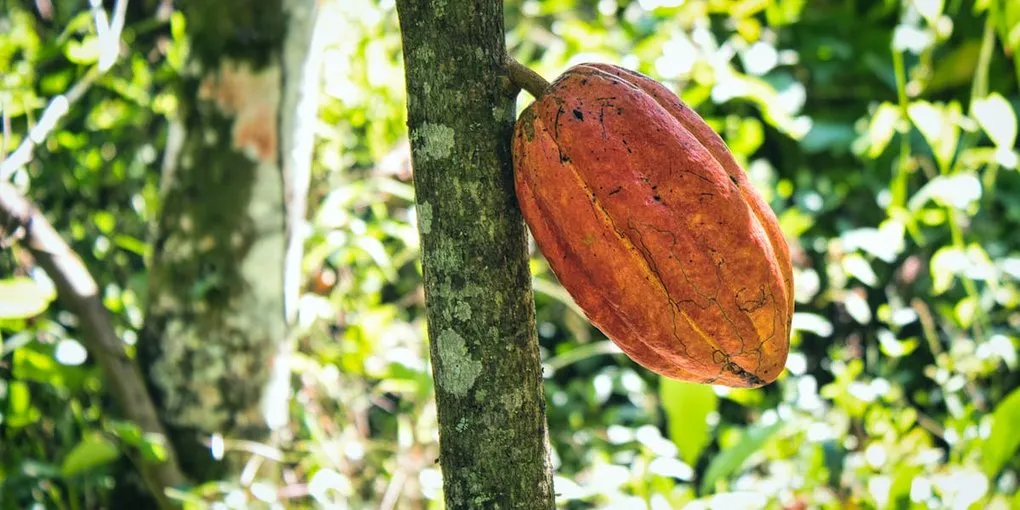
The trees display cauliflory — pods grow directly from the trunk and major branches rather than from the tips of small branches. This unusual growth pattern means the trunk of a productive cacao tree is studded with pods at various stages of ripeness, creating a visual unlike any temperate fruit tree.
Each cacao pod contains 20 to 50 seeds embedded in white mucilaginous pulp. The pulp is sweet, tangy, and genuinely delicious eaten fresh — it tastes nothing like chocolate. The seeds are what become chocolate after fermentation, drying, and roasting. Here is a fact that surprises most people: each bean in a single pod can have different genetics. The husk and pulp are genetically consistent with the parent tree, but each bean results from a different piece of pollen.
Pollination: The Midge Bottleneck
Cacao flowers are small — about 1 to 1.5 centimeters — and they are pollinated primarily by tiny midges in the family Ceratopogonidae. These midges can travel up to a mile, but they are finicky, habitat-dependent creatures. Without the right midge population, cacao trees produce far fewer pods regardless of their genetic potential.
The pollination rate for cacao is remarkably low. Only about 1 to 5% of flowers on a typical tree are successfully pollinated and develop into mature pods. A productive tree might flower thousands of times per year but set only 20 to 50 pods. This natural bottleneck is one reason cacao yields are inherently limited compared to crops with more efficient pollination systems.
Farms that maintain diverse shade canopies and leaf litter — the natural habitat for midges — tend to have better pollination rates. The push toward monoculture cacao plantations, which removes the shade trees and understory complexity that midges need, can actually reduce pollination and ultimately reduce yield despite the theoretical advantages of more trees per hectare.
Planting and Maturation
Cacao trees take 3 to 5 years to reach fruiting age. Grafted trees — where a cutting from a proven variety is grafted onto a rootstock — may produce faster, but most smallholder farmers grow trees from seed because grafting requires technical knowledge and access to quality scion wood.
The decision of what to plant is the most consequential choice a cacao farmer makes. A tree planted today will produce (or fail to produce) for 25 to 40 years. This is why the spread of high-yield varieties like CCN-51 has been so rapid and so permanent — once a farmer replants with CCN-51, the heirloom genetics that tree replaced are gone for decades.
The Motamayor 2008 study identified 10 distinct genetic clusters of cacao, replacing the traditional Criollo-Forastero-Trinitario classification. Most farmers do not know which genetic cluster their trees belong to. They know their trees as “the ones my father planted” or “the new variety from the extension agent.” The gap between scientific taxonomy and farming practice is enormous.
The Growing Environment
Cacao requires specific conditions that constrain its geography to the tropics. Temperatures between 20 and 33 degrees Celsius year-round, with no frost tolerance whatsoever. Annual rainfall of 1,250 to 3,000 millimeters, ideally distributed throughout the year. Deep, well-drained soils rich in organic matter. Humidity above 80%.
The 20-degree latitude band is not arbitrary — it traces the zone where these conditions reliably coexist. Some production exists at the margins (parts of Peru and Bolivia extend slightly beyond), but the core of world production clusters between 10 degrees north and 10 degrees south.
An interesting note on fat content and geography: the farther from the equator and more temperate the climate, the higher the cocoa butter content in the beans. Tanzanian and Trinidadian beans run 57 to 58% fat, while Ecuadorian beans average about 52%. This affects not just yield economics but also chocolate texture and working properties.
Harvest: Still Done by Hand
Cacao harvest is manual work. There is no mechanical harvester for cacao pods because they grow directly from the trunk, ripen at different rates on the same tree, and must be cut without damaging the flower cushion (the spot where future flowers will emerge). A machete or pruning hook is the universal tool.
Harvest seasons vary by region. Most origins have a main crop and a smaller mid-crop, roughly corresponding to wet and dry seasons. West African origins (Ivory Coast, Ghana) typically harvest October through March. Latin American origins vary more widely. Some equatorial farms harvest nearly year-round.
A skilled farmer judges ripeness by pod color (which changes from green or red to yellow or orange depending on variety), by sound (a ripe pod sounds hollow when tapped), and by the slight give when the pod is squeezed. Color alone is unreliable because some varieties change color dramatically while others barely shift. Experience matters more than any single indicator.
After cutting, pods are split open — usually on the spot — and the wet beans with their surrounding pulp are scooped out. The empty husks are left on the ground to decompose. The wet beans go to fermentation, either on-farm or at a centralized fermentation facility.
Disease: The 30% Tax
Thirty percent of global cacao production is lost to pests and disease every year. That number is not an outlier or a bad year — it is the baseline. Cacao disease is a permanent tax on the industry that affects every producing country.
The three most devastating diseases are:
Witches’ broom (Moniliophthora perniciosa) causes abnormal growth on branches that look like dense clusters of twigs — the “broom.” It caused a 70% cacao loss in Brazil between 1985 and 1997, an event regarded as bioterrorism. Six people connected to the Workers’ Party were identified as having deliberately spread the fungus to plantations in southern Bahia.
Frosty pod rot (Moniliophthora roreri) attacks the pods directly, covering them in a white powder of spores. It can cause up to 90% yield loss in susceptible varieties. When frosty pod arrived in Costa Rica in 1978, it turned the country from a net cacao exporter to a net importer in less than a year.
Black pod (Phytophthora megakarya and P. palmivora) is the most geographically widespread. It thrives in wet conditions and is especially prevalent in West Africa, where the combination of heavy rainfall and dense planting creates ideal conditions.
Disease resistance is the primary driver behind the adoption of hybrid varieties. When your crop is being destroyed, the variety that survives — even if it produces mediocre flavor — becomes the rational choice. This tension between disease resistance and flavor quality defines the genetics debate in cacao agriculture.
Post-Harvest: Where Farming Meets Processing
The line between farming and processing blurs at fermentation. Some farmers ferment their own cacao. Many sell wet beans to intermediaries or cooperatives who handle fermentation centrally. The economic incentive depends on whether the buyer pays a premium for quality-fermented beans or simply buys by weight regardless of fermentation status.
In Peru, where there was historically very little fermentation tradition, farmers picked cacao alongside coffee and left it for middlemen. This meant the middlemen — not the farmers — controlled the fermentation quality that determines a large portion of final flavor. The rise of direct-trade relationships in craft chocolate has changed this dynamic in some regions, but the middleman model persists in most of the cacao world.
Drying follows fermentation and is the farmer’s last intervention. Sun drying on raised beds, concrete patios, or tarps brings moisture from roughly 60% (fresh fermented) down to the target 6 to 8% needed for safe shipping. Below 5% and beans become brittle and crack. Above 8% and mold risk increases dramatically.
The drying rate itself affects flavor. Faster drying traps acids inside the bean, creating more acidic, fruitier chocolate. Slower drying allows more time for volatile acids to evaporate, producing mellower beans. Farmers who dry on tarps beside a road versus those who use raised beds with controlled airflow are making an implicit flavor decision, even if they do not frame it that way.
The Economics
The numbers are grim. An average fine-flavor farmer nets about $2,500 per year from 3 hectares producing 1,500 kilograms of dried cacao. Bulk cacao farmers in West Africa often earn less than $2 per day. The average farmer age of 56 suggests the next generation is not rushing to take over.
The entire US craft chocolate industry consumed about 2,000 metric tons in 2015 — 0.05% of global production. Fine-flavor cacao as a whole is roughly 5 to 7% of the world supply, down from about 50% at the turn of the 20th century and still 10% at mid-century. The trend line is clear: bulk production has expanded massively while fine-flavor has contracted to a niche.
Premiums for fine-flavor cacao are real but variable. Venezuelan premiums can exceed $1,000 above market price. Dominican fine-flavor farmers net $2,500 per year. The gap between what the market pays for commodity Forastero and what it pays for exceptional Criollo or Nacional is the economic engine that keeps heirloom genetics alive — when those premiums exist and actually reach the farmer.
What Consumers Can Do
Every craft chocolate bar you buy traces back to one of those 6.5 million farms. The supply chain that connects a smallholder in Tanzania or Ecuador to a chocolate bar on your shelf is long and often opaque. Makers who identify their source farm or cooperative, publish the price they pay for beans, and maintain long-term buying relationships are providing the transparency that lets you make informed choices.
The farm is where quality begins. Genetics, soil, shade, pollination, harvest timing, and disease management create the raw material that fermentation, drying, and roasting then shape into chocolate. No amount of skill at the roasting or refining stage can rescue beans that were poorly grown, carelessly harvested, or ravaged by disease.
Good cacao farming is the foundation. Everything else is refinement.
Frequently Asked Questions
- How long does it take a cacao tree to produce pods?
- Cacao trees take 3 to 5 years from planting to reach fruiting age. Grafted trees — where a cutting from a proven variety is attached to an established rootstock — may produce slightly faster. Once mature, a tree can produce for 25 to 40 years, which is why the choice of what to plant is the most consequential decision a cacao farmer makes.
- Can cacao grow outside the tropics?
- Cacao requires year-round temperatures between 20 and 33 degrees Celsius with zero frost tolerance, annual rainfall of 1,250 to 3,000 mm, humidity above 80%, and deep well-drained soils. These conditions exist almost exclusively within 20 degrees north and south of the equator. Greenhouse cultivation is possible at higher latitudes but not economically viable for chocolate production.
- Why can't cacao harvesting be mechanized?
- Cacao pods grow directly from the trunk and major branches (cauliflory), ripen at different rates on the same tree, and must be cut without damaging the flower cushion where future flowers will emerge. No machine has been developed that can navigate the tree trunk, identify ripe pods by color and feel, and cut them cleanly. Every cacao pod on earth is harvested by hand with a machete or pruning hook.
- What percentage of a cacao tree's flowers become pods?
- Only about 1 to 5% of cacao flowers are successfully pollinated and develop into mature pods. A productive tree may flower thousands of times per year but set only 20 to 50 pods. The pollination bottleneck is created by dependence on tiny midges (Ceratopogonidae) that require specific habitat conditions — diverse shade canopy and leaf litter — to thrive.
- Is cacao farming sustainable as a career?
- The economics are challenging. An average fine-flavor farmer nets about $2,500 per year from 3 hectares. Bulk cacao farmers in West Africa often earn less than $2 per day. The average farmer age of 56 suggests the next generation is not entering the profession at replacement rates. Sustainability depends on premium prices reaching farmers — which is why direct-trade relationships and transparent supply chains matter.
- What diseases threaten cacao production?
- Thirty percent of global cacao production is lost to pests and disease annually. The three most devastating are witches' broom (70% loss in Brazil 1985-1997), frosty pod rot (up to 90% yield loss in susceptible varieties), and black pod (widespread in West Africa). Disease resistance is the primary driver behind the adoption of high-yield hybrid varieties like CCN-51, even when they produce less flavorful chocolate.
- How does drying affect cacao flavor?
- Drying rate directly affects flavor. Faster drying traps acids inside the bean, creating more acidic, fruitier chocolate. Slower drying allows more volatile acids to evaporate, producing mellower beans. The target moisture for export is 6 to 8% — below 5% beans become brittle and crack, above 8% mold risk increases dramatically. Sun drying on raised beds generally produces the best quality.