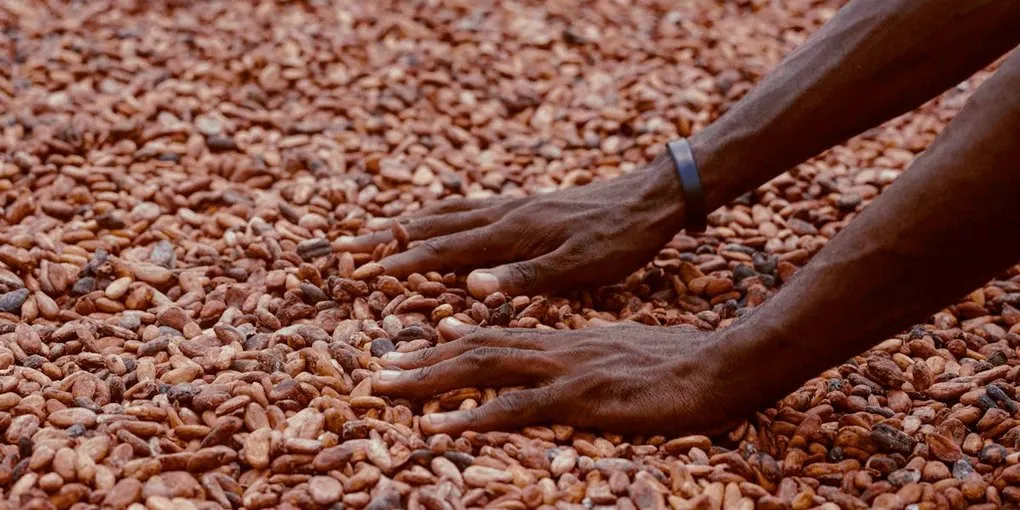
Ghana and Ivory Coast together produce more than 60% of the world’s cacao. By any agricultural measure, these two West African nations are the foundation of the global chocolate industry. Yet in the craft chocolate world, they are almost invisible. Open a hundred single-origin craft bars and you might find one or two from either country. The Flavors of Cacao database, which catalogs over 2,700 bar reviews, shows West African origins scoring consistently lower and appearing far less frequently than Latin American or even other African origins like Madagascar or Tanzania.
This gap between production dominance and craft absence tells a story about genetics, colonial history, post-independence agricultural policy, and the economics of a crop that pays farmers an average of $2,500 per year from 3 hectares.
The Genetics: Amelonado’s Reign
The vast majority of cacao grown in West Africa belongs to the Amelonado genetic cluster. In the modern 10-cluster classification established by Motamayor and colleagues in 2008, Amelonado traces its origins to the Para River region of Brazil. It is the genetic backbone of what the old three-way classification called “Forastero” — the bulk cacao that accounts for 80 to 90% of world production.
Amelonado trees are robust, high-yielding, and disease-tolerant. Their beans have purple-pigmented cotyledons and high polyphenol content. These are important agricultural virtues in a region where 90% of cacao is cultivated on small family farms of 2 to 5 hectares, where disease resistance and predictable yield are not luxuries but survival requirements.
The flavor trade-off is real. Bulk cacao varieties like Forastero and Amelonado “develop most of their flavor during roasting” rather than from genetics and fermentation alone. The fine-flavor characteristics associated with Criollo, Nacional, or Trinitario genetics — complex fruit, floral notes, layered acidity — are largely absent. What Amelonado delivers is a solid, dependable base chocolate flavor: deep cocoa, moderate bitterness, and the foundational taste that most people associate with the word “chocolate.”
For a broader look at how cacao genetics shape flavor across all origins, see our cacao genetics guide.
Ghana: The Quality Benchmark for Bulk Cacao
Ghana has historically been considered the quality standard for bulk cacao. “Ghana Standard” was a grade designation that other origins measured themselves against. The country’s cocoa marketing board (COCOBOD) maintained quality controls that were unusual in the commodity cacao world — including centralized buying, quality inspections, and fixed farmgate prices.
Ghana’s cacao industry was established under British colonial rule in the late 19th century, built primarily on Amelonado stock imported from Fernando Po (now Bioko, Equatorial Guinea). The genetic base was narrow but well-suited to the West African climate and disease environment.
The flavor profile of traditional Ghanaian cacao was described by industry veterans as distinctly “West African” — a full-bodied cocoa character with moderate acidity and a clean, well-defined chocolate base. It was the flavor that defined what chocolate should taste like for most of the 20th century.
Then the replanting happened. Gary Guittard, fourth-generation head of the Guittard Chocolate Company and one of the most experienced palates in the American industry, observed that Ghana “lost that West African flavor” after replanting in the 1970s and that the decline accelerated “even more so in the last few years because they have integrated more hybrid trees.” The shift toward higher-yielding hybrid varieties — crosses between Amelonado and various Trinitario and Upper Amazon selections — improved output but diluted the flavor identity that had made Ghana cacao distinctive.
Kuapa Kokoo: The Cooperative Model
Kuapa Kokoo, founded in 1993, is Ghana’s largest farmer-owned cacao cooperative, with over 100,000 members across multiple regions. The cooperative was a direct response to the liberalization pressures on COCOBOD and the desire among farmers to have more control over pricing and quality.
Kuapa Kokoo is the farmer-owned supplier behind Divine Chocolate, the UK-based fair trade chocolate brand. The cooperative model demonstrates that farmer organization can improve both income and quality in a system that traditionally paid subsistence wages. Kuapa Kokoo farmers benefit from fair trade premiums on top of the COCOBOD farmgate price.
The Aging Farmer Crisis
The average age of a cacao farmer globally is approximately 56 years. In Ghana, the demographic challenge is acute. Young people in cacao-growing regions increasingly choose urban employment or other agricultural sectors over inheriting family cacao farms. The combination of aging farmers, low incomes, and the 3-to-5-year wait before newly planted trees reach fruiting age creates a succession crisis that threatens long-term supply.
Ivory Coast: The Volume Leader
Ivory Coast (Cote d’Ivoire) is the world’s largest cacao producer, responsible for approximately 40% of global output with annual production of roughly 2.2 million metric tons. The country’s cacao industry expanded rapidly after independence in 1960 under President Felix Houphouet-Boigny, who encouraged cacao planting as a path to national economic development. By the 1970s, Ivory Coast had overtaken Ghana as the world’s top producer.
The Ivorian model prioritized volume over quality. Extensive monoculture planting, often involving forest clearing, created enormous production capacity. The genetic base is predominantly Amelonado and hybrid varieties, similar to Ghana but with even less emphasis on flavor preservation.
Flavor Profile
Ivory Coast cacao, when it appears in craft chocolate at all, tends to score poorly. The Flavors of Cacao database shows West African origins as “almost absent from craft use; when appearing, scores are poor.” This is partly a function of genetics (bulk Amelonado) and partly a function of post-harvest handling. Commodity cacao is not optimized for flavor — it is optimized for volume, consistency, and minimum acceptable quality for industrial blending.
The standard Ivorian bean is fermented in heaps (25 to 2,000 kg, covered with banana leaves) for 5 to 6 days, sun-dried, and sold through a chain of middlemen to export companies. The fermentation and drying protocols are adequate for producing functional cocoa for industrial use but are not designed to develop the complex flavor precursors that craft makers seek. For more on how fermentation drives flavor development, see our fermentation science guide.
Explore the full map of cacao origins, including flavor notes and genetic profiles, on the Origin Map.
The Sustainability Challenge
West African cacao production faces interconnected sustainability challenges that make simple solutions elusive.
Deforestation
Ivory Coast has lost approximately 80% of its forest cover since the 1960s, with cacao farming as a primary driver. The “frontier model” — clearing virgin forest for new cacao plantations, farming until soil is exhausted, then clearing more forest — was the dominant expansion strategy for decades. Ghana has experienced similar but less extreme deforestation.
The irony is that cacao trees perform best under shade canopy in agroforestry systems, but the short-term yield from full-sun monoculture incentivized clearing. As soil quality degrades in older plantations, productivity drops, reinforcing the cycle of clearing new land.
Child Labor
The issue of child labor in West African cacao farming has been documented extensively since the early 2000s. NORC at the University of Chicago, commissioned by the U.S. Department of Labor, found in its 2020 report that an estimated 1.56 million children were engaged in hazardous work in cacao production in Ghana and Ivory Coast combined. The problem is structural — it is rooted in the poverty of farming households where annual income from cacao is insufficient to hire adult labor.
The chocolate industry has made repeated pledges to address child labor, beginning with the Harkin-Engel Protocol in 2001. Progress has been slow. Certification schemes (Fairtrade, Rainforest Alliance, UTZ) provide premiums and monitoring but have not eliminated the problem. The fundamental economic equation — low farmgate prices relative to the labor demands of cacao cultivation — remains unchanged.
Price Volatility
Cacao is a commodity traded on futures markets in London and New York. Prices are set by global supply and demand, not by the cost of production. When oversupply drives prices below the cost of sustainable farming, farmers have no buffer. Both Ghana and Ivory Coast have implemented stabilization mechanisms (COCOBOD in Ghana, Conseil du Cafe-Cacao in Ivory Coast, plus the joint Living Income Differential introduced in 2019), but these can only partially insulate farmers from global price swings.
Why Craft Chocolate Rarely Uses West African Beans
Craft bean-to-bar makers need traceable, single-origin beans with specific fermentation and drying protocols optimized for flavor. The West African commodity chain is designed for fungibility — beans from thousands of small farms are aggregated, mixed, and sold as undifferentiated bulk. Traceability to a specific farm, cooperative, or fermentation protocol is the exception, not the norm.
The genetics work against craft use as well. Amelonado and its hybrids produce beans that are best suited to the industrial chocolate-making process — heavy roasting, alkalizing, blending with vanilla and additional cocoa butter — that maximizes the consistent “chocolate flavor” consumers expect from mass-market products. These are not the genetics that produce the fruity, floral, or complex profiles that craft chocolate celebrates.
There are exceptions. Some specialty importers and cooperatives in Ghana are producing traceable, quality-focused lots. Kuapa Kokoo’s relationship with Divine Chocolate demonstrates that the cooperative model can support higher-quality production. But these remain niche volumes in an industry that moves over 3 million metric tons annually.
For more on how cacao farming works at the small-farm level, or to understand how CCN-51 and other high-yield varieties are reshaping cacao agriculture globally, explore our dedicated guides. You can also compare West African origins to the very different stories playing out in Ecuador, Peru, or Venezuela.
The Future: Specialty Potential
The conversation about West African cacao quality is beginning to shift. As land suitable for cacao expansion diminishes, both countries are showing increased interest in quality improvement as a strategy for maintaining export revenue without expanding acreage.
Ghana’s Cocoa Research Institute has been developing improved varieties that balance yield with flavor characteristics. Ivory Coast has launched programs to rehabilitate degraded cacao farmland through agroforestry rather than clearing new forest. Both countries have seen the emergence of small-scale, quality-focused operations that are beginning to sell directly to craft makers.
The genetic diversity exists within the Amelonado and hybrid populations to produce interesting chocolate when post-harvest processing is optimized. The “series of fourths” model — genetics contributes roughly one quarter of final flavor, with environment, fermentation, and roasting each contributing another quarter — suggests that better fermentation protocols alone could meaningfully improve the flavor profile of existing West African plantings.
Whether the economics of quality can compete with the economics of volume remains the central question for West African cacao’s next chapter.
For information on where to source beans from various origins, including the rare West African specialty lots that are beginning to appear, see our guide to buying cacao beans.
Frequently Asked Questions
- Why is most chocolate made from West African cacao if it scores poorly in tastings?
- Industrial chocolate is designed differently than craft chocolate. Mass-market manufacturers blend beans from multiple origins, roast heavily, alkalize (Dutch process), and add vanilla, extra cocoa butter, and sugar to create a consistent product. This process deliberately overrides origin-specific flavors. West African Amelonado cacao is ideal for this approach because it provides a dependable cocoa base at scale. Poor tasting scores reflect its performance in single-origin craft bars, not its suitability for its intended industrial use.
- What does Ghana cacao taste like compared to Ivory Coast cacao?
- Traditional Ghanaian cacao had a distinctly 'West African' flavor — full-bodied cocoa character with moderate acidity and a clean chocolate base. This profile has degraded since the 1970s replanting with hybrid varieties. Ivory Coast cacao is generally similar but with less historical emphasis on quality — its flavor profile tends toward generic bulk cocoa. In practice, most consumers cannot distinguish between the two because both are almost exclusively used in blended, industrially processed chocolate rather than single-origin bars.
- Is there fair trade cacao from Ghana and Ivory Coast?
- Yes. Kuapa Kokoo in Ghana, with over 100,000 members, is the largest farmer-owned cacao cooperative in the country and supplies Divine Chocolate under fair trade terms. Both countries have multiple Fairtrade and Rainforest Alliance certified cooperatives. Fair trade premiums provide a price floor above market rates, though the structural economics of cacao farming — average income of roughly $2,500 per year from 3 hectares — remain challenging even with certification.
- Can West African cacao be used for craft chocolate?
- It can, but it rarely is. The main obstacles are traceability (commodity supply chains mix beans from thousands of farms) and genetics (Amelonado varieties produce less complex flavor profiles than Criollo, Nacional, or Trinitario). Specialty importers are beginning to source traceable, quality-focused lots from Ghana, and some cooperatives are experimenting with improved fermentation protocols. These remain niche volumes but represent a growing trend.