Cacao generally contains more theobromine than caffeine, unlike coffee. Concentrations and ratios vary with genetics and processing; a broad raw-bean range cannot predict a particular finished bar. Both compounds are pharmacologically active. A study of methylxanthine composition documents variation between beans and products.
Chocolate supplies both compounds. Its theobromine-dominant composition does not make its caffeine irrelevant, particularly for a large serving or a caffeine-sensitive person. That compositional difference is what this article unpacks — what theobromine is, how much is actually in each type of chocolate, how it compares with caffeine, and how cacao variety shifts the balance.
What Theobromine Is
Theobromine is a methylxanthine alkaloid, chemically related to caffeine but structurally distinct. Both compounds are xanthine derivatives — theobromine is 3,7-dimethylxanthine while caffeine is 1,3,7-trimethylxanthine. That structural difference contributes to differences in receptor activity and metabolism; dose and absorption also matter.
Theobromine vs Caffeine in Chocolate
Composition and pharmacology do not predict a universal subjective experience
| Property | 01Theobromine | 02Caffeine |
|---|---|---|
| Chemical Class | Methylxanthine (3,7-dimethylxanthine) | Methylxanthine (1,3,7-trimethylxanthine) |
| Amount in Cacao Nibs | Usually the more abundant methylxanthine; concentration varies | Usually less abundant; concentration varies |
| Pharmacological Activity | Weaker adenosine antagonist; measurable cardiovascular activity | Stronger adenosine antagonist; marked CNS stimulation |
| Time course | Absorption depends on dose and food matrix | Absorption depends on dose and food matrix |
| Half-Life (human) | ~6-10 hours | ~3-7 hours |
| Genetics and origin | Influence concentration; no label guarantees a dose | Influence concentration and the ratio to theobromine |
| Sleep Impact | Likely milder, but not well established | Well-documented disruption |
| In a 70-85% Dark Bar (70g) | ~560 mg (USDA benchmark) | ~56 mg |
Per-bar values use the USDA representative 70–85% dark-chocolate entry. Half-lives are approximate reported adult ranges, not fixed durations of a felt effect or guarantees for an individual.
jayarrchocolate.comThe name “theobromine” does not come from bromine. It derives from Theobroma, the genus name for cacao, which Linnaeus coined in 1753 from the Greek theos (god) and broma (food). The genus name is commonly translated as “food of the gods”; the alkaloid name is derived from that genus. Despite the name suggesting divine origins, its physiological effects are notably milder than caffeine’s.
Cocoa foods are important dietary sources of theobromine. Concentration is not the same as intake: a spoonful of powder and a full bar have very different serving weights.
What Caffeine Does Differently
Caffeine blocks adenosine receptors and has more pronounced central stimulant effects than theobromine. Reported half-lives vary between people. In one small direct comparison in six volunteers, mean half-lives were 7.2 hours for theobromine and 4.1 hours for caffeine. Those group means do not specify how long an individual will feel an effect. Absorption research also shows that the food or capsule carrying the compound matters.
Theobromine has weaker central stimulant activity, but that is not the same as being inactive or universally free of adverse effects. Effects on circulation and heart rate depend on dose and conditions; they should not be interpreted as a guaranteed cardiovascular benefit from chocolate.
It is tempting to map this onto experience — to say coffee delivers a sharp, focused alertness while chocolate delivers a slower, warmer mood lift. That story is popular, but the controlled evidence is thin. A placebo-controlled trial in healthy adults by Baggott and colleagues found only limited subjective effects from 250 milligrams of theobromine, while higher doses of 500 and 1,000 milligrams produced negative mood effects and heart rate rose with dose. In other words, isolated theobromine at chocolate-relevant amounts does not reliably produce the pleasant warm lift the folk account describes. The isolated doses in this experiment are not identical to eating chocolate. They do show why a longer half-life should not be marketed as a proven gentle mood lift.
The Numbers in Your Bar
Measured food-composition data gives a more reliable picture than scaling the nib-level 1.5 to 3% figure by cacao percentage. That shortcut produces theoretical endpoints, and it breaks down whenever part of the cacao percentage is added cocoa butter, which carries almost no theobromine. The USDA Standard Reference food-composition report lists dark chocolate in the 70 to 85% band at 802 milligrams of theobromine and 80 milligrams of caffeine per 100 grams. So a 70-gram bar in that band carries roughly 561 milligrams of theobromine and 56 milligrams of caffeine — a representative benchmark rather than a universal value, since origin, recipe, and processing all shift the numbers.
For comparison, an 8-ounce cup of brewed coffee is often estimated at about 80 to 100 milligrams of caffeine, although actual products vary considerably. FDA guidance emphasizes serving size and individual sensitivity. So that 70-gram dark bar carries a little over half the caffeine of a cup of coffee — but the caffeine arrives alongside several hundred milligrams of theobromine, so the ratio of the two methylxanthines is the reverse of coffee’s.
That reversed ratio is the concrete, measurable difference between chocolate and coffee. Whether it produces a distinctly different subjective experience is a separate question, and one the controlled evidence does not clearly answer.
How Much Theobromine Is in Each Type of Chocolate
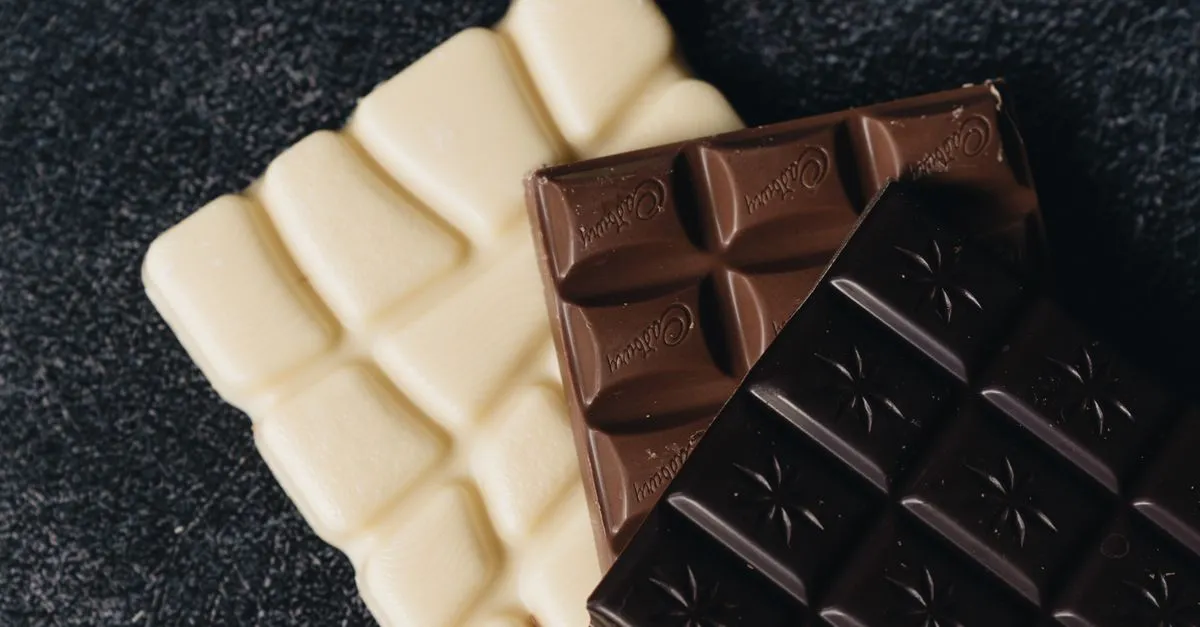
The nonfat cocoa material is the main source of these alkaloids; cocoa butter contributes little. That helps explain broad differences between cocoa powder, dark chocolate, milk chocolate and white chocolate. It does not produce a perfect ranking of every product, because the source cocoa and formulation also vary.
The figures below are representative measured entries from USDA FoodData Central (SR Legacy), not values calculated by scaling cacao percentage. Treat them as representative database entries rather than universal values — cacao origin (Forastero runs higher than Criollo), variety, recipe, and processing all cause variation. The USDA report linked above provides the underlying reference values; figures in the table are rounded where indicated by their scale.
| Food (per 100 g) | Theobromine | Caffeine |
|---|---|---|
| Natural cocoa powder (FDC 169593) | 2,060 mg | 230 mg |
| Alkalized (Dutch) cocoa powder (FDC 169594) | 2,630 mg | 78 mg |
| Unsweetened baking chocolate (FDC 167568) | 1,300 mg | 80 mg |
| Dark chocolate, 70–85% (FDC 170273) | 802 mg | 80 mg |
| Dark chocolate, 60–69% (FDC 170272) | 632 mg | 86 mg |
| Dark chocolate, 45–59% (FDC 170271) | 493 mg | 43 mg |
| Milk chocolate (FDC 167587) | 205 mg | 20 mg |
| White chocolate | negligible | negligible |
One detail in this table is worth flagging: the alkalized (Dutch) cocoa entry actually carries more theobromine than the natural one, not less, even though its caffeine is lower. That is a caution against the common assumption that alkalization uniformly reduces theobromine — the direction is not fixed (see below).
The practical takeaway: serving size and the amount of nonfat cocoa matter, but the cacao percentage includes cocoa butter and is not an exact alkaloid-dose dial. A 70-gram bar in the 70 to 85% band carries roughly 560 milligrams of theobromine on the USDA benchmark; the same weight of milk chocolate carries about 140 milligrams; white chocolate carries essentially none. Cocoa powder — over 2,000 milligrams per 100 grams in both representative USDA entries — is the most concentrated everyday source in the table.
How Cacao Variety Affects the Ratio
Genetics influence methylxanthine composition, but broad Forastero/Criollo labels are not precise predictions of a bar’s content. An ICCO project found that the theobromine-to-caffeine ratio had potential to distinguish the fine and bulk cocoa samples studied. That analytical result does not establish that every Criollo bar has less theobromine, less total stimulant effect or less bitterness than every Forastero bar.
ICCO’s definition of fine-flavor cocoa considers sensory attributes together with genetics, growing conditions and production practices. Quality and physiological response cannot be inferred from one ratio. The cacao percentage tells you the combined cacao-derived share, not the exact alkaloid content.
Roasting and Processing Effects
Methylxanthines are less volatile than many aroma compounds, but “not easily evaporated” does not mean their measured concentrations stay unchanged throughout processing. An original study of bean maturity and fermentation found effects of maturity, method and duration on theobromine and caffeine. A study comparing unroasted and roasted beans also found that roasting conditions affected xanthine concentrations. There is no universal percentage retained across all processes.
The USDA natural and alkalized cocoa entries are different reference foods, not a before-and-after experiment on the same beans. Their different values cannot establish the direction or size of an alkalization effect. The same caution applies to attributing every difference in bitterness to one compound.
For makers, fermentation, roasting and melanger work shape the finished product, but a clock or roast temperature does not replace analytical testing of alkaloids. Sugar and added cocoa butter also dilute their concentration per gram of finished chocolate. See the flavor-compounds guide for the wider chemistry.
The Chocolate-Before-Bed Question
Theobromine’s half-life is longer than caffeine’s in humans — commonly reported in the 6 to 10 hour range — but it is a weaker CNS stimulant. How chocolate affects sleep specifically has not been well characterized in controlled studies. Anecdotally, many people tolerate moderate dark chocolate in the evening better than a comparable dose of coffee, but that is not established, and the total methylxanthine load still matters.
Individual sensitivity clearly varies. Some people metabolize both methylxanthines slowly and report sleep effects from chocolate consumed after dinner; others notice nothing. If you are caffeine-sensitive enough that a cup of afternoon tea keeps you up, dark chocolate after dinner may also affect you — although the relative contribution of each compound to that individual sleep response is not established here.
Milk chocolate is a different calculation. Many milk chocolates contain less nonfat cocoa and therefore less of both alkaloids per gram than high-cocoa dark chocolate, but milk-chocolate recipes and cacao percentages vary. White chocolate contains essentially no theobromine or caffeine — it is made from cocoa butter, milk solids, and sugar, with no nonfat cocoa solids, which is where the alkaloids reside.
Theobromine and Bitterness
Theobromine contributes bitterness, while polyphenols can contribute both bitterness and astringency. Astringency is the drying or puckering sensation; it is not another name for bitterness. The finished sensory balance also depends on acids, aroma, sugar, fat and processing.
A bean’s genetic label does not guarantee a particular taste. If you find one 70% bar too bitter, comparing actual bars and formulations is more useful than assuming every Criollo or Trinitario bar at the same percentage will be milder. Roasting and fermentation can alter the sensory balance as well as measured compounds.
Species Sensitivity: Why Chocolate Is Toxic to Dogs
Chocolate poisoning in pets involves both theobromine and caffeine. Dogs clear theobromine slowly; the Merck Veterinary Manual reports a canine half-life of about 17.5 hours. Risk depends on the animal’s weight, product and amount eaten. Cocoa powder and baking chocolate generally supply much more methylxanthine per gram than milk chocolate. Cats can also be poisoned, although dogs are more often involved in reported exposures.
If a pet eats chocolate, contact a veterinarian or the ASPCA Poison Control hotline at 888-426-4435 promptly. Have the packaging, amount and timing available. White chocolate has very little methylxanthine but is not an appropriate pet treat; other ingredients and its fat can present problems.
For humans, ordinary food servings are a different exposure from concentrated supplements, but “not usually lethal” is not a useful safety standard. The human trial discussed above found adverse subjective effects and increased heart rate at higher isolated doses. This article cannot establish a universally safe theobromine dose or support escalating chocolate intake for a stimulant effect.
Cacao’s Long History Is Not a Pharmacology Experiment
Archaeological research found evidence of cacao use at Santa Ana-La Florida in Ecuador about 5,300 years ago. Detecting theobromine residue establishes evidence of cacao use; it does not tell us that people used it specifically as a stimulant or experienced a particular modern-described mood effect. Later cacao drinks had varied cultural, social and economic roles.
For chocolate lovers, the practical distinction is chemical: chocolate typically supplies more theobromine than caffeine. It does not follow that a high-theobromine bar is a better energy aid, that a named origin guarantees a dose, or that weaker central stimulation makes a supplement risk-free.
A Madagascar bar and a West African-origin bar may differ in alkaloid composition, but taste and labels alone cannot quantify the difference. Cacao nibs also contain both compounds; they are not an unprocessed, universally highest-concentration source. Cocoa powder is more concentrated per gram in the reference examples above because much of the fat has been removed.
Frequently Asked Questions
- How much theobromine and caffeine is in a dark chocolate bar?
- A 70-gram bar of dark chocolate in the 70 to 85% band carries roughly 560 milligrams of theobromine and 56 milligrams of caffeine, based on USDA FoodData Central's representative entry of 802 mg theobromine and 80 mg caffeine per 100 g. Treat that as a representative benchmark, not a fixed value — cacao origin, variety, and processing all shift it, with Forastero-dominant beans tending higher. For reference, an 8-ounce cup of brewed coffee contains about 80 to 100 milligrams of caffeine.
- Can chocolate keep me awake at night?
- It can, especially if you are caffeine-sensitive or eat a large amount of high-percentage dark chocolate late in the evening. Theobromine has a longer half-life than caffeine in humans (commonly cited at 6 to 10 hours) but is a weaker CNS stimulant. How chocolate affects sleep specifically has not been well characterized in controlled studies, and individual sensitivity varies. Milk and white chocolate are much lower in alkaloids and are correspondingly less likely to be a factor.
- Is theobromine a stimulant?
- Theobromine is pharmacologically active and has weaker central stimulant activity than caffeine. Human experiments have found dose-dependent effects, including increased heart rate; those findings should not be treated as a guaranteed health benefit. A distinct warming or mood-lifting subjective effect from ordinary chocolate is commonly described but not well established in controlled trials; a placebo-controlled study actually found negative mood effects at higher isolated doses.
- Is theobromine toxic to humans?
- Theobromine can cause adverse effects in humans, particularly at higher or concentrated doses. Controlled research found negative subjective effects and increased heart rate at higher isolated doses. Ordinary food use is a different exposure, but this does not establish a universally safe dose or justify supplement use. Pets are especially vulnerable to chocolate; contact a veterinarian promptly after ingestion.
- How much caffeine is in dark vs milk chocolate?
- Milk chocolate often contains less of both alkaloids per gram than high-cocoa dark chocolate because it has less nonfat cocoa material. Recipes vary, so compare specific composition information when available. White chocolate contains no nonfat cocoa solids (it contains cacao-derived cocoa butter, typically with milk and sugar) and therefore contains essentially no theobromine or caffeine.
- Does white chocolate contain theobromine or caffeine?
- Essentially none. White chocolate is made from cocoa butter, milk solids, and sugar, with no nonfat cocoa solids. Theobromine and caffeine reside in the nib portion of the cacao bean, not in the fat, so white chocolate carries only negligible traces at most.
- Can you get a theobromine supplement instead of eating chocolate?
- Isolated theobromine is sold as a supplement, though the evidence for specific health benefits is limited and this article makes no health claims for it. In any case, the theobromine in chocolate arrives alongside hundreds of other bioactive compounds — polyphenols, flavanols, Strecker aldehydes, and additional methylxanthines. Isolating theobromine removes that matrix. A placebo-controlled trial also found that isolated theobromine produced only limited subjective effects at a moderate dose and negative mood effects at higher doses, so a supplement is not a shortcut to whatever people enjoy about chocolate.
- Why is chocolate especially dangerous to dogs?
- Dogs clear theobromine slowly, and both theobromine and caffeine contribute to chocolate poisoning. The same mass of chocolate represents very different doses for a small dog and an adult person. Dark chocolate, baking chocolate, and cocoa powder are the most dangerous forms because they contain the highest theobromine concentrations. Milk chocolate is less dangerous but still hazardous in quantity. White chocolate is not a theobromine concern for pets (though its fat and sugar can still cause other problems). If your dog eats chocolate, call your veterinarian — severity depends on the dog's weight and the type and quantity of chocolate consumed.
- Does cocoa powder have more theobromine than a chocolate bar?
- Usually, gram for gram, in these reference examples. Cocoa powder has much of its cocoa butter removed and therefore more nonfat cocoa material per gram. USDA FoodData Central lists natural cocoa powder at about 2,060 milligrams of theobromine per 100 grams, versus roughly 802 milligrams for dark chocolate in the 70 to 85% band. Interestingly, USDA's alkalized (Dutch-processed) cocoa entry shows even more theobromine (about 2,630 mg per 100 g), not less — but the entries are not paired samples from the same beans, so they cannot show what alkalization did to theobromine.