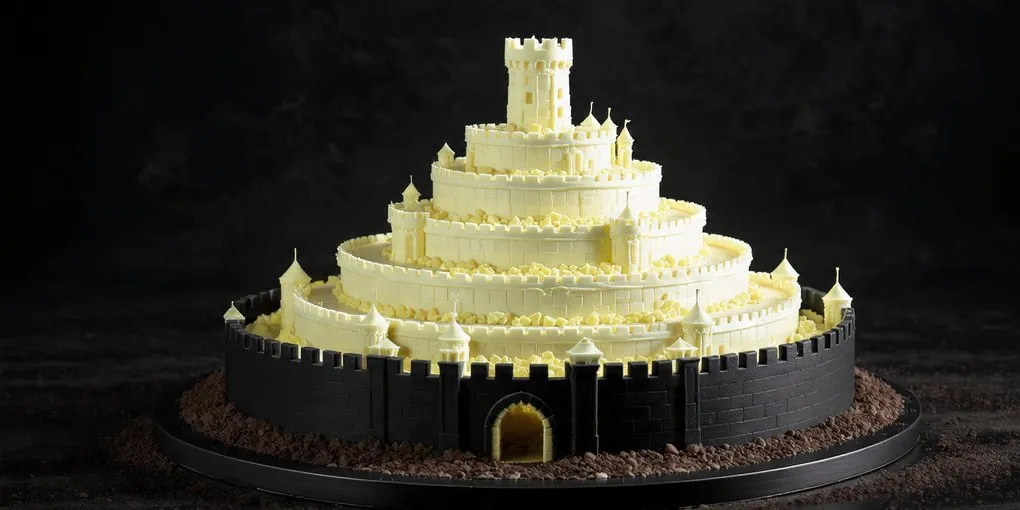
Minas Tirith is an inviting subject for cake decoration: ascending terraces, walls, a projecting rock formation, and a tower give the silhouette an identity before the tiny buildings are added. Translating that image into food, however, involves separate decisions about flavor, appearance, and support.
It also calls for accurate attribution. A photograph of a white cake does not establish that its covering is white chocolate.
What Michelle Gillott actually made
In her January 10, 2012 post, Gillott describes a commissioned seven-layer fruit cake and a build lasting four and a half days and nights. Her 2020 reply to a reader specifies marzipan and fondant, with the exterior mainly fondant. She credits photographer Jean-Luc Benazet.
Those details do not support a pound-cake core, tempered couverture walls, or a prescribed modeling-chocolate tower. Nor does the post establish that this was the first Minas Tirith cake or the template for all later examples. Credit belongs to the documented work without inventing a wider lineage.
Our Chocolate Shells archive page provides context and a route to the author’s own site. The design considerations below describe a possible new adaptation; they are not Gillott’s recipe.
Decide which image of the city you want to evoke
Wētā’s description of its Minas Tirith environment identifies seven levels, concentric walls, and the Tower of Ecthelion and Court of the Fountain at the summit. That provides a useful reference for a cake inspired by the film design.
Choose a reference before drawing the cake. A film miniature, an illustration, and a close reading of the novel need not produce identical buildings or proportions. A cake can preserve the impression of rising terraces without claiming to be an exact architectural model.
Seven visible levels also need not mean seven independently baked, full-height tiers. A smaller cake could suggest the upper levels through decoration or a removable display element. Decide the number of servings and the available work and transport space before deciding how literal the structure should be.
Avoid an arbitrary pan progression. Starting at 12 inches and subtracting one inch six times finishes at 6 inches, not 2. Subtracting 1½ inches finishes at 3. A drawing with actual dimensions is more useful than a list that fails its own arithmetic.
Choose the covering for the job
Fondant, buttercream, modeling chocolate, and tempered couverture are different materials. None is the uniquely correct way to evoke pale stone.
Fondant can supply a smooth covering and sculpted detail. Buttercream can provide texture. Modeling chocolate is a pliable chocolate-and-syrup preparation; it is not simply a sheet of tempered couverture. Ann Reardon’s comparative modeling-chocolate tests illustrate how changing the chocolate and syrup changes the result. A universal two-to-one ratio is not a reliable specification for every brand and application.
Tempered white couverture can be useful for selected panels, gates, or other decorative pieces. Its natural ivory color may suit the design, but choosing it should follow the desired finish and handling properties. It need not cover every surface.
For any food coloring, use a product labeled edible and compatible with the intended medium. An unspecified charcoal additive is not a necessary route to a dark wall. Test the chosen coating and color together before committing to a large batch.
If you use couverture, follow its own tempering method
Tempering controls cocoa-butter crystallization so chocolate sets with useful handling and appearance. It is not a treatment that turns a thin decorative shell into a substitute for cake supports. Our cocoa-butter crystallization guide explains the underlying subject.
For one specific example, Callebaut’s published W2 white-chocolate curve gives 45°C to melt, 27°C to cool, and 28–29°C to rewarm for working. The company also calls for a small crystallization test before use. Those stages should not be collapsed into “melt to 50°C, cool to the working temperature, and hold.” Seeding and other methods have their own instructions.
Follow the selected manufacturer’s procedure, including how to introduce seed if using it. The working temperature concerns the chocolate while it is being handled; a finished cake is not held at that temperature for several days. A glossy photograph alone cannot verify the state of its crystals.
Our equipment guide covers relevant tools. The bonbon shell guide discusses molding, but a bonbon cavity is not a structural specification for a large cake panel. Likewise, adding cocoa butter changes the formulation: it is not a guarantee that an altered batch remains correctly tempered.
Supports carry the cake; decoration supplies the city
Wilton’s stacked-cake construction guidance uses cake boards and dowel supports to stabilize tiers and carry their weight. Dense cake, a firm filling, or a chocolate exterior does not eliminate that requirement.
For a custom design, plan where each supported tier rests, how upper elements attach, and how the cake will be transported and disassembled. Use components intended for food contact and identify anything that must be removed before serving. A narrow tower deserves its own attachment plan; placing it on soft cake at the last minute does not establish stability.
This article supplies no tested dimensions, support count, load rating, or assembly diagram for a seven-tier structure. Those decisions need a proven construction method matched to the actual cake, or an experienced cake decorator. A smaller design with fewer structural tiers can still communicate the subject.
Plan storage around the whole dessert
There is no universal rule that white chocolate looks good for 48 hours and blooms at 72–96 hours. Callebaut’s bloom guidance identifies poor tempering, migration of fats from fillings, and unsuitable storage temperatures or fluctuations as contributing factors. That does not supply a fixed countdown for every cake.
The cake and filling also have requirements of their own. A cream filling is not made shelf-stable by a chocolate wall. Choose tested recipes with appropriate storage instructions, and plan decorating, refrigeration where required, transport, and display around the finished dessert. A chocolate-bar storage recommendation cannot set the safe display time of an entire filled cake.
The same applies to the schedule. Baking, cooling, making decorative elements, assembly, and transport are separate jobs. Estimate them from your chosen recipes and design rather than assuming a universal three-day plan.
A useful chocolate adaptation starts with a small test
Make a sample panel, a short section of wall, and a representative attachment before constructing the whole city. Check the finish against the cake covering, whether details can be handled without breaking, and whether the planned proportions remain recognizable.
That test is a practical design exercise, not proof that a full structure will bear its loads. Keep the edible recipes, the support plan, and the decorative choices explicit. The strongest tribute is a cake whose construction works—and whose description gives the original maker accurate credit.
Frequently Asked Questions
- Was Michelle Gillott's Minas Tirith cake made of white chocolate?
- No. Her own account identifies fruit cake, marzipan, and fondant. A white-chocolate version would be a separate adaptation.
- Do I need seven full cake tiers?
- Seven visible levels evoke the city, but the design can use fewer structural cake tiers and suggest additional terraces through decoration. Plan servings, dimensions, and supports before choosing pans.
- What temperature should I use for white chocolate?
- Follow the particular manufacturer's method and test the temper. The published Callebaut W2 example melts at 45°C, cools to 27°C, then rewarms to a 28–29°C working range; that is not a universal method for every product.
- Can chocolate walls support a tall cake?
- Do not treat decorative chocolate walls as the cake's support system. Tiered construction needs an appropriate arrangement of food-contact boards and supports matched to its dimensions and weight.
- Will the cake bloom after three days?
- There is no universal three-day bloom deadline. Temper, filling fats, and storage conditions affect appearance; the cake and filling also require their own storage plan.
- Is this a tested Minas Tirith cake recipe?
- No. It explains attribution and design considerations. It does not provide a tested batter formula, serving yield, structural plan, or validated storage period for a complete cake.