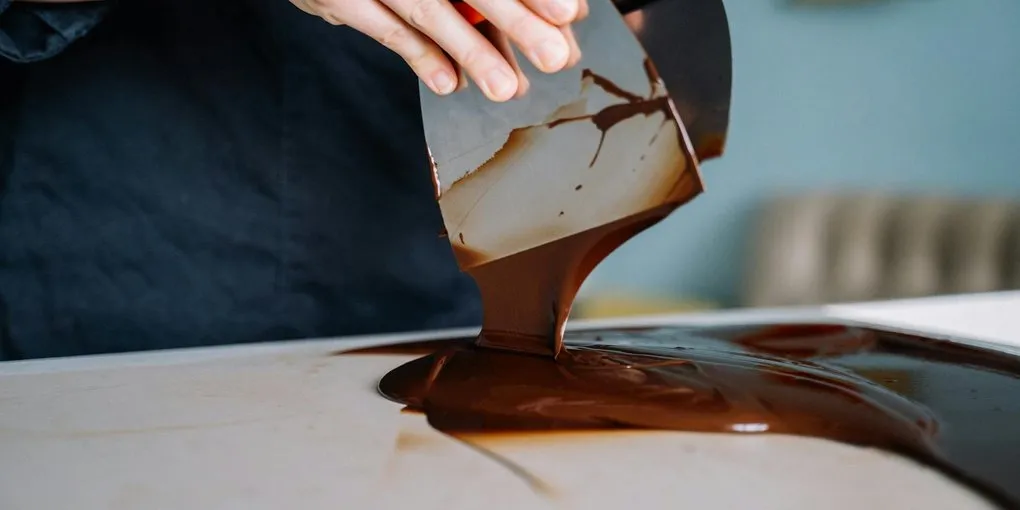
Tempering chocolate is the process of bringing it through a specific temperature protocol to ensure it solidifies with Form V cocoa butter crystals — the form that produces snap, gloss, clean melt, and bloom resistance. For dark chocolate, melt fully to 120°F (48.9°C), cool to 80°F or below, then work at 85.5 to 87°F (29.7 to 30.6°C). Do not exceed 90°F during working or the temper breaks.
Why Tempering Exists: The Crystal Story
Cocoa butter is a polymorphic fat — it can solidify into six distinct crystal forms depending on how it cools. These forms have different melting points and different physical properties. Getting the right form means controlling the temperature protocol precisely.
The six forms and their melting points:
Form I (gamma) melts at approximately 17°C. Form II (alpha) at approximately 21°C. Form III (beta-prime 2) at approximately 26°C. Form IV (beta-prime 1) at approximately 28°C. Form V (beta-2) at approximately 34°C — this is the target. Form VI (beta-1) at approximately 36°C — the most stable form, but too stable for good eating quality.
Form V gives snap when broken, surface gloss, clean contraction from molds, and melt-in-mouth at body temperature. Chocolate that melts cleanly at 34°C (just below body temperature of 37°C) releases flavor compounds quickly and completely. Form VI has a higher melting point than body temperature — chocolate with Form VI crystals feels waxy and does not melt cleanly.
When you melt chocolate to remove all crystal memory, then cool it, it will spontaneously form the most stable structure available — without guidance, that produces a mix of forms. Tempering provides that guidance by seeding Form V at the right temperature.
Equipment You Need
- Probe thermometer accurate to 1°F (Thermapen ONE or equivalent)
- Double boiler or microwave for melting
- Stainless or glass bowl for working
- Scraper or stiff spatula for stirring
- Marble slab (for tabling method only)
- Tempered solid chocolate for seed (for seed method)
The thermometer is the non-negotiable item. The working range for dark chocolate is 1.5°F wide. See our thermometer guide for specific recommendations.
Method 1: The Seed Method (Recommended)
The seed method uses solid tempered chocolate as the Form V seed source. The ratio is approximately 3 parts melted chocolate to 1 part solid chocolate.
Step 1 — Melt: Bring your chocolate to 120°F (48.9°C) using a double boiler or microwave in short bursts. This temperature melts all six crystal forms, giving you a fully unstructured melt. Do not exceed 130°F.
Step 2 — Add seed: Remove from heat. Add solid tempered chocolate — callets, a broken bar, or chocolate from a previous well-tempered batch — at approximately 25% of the total weight. If you have 300g of melt, add about 100g of solid.
Step 3 — Stir: Stir continuously as the solid chocolate melts. The tempered crystals in the solid are acting as Form V seed. As the solid melts into the warm batch, Form V seeds distribute through the mass.
Step 4 — Check temperature: Continue stirring and checking temperature. You want the mass to reach approximately 86 to 87°F (30 to 30.6°C) with all solid pieces completely melted. This usually takes 5 to 10 minutes of stirring.
Step 5 — Work quickly: Once at working temperature, pour into molds or use for dipping. Do not let the chocolate cool below 84°F during work — it will thicken and develop streaks. Do not let it warm above 90°F — the temper breaks.
If you need to hold the chocolate warm during extended work, place the bowl over barely warm water (not hot — you want to add minimal heat). Check temperature frequently.
Method 2: Tabling
Tabling is the classic European professional method. It requires a marble or granite slab.
Step 1 — Melt to 120°F as above.
Step 2 — Table two-thirds: Pour two-thirds of the melted chocolate onto the marble slab. Work it back and forth with a scraper and palette knife, pulling it into the center repeatedly. The marble cools the chocolate; your repeated working agitates the forming crystals.
Step 3 — Cool to 26 to 27°C (78.8 to 80.6°F): Continue working until the chocolate thickens noticeably, showing a slight drag when you spread it. This indicates Form V nucleation.
Step 4 — Recombine: Return the tabled chocolate to the warm third and stir thoroughly. The combined mass should reach approximately 31 to 32°C (87.8 to 89.6°F) — the dark chocolate working temperature.
Step 5 — Test and work as for the seed method.
Temperature Reference by Type
| Type | Melt Out | Cool To | Working Temp |
|---|---|---|---|
| Dark (Dandelion craft) | 120°F / 48.9°C | 80°F or below | 85.5–87°F / 29.7–30.6°C |
| Dark (industrial) | 50°C / 122°F | 27–28°C / 80.6–82.4°F | 31–32°C / 87.8–89.6°F |
| Milk | 50°C / 122°F | 26–27°C / 78.8–80.6°F | 29–30°C / 84.2–86°F |
| White | 50°C / 122°F | — | 28–29°C / 82.4–84.2°F |
Testing Your Temper
The spoon or dip test is the standard field test: dip the tip of a spoon or the blade of a knife into the tempered chocolate and set it on a clean surface at room temperature. Well-tempered dark chocolate should be firm to the touch in 3 minutes, showing a dull but even sheen with no white streaks.
If it is still soft after 3 minutes, the temper is inadequate. If it shows white streaks or a mottled surface, crystals formed unevenly. If it is firm but has an uneven surface with spots, the chocolate was over-seeded.
When Temper Breaks: Restart Protocol
If your chocolate exceeds 90°F during working, the Form V seed crystals melt and the temper collapses. There are no shortcuts to recovering a broken temper.
Restart protocol: Bring the chocolate back to 120°F to fully re-melt. Allow to cool to working temperature using whichever method you prefer. This fully resets the crystallization state.
A batch can be re-tempered multiple times without quality loss — the chocolate is not damaged, just re-processed.
For a complete troubleshooting guide, see our article on chocolate that won’t temper. For what happens at the crystal level when bloom develops, see our fat bloom and sugar bloom prevention guide.
Tempering and Flavor Perception
One interesting observation from Dandelion Chocolate: tempering does not change the actual flavor compounds in chocolate, but it changes how you experience them. Well-tempered chocolate melts slowly and distributes flavor compounds gradually over a longer melt. Untempered chocolate melts quickly and delivers all flavors in a short burst. The well-tempered version feels more complex and nuanced to tasters because the time distribution allows you to pick up individual flavor notes in sequence.
Frequently Asked Questions
- What is the correct temperature to temper dark chocolate?
- For dark chocolate, melt fully to 120°F (48.9°C) to destroy all crystal memory. Cool to 80°F or below to nucleate Form V crystals. Work at 85.5–87°F (29.7–30.6°C). Do not exceed 90°F (32.2°C) during working — that breaks the temper. Industrial parameters run slightly warmer at 31–32°C (87.8–89.6°F) working temperature.
- What is the seed method for tempering chocolate?
- The seed method adds solid tempered chocolate (about 25% of the melt weight) to fully melted chocolate at 120°F. Stir continuously until the solid melts completely and the combined mass reaches 86–87°F. The tempered crystals in the solid chocolate seed Form V throughout the melt without requiring a marble slab or special equipment.
- Why does my tempered chocolate bloom within days?
- Fat bloom after days of storage indicates either poor temper at molding (insufficient Form V crystallization) or temperature cycling during storage. Form V crystals slowly convert to Form VI over time, with warming above 25°C accelerating this. Store tempered chocolate below 18°C in a stable environment and ensure good temper at the time of molding.
- How long does tempered chocolate take to set?
- Well-tempered dark chocolate should be firm to touch within 3 minutes at room temperature (approximately 68–74°F). The chocolate fully contracts and is ready for demolding from polycarbonate molds in 15–20 minutes. At warmer room temperatures, cooling takes longer. Do not refrigerate during setting unless necessary — rapid cooling can create stress cracks.
- What does over-tempered chocolate look like?
- Over-tempered chocolate (too many Form V seed crystals) appears dull rather than glossy, may show a grainy or speckled surface, and is often too thick to pour or dip smoothly. It sets very quickly and may have visible crystal streaks. Reduce the amount of seed chocolate in your next batch.
- Can I re-temper chocolate that has bloomed?
- Yes. Melting bloomed chocolate fully to 120°F destroys all crystal structure and gives you a completely fresh starting point for tempering. The chocolate is not chemically damaged by bloom — only its crystal structure has changed. Re-temper using your normal protocol and it will perform identically to freshly tempered chocolate.