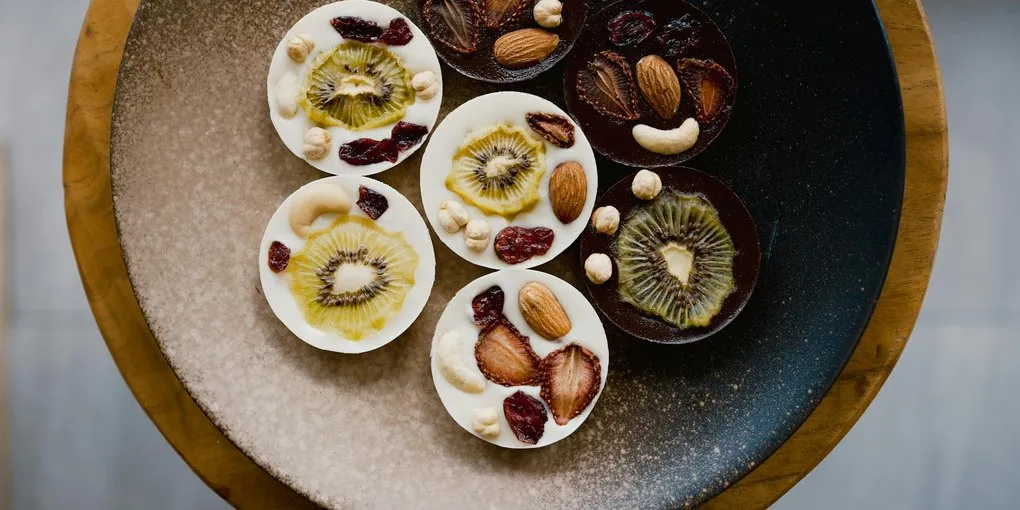
Inclusions are the fastest way to ruin well-made chocolate. They are also the fastest way to make it extraordinary. The difference comes down to understanding moisture, fat, and timing — three variables that interact in ways most home chocolate makers discover only after a batch seizes or blooms prematurely.
This guide covers the practical mechanics of adding inclusions to bean-to-bar chocolate: what works, what does not, and why the rules exist.
What Counts as an Inclusion
An inclusion is any solid addition to a finished chocolate bar — nuts, dried fruit, cacao nibs, salt crystals, spices, coffee beans, puffed rice, cookie pieces, candy. The term specifically excludes ingredients that dissolve into the chocolate mass during refining, like sugar or milk powder.
The distinction matters because inclusions sit within the tempered chocolate matrix rather than becoming part of it. Each inclusion creates an interface between two materials with different moisture content, fat composition, and thermal behavior. Managing those interfaces is what this guide is about.
The Moisture Rule
Chocolate and water are incompatible. Even 0.1% moisture dramatically increases yield value — the force required to get chocolate flowing. Sugar particles in the chocolate dissolve slightly at the wet interface, then recrystallize into rough, grainy bonds that spike viscosity irreversibly.
Every inclusion must be bone dry. This eliminates most fresh fruit, any undried ingredient, and anything stored in a humid environment without protection. Dried fruit should be at or below 15% moisture content. If you are uncertain, dehydrate further before use.
Common moisture traps:
- Freeze-dried fruit that has reabsorbed ambient humidity
- Nuts that were rinsed and not thoroughly dried
- Salt from a container left open in a humid kitchen
- Candied peel that feels dry on the surface but retains moisture internally
Fat Migration: The Silent Killer of Shelf Life
When a fat-containing inclusion — a nut, a piece of cookie with butter, a caramel filling — sits inside tempered chocolate, two fat phases are in contact. Over time, softer fats from the inclusion migrate into the chocolate shell. This disrupts the Form V crystal structure that tempering created, triggering fat bloom: a white or grey powdery coating on the surface.
This is the same mechanism that causes bloom in pralines and filled bonbons. The soft fat from nut fillings migrates through the chocolate shell over days or weeks. Temperature cycling accelerates it — warming above 25 degrees Celsius partially melts Form V crystals, and each melt-recrystallize cycle pulls the system closer to the more stable (but undesirable) Form VI.
Prevention strategies:
- Roast or toast all nuts before inclusion. This reduces moisture and modifies the fat structure.
- Store finished bars below 18 degrees Celsius with minimal temperature fluctuation.
- Use a slightly thicker chocolate shell around high-fat inclusions. More tempered chocolate means a longer diffusion path for migrating fats.
- Consider barriers. Some makers pre-coat nuts in a thin layer of tempered chocolate or cocoa butter before embedding them. The coating acts as a fat migration buffer.
Timing: When to Add Inclusions
There are two windows for adding inclusions to a bar, and they produce different results.
During Molding (The Standard Method)
Fill your mold halfway with tempered chocolate. Tap to level. Place inclusions. Cover with more tempered chocolate. Tap again to settle and remove air bubbles.
This method encases the inclusion entirely within chocolate. It produces the cleanest appearance, the best snap, and the longest shelf life because the inclusion is sealed against ambient moisture and oxygen.
The chocolate must be in proper temper when you add the inclusion — working temperature of 31 to 32 degrees Celsius for dark chocolate, 29 to 30 for milk. If the chocolate is too warm, the inclusion sinks to the bottom. If too cool, the chocolate is too viscous to flow around the inclusion and you trap air pockets.
On Top of a Filled Mold (Visible Inclusions)
Fill the mold completely with tempered chocolate. While the chocolate is still liquid, press inclusions gently into the surface from the top (which becomes the bottom of the unmolded bar). The inclusion remains partially exposed.
This method is visually striking but compromises shelf life. Exposed inclusions absorb ambient moisture and oxidize faster. Nuts go rancid sooner. Salt crystals can dissolve in humid conditions and cause localized sugar bloom when they recrystallize.
For visible-top bars, plan for shorter shelf life and recommend refrigerated storage.
Specific Inclusion Types
Nuts
Almonds, hazelnuts, pistachios, pecans, and macadamias all work well. Cashews and peanuts have higher fat mobility and bloom faster.
Toast all nuts before use. This accomplishes three things: it drives off residual moisture, develops flavor through Maillard reactions (the same amino acid plus sugar chemistry that makes roasted cacao beans taste like chocolate), and partially denatures proteins that would otherwise bind moisture from the air.
Toast at 150 to 170 degrees Celsius for 8 to 15 minutes depending on the nut. Cool completely before adding to chocolate.
Chop to a consistent size. Irregular chunks create uneven snap and inconsistent mouthfeel. For standard bars, pieces of roughly 5 to 8 millimeters work well — large enough to identify by taste, small enough not to crack the bar when you break it.
Cacao Nibs
Nibs are the purest inclusion for a bean-to-bar maker because they are just roasted, cracked cacao — the same starting material as the chocolate itself. They add crunch, bitterness, and textural contrast without introducing foreign fats.
Use nibs from the same origin as your bar for coherence, or deliberately cross origins for contrast. A Madagascar bar with Tanzania nibs introduces the Tanzanian melon note against Madagascar’s berry acidity.
Nibs are already low moisture and shelf-stable. No additional preparation is needed beyond ensuring they are free of husk fragments.
Dried Fruit
Cherries, cranberries, blueberries, and mango are the most common. Raisins work but their flavor can be indistinct against dark chocolate.
Freeze-dried fruit produces the best results. It is extremely low moisture, crunchy, and intensely flavored. Conventionally dried fruit (like standard dried cranberries) often has added sugar and oil, which introduce variables you do not control.
Cut or break large pieces to 5 to 8 millimeters. Dust off any residual powder — loose particles cloud the chocolate surface.
Salt
Flaky sea salt (Maldon, fleur de sel) produces the best visual and textural result. Fine-grain salt dissolves too quickly and can create moisture pockets in humid conditions.
Place salt crystals on top of the bar rather than mixing into the chocolate mass. Salt within the mass dissolves microscopically at the crystal-chocolate interface and can trigger localized sugar bloom.
Use restraint. Two to four crystals per bar section is usually enough. Salt amplifies bitterness and acidity in dark chocolate — the effect is stronger than you expect.
Spices
Ground spices (chili, cinnamon, cardamom, ginger) can be added to the melanger during the last hour of refining. This distributes them evenly throughout the mass and reduces them to particle sizes below the grittiness threshold of approximately 30 microns.
Adding spices as visible inclusions rather than refining them in produces a different effect: bursts of concentrated flavor rather than even distribution. Cinnamon stick fragments, whole pink peppercorns, and candied ginger pieces all work this way.
Be aware that chili heat intensifies over time in chocolate. A bar that seems mildly spiced at three days may be noticeably hotter at three weeks as capsaicin continues to diffuse through the fat phase.
Coffee
Whole roasted coffee beans, coarsely crushed espresso, or coffee nibs all work. Coffee is low moisture and high in its own fat phase, so it integrates well.
The flavor pairing is natural — both chocolate and coffee develop character through Maillard reactions during roasting, and they share several key flavor compounds including pyrazines and furanones.
Use freshly roasted coffee (within two weeks of roast date). Stale coffee beans taste papery and flat, which carries directly into the chocolate.
Formulation Adjustments
Inclusions change the effective cacao percentage of a bar. A 70% dark chocolate bar at 100 grams that includes 15 grams of almonds is no longer 70% cacao in the eating experience — the almonds dilute the chocolate intensity.
For bars with heavy inclusions (more than 10% of bar weight), consider starting with a slightly higher-percentage base chocolate. A 72% or 75% base compensates for the dilution and keeps the chocolate character front and center.
Added cocoa butter (approximately 5 grams per kilogram of chocolate) can improve flow around inclusions during molding without significantly altering flavor. This is particularly useful for bars with large or irregularly shaped inclusions where air trapping is a risk.
Storage and Shelf Life
Plain tempered chocolate stored properly (below 18 degrees Celsius, low humidity, away from light) holds for months before bloom becomes an issue. Inclusions shorten this window.
Realistic shelf life by inclusion type:
- Nibs: 4 to 6 months (comparable to plain chocolate)
- Toasted nuts: 2 to 4 months before fat migration becomes visible
- Dried fruit: 2 to 3 months; moisture migration is the limiting factor
- Salt: 3 to 6 months if stored in low humidity; faster degradation in humid climates
- Spices: 3 to 4 months; flavor intensity fades before visual degradation appears
Vacuum sealing extends all of these timelines by reducing oxygen and moisture exposure. If you are selling bars, print a “best by” date that reflects the weakest inclusion in your recipe.
Common Mistakes
Adding inclusions to chocolate that is out of temper. If your chocolate has exceeded 32 degrees Celsius for dark (30 for milk, 29 for white), the seed crystals are destroyed. Inclusions added to un-tempered chocolate will be embedded in a dull, soft, bloom-prone matrix regardless of how good the inclusions themselves are.
Using inclusions that are too large. A whole almond in a thin bar creates a stress point. The bar cracks at the inclusion rather than breaking cleanly at the intended score line.
Skipping the tap. After adding inclusions and the cover layer of chocolate, tap the mold firmly on the counter 10 to 20 times. This forces chocolate into gaps around the inclusion and releases trapped air. Skipping this step produces bars with visible air pockets and weak structural points.
Overloading the bar. When more than 30% of the bar weight is inclusions, you no longer have a chocolate bar with additions — you have a candy bar. The chocolate cannot form a continuous matrix around that volume of foreign material, and snap, temper, and shelf stability all suffer.
Inclusions should complement the chocolate, not compete with it. Start simple — a single type per bar — and let the origin character of your chocolate remain the lead voice.
Frequently Asked Questions
- What is the biggest risk when adding inclusions to chocolate?
- Moisture is the biggest risk. Even 0.1% water dramatically increases chocolate viscosity and can cause irreversible seizing. Every inclusion must be bone dry before contact with tempered chocolate. Dried fruit, nuts, and salt should all be checked for residual moisture, and freeze-dried fruit should be verified that it has not reabsorbed ambient humidity.
- Why do nuts cause white spots on chocolate bars over time?
- Nuts contain soft fats that migrate through the chocolate shell over days and weeks. This disrupts the Form V crystal structure created during tempering, causing the chocolate to transition toward Form VI — which appears as a white or grey powdery coating called fat bloom. Temperature cycling accelerates this process. Storing bars below 18 degrees Celsius slows fat migration significantly.
- When should I add inclusions — during molding or on top?
- During molding (sandwiched between two layers of chocolate) produces better shelf life because the inclusion is sealed against air and moisture. Placing inclusions on top of the bar is more visually striking but exposes them to oxidation and humidity, shortening shelf life. For selling bars, embedded inclusions are the safer choice.
- Can I add fresh fruit to chocolate?
- No. Fresh fruit contains far too much moisture for chocolate. Even a small amount of water causes sugar in the chocolate to dissolve and recrystallize, ruining texture. Use freeze-dried fruit instead — it is extremely low moisture, crunchy, and intensely flavored. Conventionally dried fruit can work if moisture content is at or below 15%.
- How much inclusion is too much in a chocolate bar?
- When inclusions exceed about 30% of total bar weight, the chocolate can no longer form a continuous matrix around the additions. Snap, temper quality, and shelf stability all degrade. For most bars, 10–20% inclusion by weight is the practical sweet spot — enough to register clearly in flavor and texture without overwhelming the chocolate.
- Should I adjust my chocolate recipe when making inclusion bars?
- Yes. Inclusions dilute the effective cacao intensity. For bars with heavy inclusions (more than 10% of bar weight), starting with a 72–75% base rather than a standard 70% helps maintain chocolate character. You can also add approximately 5 grams of cocoa butter per kilogram of chocolate to improve flow around inclusions during molding.
- How long do chocolate bars with inclusions last?
- Shelf life depends on the inclusion type. Nibs last 4–6 months (comparable to plain chocolate). Toasted nuts last 2–4 months before visible fat migration. Dried fruit lasts 2–3 months. Salt lasts 3–6 months in low humidity. Store all inclusion bars below 18 degrees Celsius with minimal temperature fluctuation. Vacuum sealing extends these timelines.