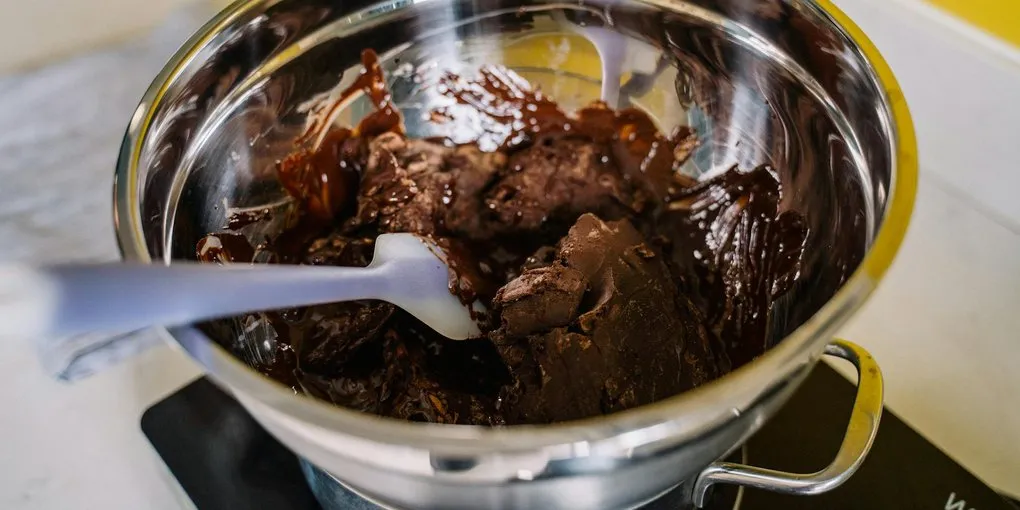
Thick, sluggish chocolate that refuses to pour cleanly into molds is one of the most common problems in bean-to-bar making. It is also one of the most fixable — once you understand why chocolate behaves the way it does as a fluid. The solution is not always “add more cocoa butter,” and adding the wrong thing at the wrong time can make things worse.
Why Craft Chocolate Is Naturally Thick
Two-ingredient chocolate — just nibs and sugar, the standard American craft format — is inherently more viscous than European-style bars with added fat and emulsifiers. This is physics, not a defect.
When you grind nibs and sugar in a melanger, you are suspending solid particles (sugar crystals, cocoa solids, residual husk) in a fat phase (cocoa butter). The viscosity of this suspension depends on the ratio of solids to fat. A two-ingredient 70% bar has a natural fat content of roughly 34 to 41% depending on the bean’s origin. Tanzanian beans at 57 to 58% fat yield more fluid chocolate at the same recipe than Ecuadorian beans at 52% fat. If your beans happen to be on the low-fat end, your chocolate will be thicker before you do anything else.
European-style bars add cocoa butter and emulsifiers precisely to manage this. Dandelion Chocolate, which makes only two-ingredient bars, accepts the drier, crisper mouthfeel as a feature — but it means their chocolate is harder to pour and mold than a four-ingredient bar at the same percentage.
The Casson Model in Plain English
Liquid chocolate is a non-Newtonian fluid, which means it does not behave like water. Water flows as soon as you tilt the glass. Chocolate requires a minimum force just to start moving. The standard model for describing this behavior is the Casson model, which breaks viscosity into two components:
Yield value — the minimum force required to make the chocolate start flowing. Think of yield value as the effort needed to get the chocolate to move at all. High yield value means the chocolate sits in a lump until you push hard enough. Yield value is controlled primarily by lecithin content, moisture level, particle size, and fat content.
Plastic viscosity — the resistance to flow once the chocolate is already moving. This is how thick it feels while pouring. Plastic viscosity is controlled by total fat content, particle size, and temperature.
All viscosity measurements are taken at a standard temperature of 40 degrees Celsius. If your chocolate seems thick at room temperature, warming it to the proper working temperature may solve the problem entirely before you reach for additives.
The Moisture Disaster
Before adding anything to fix viscosity, check for moisture. Even 0.1 to 0.5% water in the chocolate dramatically increases yield value. The mechanism is straightforward: water dissolves the surface of sugar particles, creating a sticky interface that causes particles to clump together.
This is why the absolute rule in melanger work is no water. Ever. Your melanger must be completely dry. Your tools must be dry. Your ingredients must be dry. If water gets into the batch, the viscosity spike is often irreversible — the sugar has already been partially dissolved and will not return to its original particle structure even if you drive the water off through continued refining.
Common moisture sources include:
- Inadequately dried beans (above 6 to 8% moisture)
- Sugar that has absorbed ambient humidity
- Condensation on melanger components
- Wet hands or utensils
If you suspect moisture contamination, the fix is prevention on the next batch, not rescue on this one.
Fix 1: Add Cocoa Butter
The simplest viscosity fix. More fat means more liquid phase relative to solid particles, which reduces both yield value and plastic viscosity. Dandelion recommends approximately 5 grams of cocoa butter per kilogram of chocolate as a starting point.
Add the cocoa butter at the beginning of refining, not at the end. If added during the initial melanger loading, it integrates naturally as the nibs break down and release their own fat. Adding it late means the butter must be melted and thoroughly incorporated into an already-formed chocolate mass, which takes longer and may not distribute evenly.
The trade-off is dilution. Adding cocoa butter increases total fat and therefore increases the cacao percentage (since cocoa butter is a cacao-derived ingredient), but it reduces the proportion of non-fat cocoa solids. The flavor shifts toward milder, the mouthfeel toward smoother. If you are making a two-ingredient bar where the point is origin intensity, adding fat works against your creative intent.
For a deeper look at when and how to add cocoa butter, see our guide to adding cocoa butter.
Fix 2: Lecithin
Lecithin is the most efficient viscosity reducer available to chocolate makers, and also the most misunderstood.
Soy lecithin is an emulsifier. It works by coating sugar particles with a thin layer that prevents them from interacting with each other and with water. This dramatically reduces yield value — the force needed to start the chocolate flowing. The effect on plastic viscosity is smaller.
The dosage window is narrow and non-linear. Dandelion recommends a maximum of 0.5% lecithin. The ideal range for craft use is 0.01 to 0.05%. The FDA caps total emulsifier content at 1%.
Here is the critical finding from industrial research: above approximately 0.5 to 0.6% lecithin, yield value actually increases. This is counterintuitive but well-documented. Excess lecithin creates micelle structures that trap fat rather than freeing it. More is demonstrably worse.
The practical math: lecithin takes roughly 10 times less material than cocoa butter for the same viscosity reduction. If you need to thin your chocolate without significantly changing the flavor profile, lecithin at 0.01 to 0.05% is the precision tool.
Add lecithin at the end of refining, during the liquid phase of conching. Adding it too early reduces its effectiveness because it gets incorporated into the particle mass rather than coating surfaces.
Fix 3: PGPR
Polyglycerol polyricinoleate (PGPR) is an emulsifier that is more effective per unit weight than lecithin for reducing yield value. The maximum dosage is 5 grams per kilogram of chocolate.
PGPR is primarily used in industrial chocolate making to improve flow properties for coating, enrobing, and thin-shell molding. Most craft makers avoid it because it has a reputation as an industrial additive, but there is nothing wrong with it from a technical or safety standpoint.
If your application requires very low yield value — thin shells for bonbons, coating, or very fine molding detail — PGPR combined with a small amount of lecithin can achieve flow properties that neither can achieve alone.
Fix 4: Pre-Refine Your Sugar
Thick chocolate is often a particle size problem masquerading as a fat problem. Sugar crystals straight from the bag are large — roughly 500 microns for standard granulated sugar. If you add them directly to the melanger with your nibs, the early hours of refining are spent breaking down sugar rather than cocoa particles. This inefficiency can leave you with a broad particle size distribution even after 24 hours, with large sugar crystals contributing to both grittiness and elevated viscosity.
The fix is to pre-refine the sugar. Run it in the melanger for 1 to 2 hours before adding nibs, or grind it separately in a spice grinder or food processor to a powdered consistency. This gives the melanger a head start and produces a tighter particle size distribution in the finished chocolate.
Dandelion notes that particle size distribution matters more than mean particle size: a tight distribution where 90% of particles fall within 10 to 20 microns is optimal. Pre-refining sugar helps achieve this by eliminating the large sugar particles that would otherwise persist as outliers.
Fix 5: Refine Longer
Sometimes the chocolate is simply not done yet. If particles are still above 30 microns — the threshold where humans begin to detect grittiness — the chocolate will feel thick and rough regardless of fat content. The optimal range is 10 to 20 microns.
Check with a grindometer if you have one. If particles are above 25 microns, continue refining. The recommended total refining time for a mini melanger is 18 to 24 hours, with flavor-optimal conching occurring around 8 hours and diminishing returns after approximately 30 hours.
Be cautious about over-refinement. Below approximately 5 microns, chocolate begins to taste gummy rather than smooth. This is rare in craft melangers but possible with extended run times.
The Decision Framework
When your chocolate is too thick, work through this sequence:
- Check temperature. Is the chocolate at 40 degrees Celsius? Cold chocolate is always thicker.
- Check for moisture. Any water contamination? If yes, the batch may be compromised.
- Check particle size. Above 25 microns? Continue refining.
- Check fat content. Low-fat origin beans? Add cocoa butter at 5g/kg as a starting point.
- Need flow, not richness? Add lecithin at 0.01 to 0.05%. Never exceed 0.5%.
- Need very low yield value? Consider PGPR at up to 5g/kg.
- Preventive for next batch? Pre-refine sugar before adding nibs.
The key principle is diagnosis before treatment. Adding cocoa butter when the real problem is moisture contamination wastes butter and does not fix the batch. Adding lecithin above 0.5% makes things worse. Understanding why the chocolate is thick tells you which fix to apply.
For related formulation guidance, see our chocolate recipe formulation guide and our guide to adding cocoa butter.
Frequently Asked Questions
- Why is my bean-to-bar chocolate so thick?
- Two-ingredient chocolate (nibs + sugar) is naturally more viscous than European-style bars because it has no added fat or emulsifiers. The natural fat content of a 70% two-ingredient bar is only 34-41% depending on the bean's origin. Low-fat origins like Ecuador (~52% bean fat) produce thicker chocolate than high-fat origins like Tanzania (57-58%). Moisture contamination, incomplete refining, and cold working temperature are other common causes.
- How much cocoa butter should I add to thin my chocolate?
- Start with approximately 5 grams of cocoa butter per kilogram of chocolate, as recommended by Dandelion Chocolate. Add it at the beginning of refining, not the end, so it integrates naturally as nibs break down. The trade-off is that added fat shifts flavor toward milder and mouthfeel toward smoother, which may not be desirable for two-ingredient origin-forward bars.
- How much lecithin should I add to chocolate?
- The ideal range for craft use is 0.01-0.05%, with a maximum of 0.5%. The FDA caps total emulsifiers at 1%. Critically, above approximately 0.5-0.6% lecithin, yield value actually increases -- more lecithin makes the chocolate thicker, not thinner. Add lecithin at the end of refining during the liquid phase of conching.
- Can water ruin a batch of chocolate?
- Yes. Even 0.1-0.5% water dramatically increases yield value. Water dissolves sugar particle surfaces, creating sticky interfaces that cause clumping. The viscosity spike is often irreversible. The absolute rule: no water in the melanger, ever. Dry beans, dry tools, dry sugar, dry melanger components.
- What is the Casson model for chocolate viscosity?
- The Casson model describes chocolate as a non-Newtonian fluid with two components: yield value (the minimum force to start flow, controlled by lecithin, moisture, particle size, and fat) and plastic viscosity (resistance once flowing, controlled by total fat, particle size, and temperature). All standard measurements are taken at 40 degrees Celsius.
- Should I pre-grind sugar before adding it to the melanger?
- Yes, pre-refining sugar is one of the most effective ways to improve final texture and reduce viscosity. Standard granulated sugar crystals are roughly 500 microns. Running sugar in the melanger for 1-2 hours before adding nibs, or grinding it in a spice grinder first, gives the melanger a head start and helps achieve the optimal tight particle size distribution of 10-20 microns.
- What is PGPR and when should I use it?
- PGPR (polyglycerol polyricinoleate) is an emulsifier that is more effective per unit weight than lecithin for reducing yield value. Maximum dosage is 5 grams per kilogram. It is primarily used for applications requiring very low yield value -- thin shells for bonbons, coating, or fine molding detail. Most craft makers reserve it for specialty applications.