Type “cacao vs cocoa” into a search engine and you will find hundreds of confident answers that contradict each other. Some sources claim cacao is raw and cocoa is roasted. Others insist cacao is the plant and cocoa is the product. A few declare the whole distinction a marketing invention. The reality sits somewhere in the middle, and it matters if you care about what you are eating, buying, or making.
The Botanical Starting Point
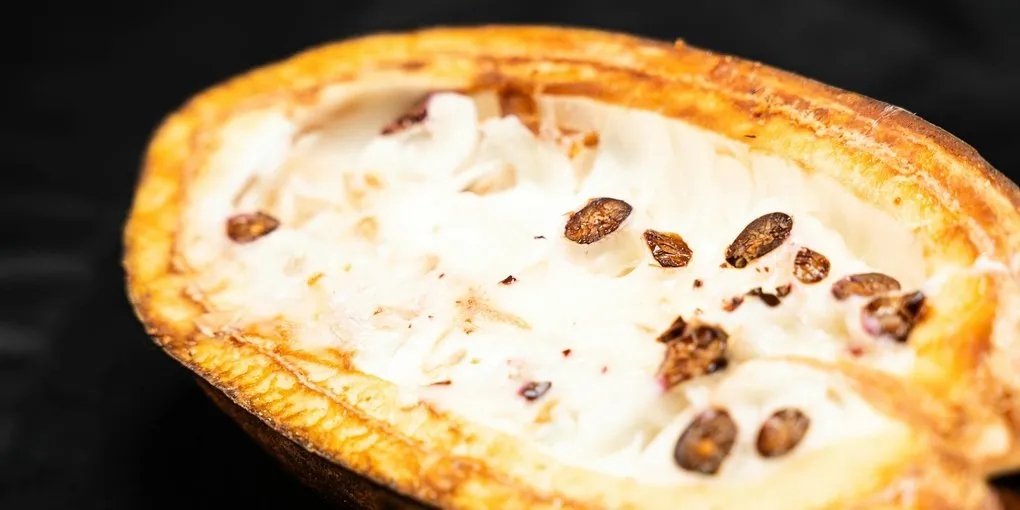
The cacao tree is Theobroma cacao L., a member of the family Malvaceae. The genus name, coined by Linnaeus in 1753, translates from Greek as “food of the gods” — theos (god) plus broma (food). Every chocolate product on earth traces back to this single species. The tree grows within 20 degrees north and south of the equator, and its pods grow directly from the trunk in a pattern called cauliflory. Each pod contains 20 to 50 seeds embedded in a white mucilaginous pulp.
Those seeds are universally called “cacao beans” at the farm level. No one in a fermentary in Ghana or a cooperative in Ecuador calls them “cocoa beans.” The word “cacao” is the original term, derived from the Nahuatl word cacahuatl. “Cocoa” is an English corruption that became standard in commerce and manufacturing.
This linguistic split is the root of most of the confusion. Both words refer to the same plant and the same seed. The divergence is in how each term has been adopted by different parts of the industry.
How the Industry Actually Uses These Terms
In commodity trading and industrial manufacturing, “cocoa” is the standard term. Cocoa beans, cocoa butter, cocoa powder, cocoa liquor (also called cocoa mass) — these are the terms used in FDA regulations, EU directives, and international trade. The FDA’s 21 CFR Part 163 regulates “cacao products” but uses “cocoa” for the processed ingredients. The EU Directive 2000/36/EC uses “cocoa” throughout.
In the craft chocolate and health food markets, “cacao” has become the preferred term. Bean-to-bar makers talk about cacao beans, cacao nibs, and cacao percentage. Health-oriented brands label their products as “cacao powder” or “cacao nibs” to distinguish them from conventional cocoa products.
This is where the marketing dimension enters. “Cacao” has acquired connotations of naturalness, minimal processing, and health benefits. “Cocoa” has become associated with industrial processing, lower quality, and the baking aisle. These connotations are not entirely wrong — but they are not reliably right either.
The Processing Distinction That Actually Matters
If there is a single technical distinction that justifies separating cacao products from cocoa products, it is alkalizing — the Dutch process.
Natural cocoa powder is made by pressing cocoa butter out of roasted, ground cacao and then pulverizing the remaining press cake. The resulting powder has a pH of approximately 5.0, a light brown color, and retains a meaningful portion of the polyphenols and flavanols present in the original bean.
Dutch-processed cocoa has been treated with an alkali (most commonly potassium carbonate, sometimes sodium carbonate or ammonium carbonate for very dark “black cocoa”) to raise the pH to 6.8-8.5. This treatment is performed on the nibs, the cocoa mass, or the powder itself at temperatures of 60-90 degrees Celsius for 1-4 hours, with typical alkali dosage of 0.5-3.0% by weight.
The effects of alkalizing go beyond pH:
Color changes dramatically. Natural cocoa powder is light reddish-brown. Mild alkalizing produces the familiar medium-brown color of European-style hot cocoa. Heavy alkalizing with ammonium carbonate creates the near-black powder used in Oreo cookies and dark cocoa blends.
Flavor shifts from sharp, acidic, and fruity to mellow, smooth, and earthy. The free acids that give natural cocoa its bite are neutralized. This is why Dutch-processed cocoa tastes “more chocolatey” to many consumers — the flavor is rounder and less complex.
Dispersibility improves. Alkalized cocoa dissolves more readily in water, which is why it became the standard for hot cocoa beverages and chocolate milk. Casparus van Houten developed the hydraulic cocoa press in 1828, and his son Coenraad Johannes van Houten introduced the alkalizing process — together they solved a practical problem: making cocoa that mixed easily into drinks.
Polyphenol content drops substantially. The same alkalizing that mellows flavor and darkens color degrades the flavanol compounds that drive the health research around dark chocolate. If you are choosing a cocoa powder partly for its bioactive compounds, Dutch processing eliminates much of what you are looking for.
For a deep comparison of these two products in baking and drinking applications, see our Dutch process vs. natural cocoa guide.
Cacao Nibs vs. Cocoa Nibs
The term “cacao nibs” refers to roasted, cracked cacao beans with the husk removed. The nib is the cotyledon — the meat of the seed — and comprises 85-90% of the bean by weight. Nibs are the fundamental ingredient that gets ground into chocolate.
Some brands sell “raw cacao nibs” and charge a premium over “cocoa nibs.” The distinction is typically that “raw” nibs were processed at lower temperatures. However, it is worth understanding that cacao beans reach 120 degrees Fahrenheit or higher during fermentation — they are not truly raw in any strict sense by the time they leave the fermentary. The “raw” label usually means the nibs were not roasted at conventional temperatures (120-150 degrees Celsius), but they were still exposed to significant heat during fermentation and drying.
The nib composition is the same regardless of what you call it: approximately 50-57% fat (cocoa butter), 11-13% protein, 5-9% starch, 1.5-3% theobromine, and 0.05-0.3% caffeine. The polyphenol content will be higher in less-processed nibs, but the basic nutritional profile is identical.
For recipes and practical uses for nibs, see our cacao nibs guide.
Cacao Powder vs. Cocoa Powder
This is where the terminology confusion causes the most real-world problems, especially in baking.
“Cacao powder” in the health food market typically means non-alkalized powder, often processed at lower temperatures. “Cocoa powder” in a supermarket can be either natural or Dutch-processed — you must read the label. If the ingredients include “cocoa processed with alkali,” it is Dutch-processed. If it simply says “cocoa,” it is natural.
The baking distinction matters because natural cocoa (acidic, pH ~5.0) reacts with baking soda (a base) to produce leavening. Dutch-processed cocoa (neutral to alkaline, pH 6.8-8.5) does not react with baking soda and must be paired with baking powder instead. Substituting one for the other without adjusting leavening will produce flat, dense, or oddly textured results.
For chocolate making, the distinction is less relevant because neither powder is the starting material — you begin with whole beans or nibs and grind them in a melanger.
Reading Labels: What to Look For
When you see “cacao” on a product label, it generally signals one or more of the following: the product is minimally processed, the brand is targeting health-conscious consumers, or the product is positioned as premium. When you see “cocoa,” it signals conventional processing and broader market positioning.
Neither term is regulated to mean a specific thing about processing. The FDA does not define “cacao powder” as distinct from “cocoa powder.” The terms are used interchangeably in regulations. Any meaningful distinction must come from reading the full ingredient list and nutrition panel.
The guide to reading craft chocolate labels on this site walks through what each line on a chocolate bar’s packaging actually tells you.
Cacao Percentage: The Number That Matters More
Whether a bar says “70% cacao” or “70% cocoa,” the number refers to the same thing: the total weight percentage of ingredients derived from the cacao bean (cocoa mass, cocoa butter, and cocoa powder combined). A 70% bar is 70% cacao-derived ingredients and approximately 30% sugar (plus any minor additions like lecithin or vanilla).
The percentage tells you the ratio of chocolate character to sweetness. It does not tell you about roast level, alkalizing, origin, or flavor quality. Two 70% bars from different makers can taste completely different because everything about how the beans were grown, fermented, roasted, and processed differs.
For a full breakdown of what cacao percentage means and does not mean, see our cacao percentage guide.
The Bottom Line
“Cacao” and “cocoa” refer to the same plant and the same seed. The distinction is primarily one of marketing convention and processing implication. In practice, “cacao” signals minimal processing and craft or health positioning, while “cocoa” signals conventional processing and broader commercial use.
The processing distinction that actually matters is alkalizing. Dutch-processed cocoa has meaningfully different flavor, color, baking chemistry, and polyphenol content compared to natural (non-alkalized) cocoa. If you care about health compounds, flavor complexity, or baking chemistry, the alkalized vs. natural distinction is far more important than the cacao vs. cocoa label.
If you are new to the world of craft chocolate and want to understand the full journey from bean to bar, our beginner’s guide covers the process from start to finish.
Frequently Asked Questions
- Is cacao butter the same as cocoa butter?
- Yes. Cacao butter and cocoa butter are identical -- the fat extracted from cacao beans, composed primarily of stearic acid (34%), oleic acid (34-35%), and palmitic acid (26-27%). The two terms are interchangeable. The fat is used in chocolate making, cosmetics, and pharmaceuticals. In FDA and EU regulations, the standard term is cocoa butter.
- Can I substitute cacao powder for cocoa powder in recipes?
- If both are non-alkalized (natural), they are interchangeable. The critical substitution issue is natural vs. Dutch-processed: natural cocoa powder (pH ~5.0) reacts with baking soda for leavening, while Dutch-processed cocoa (pH 6.8-8.5) does not. If your recipe calls for baking soda and cocoa powder, it expects natural cocoa. Switching to Dutch-processed without also switching to baking powder will produce flat results.
- Is cacao healthier than cocoa?
- It depends entirely on processing, not on the label. Non-alkalized (natural) cocoa powder retains more flavanols and polyphenols than Dutch-processed cocoa powder, regardless of whether the label says 'cacao' or 'cocoa.' A natural cocoa powder labeled 'cocoa' in the baking aisle may have more bioactive compounds than a heavily processed product labeled 'raw cacao.' Read the ingredient list for 'processed with alkali' -- that is the distinction that matters for health.
- What does 'raw cacao' actually mean?
- There is no regulated definition. In practice, 'raw cacao' products were typically processed at lower-than-conventional temperatures. However, cacao beans reach over 120 degrees Fahrenheit during fermentation and continue to generate heat during drying, so they are not truly raw by the time they leave the farm. The 'raw' label usually means the beans were not roasted at standard temperatures (250-270 degrees Fahrenheit end-of-roast) but were still exposed to significant heat during post-harvest processing.
- Why do some chocolate bars say 'cacao' and others say 'cocoa' on the label?
- Marketing positioning. Craft chocolate makers and health-oriented brands prefer 'cacao' because it signals minimal processing, origin awareness, and premium quality. Mass-market manufacturers use 'cocoa' because it is the standard commercial term used in FDA and EU regulations. The percentage number (70% cacao or 70% cocoa) refers to exactly the same thing: the total weight fraction of cacao-derived ingredients.
Some links above are affiliate links. If you purchase through them, we earn a small commission at no extra cost to you.